In the world of operations management, for an FMCG company hitting the 300-employee mark with a decentralized workforce, this size is often the “tipping point” where manual processes begin to crumble. The challenge isn’t just recording data; it is the ability to standardize and sync that data in real-time with payroll to ensure absolute accuracy and compliance.
Faced with the urgent need to streamline their machinery, Company A (a prominent FMCG player) sought a payroll solution that combined technological power with deep expertise in Tax and Social Insurance. They chose terra as their strategic partner to lead this transformation.
About terra
Operated by Vina Payroll Outsourcing Co., Ltd. (a member of I-GLOCAL, Japan), terra inherits over 21 years of experience in consulting for Japanese enterprises in Vietnam.
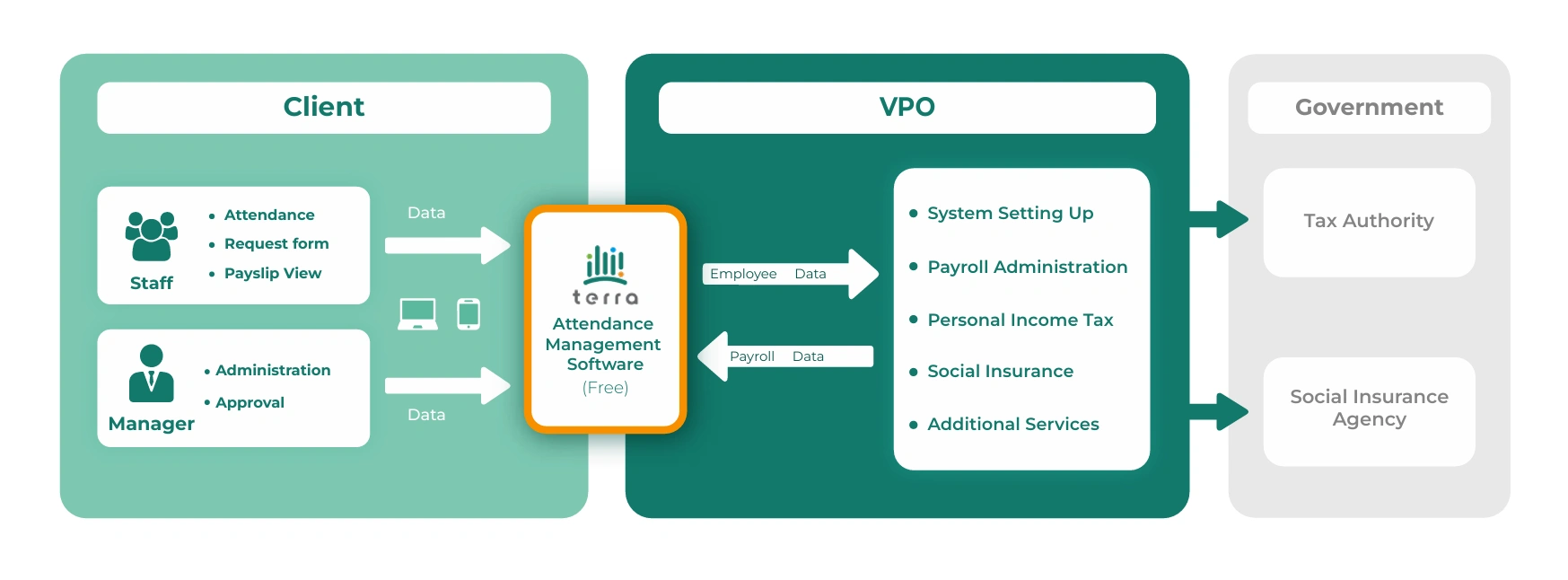
More than just software, terra provides the BPaaS (Business Process as a Service) model. This is the definitive answer to the payroll puzzle: you outsource the service but keep it integrated on a high-tech platform, allowing for a seamless, transparent, and worry-free flow from timekeeping to payout.
Before we dive into the case study, let’s look at the classic operational bottlenecks that FMCG companies typically face.
The classic operational “bottlenecks” in FMCG company
In the FMCG sector, the workforce is typically divided into three distinct segments:
1
Office staff
Working standard administrative hours with relatively stable data.
2
Factory and logistics staff
Working complex shifts, including broken shifts and heavy overtime (OT).
3
Field force (Sales/PG)
Constantly on the move and recording attendance at various points of sale.
The stark differences in work environments and recording methods make it incredibly difficult for companies to consolidate attendance data. Specifically, businesses often face several recurring issues:
PRIMARY CHALLENGES
Working days for Sales and PG teams are often not fully captured.
Factory overtime hours are frequently calculated incorrectly.
Flexible and rotating shifts are difficult to summarize by department.
Timesheets often contain errors by the end of the month.
Attendance data remains fragmented between different staff groups.
RESULTING OPERATIONAL RISKS
The C&B department spends an excessive amount of time on manual reconciliation before every payroll cycle.
Payroll remains heavily dependent on manual data entry and processing.
Failure to update legal changes promptly leads to errors in salary, tax, and insurance calculations.
When data across these groups is inconsistent, companies fall into a trap of recurring errors, prolonged manual audits, and negative feedback from the workforce.
Why are traditional methods no longer effective?
Many businesses are still attempting to manage these complexities using Excel spreadsheets or fragmented, standalone software. However, these methods come with significant drawbacks.
OPTION 1
The pitfalls of Excel
Risks involve self-reporting and the difficulty of controlling “proxy punching”
Consumes an enormous amount of time for HR to verify every entry
OPTION 2
The flaws of disconnected systems
Constant export and import of data between separate attendance and payroll software, prone to clerical errors
Increased risk of information leaks during the transfer
This reality means that while a company may have “digitized” how they record data, they have not yet “automated” the conversion of that data into an accurate payroll table. Consequently, payroll still relies on the manual effort of the HR team. This becomes an unsustainable burden as the company scales.
This is precisely why FMCG leaders are shifting toward integrated solutions. In these modern systems, timekeeping and payroll are no longer treated as two isolated islands.
Unlocking the “Data Flow” with terra BPaaS Payroll
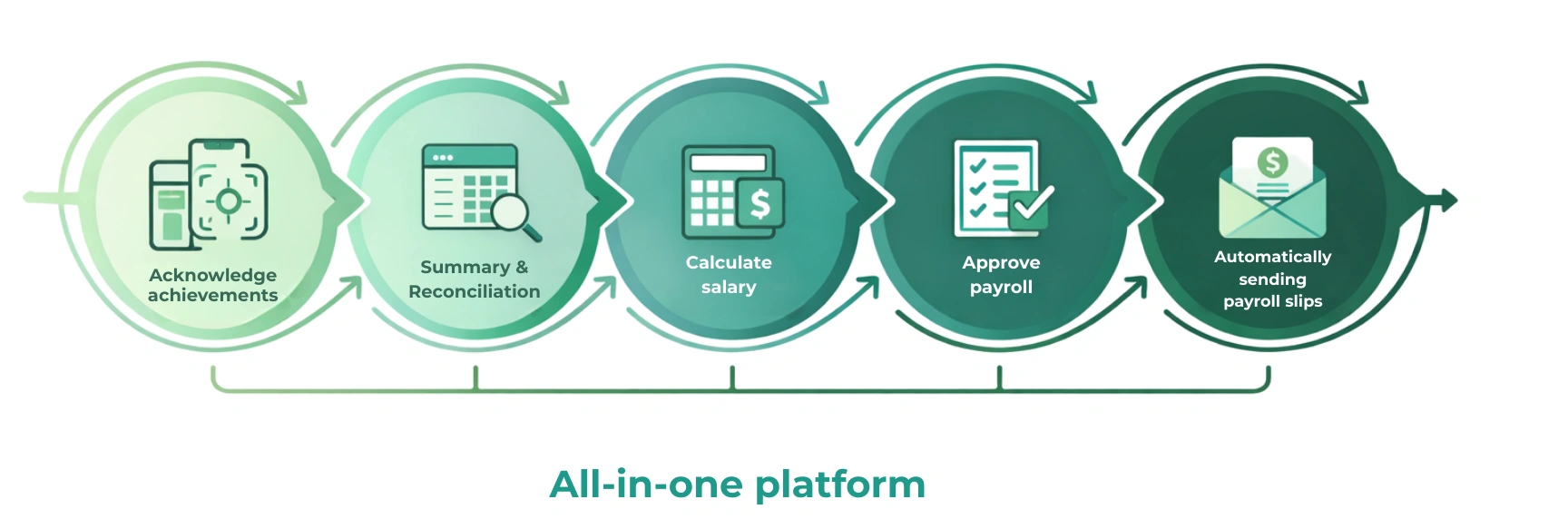
terra establishes a seamless workflow where raw data from timekeeping devices is automatically processed and transformed into a payroll table:
Strategic Data Flow Optimization via terra BPaaS Payroll
Everything happens on a single platform, eliminating intermediate manual steps.
The technology integrated payroll implementation model
This model was proven effective through a real-world project terra implemented in 2025.
Case Study: An FMCG Enterprise with 300+ multi-site employees
Project Overview
INDUSTRY
FMCG
SCALE
300+ employees (including expats)
WORK MODEL
Decentralized (Office, Factory, and Field Force)
IMPLEMENTATION TIME
1 to 2 months
SCOPE
Timekeeping management and the entire payroll process
The problem
At the start of the project, Company A managed a diverse workforce of over 300 personnel:
COMPANY A’S WORKFORCE STRUCTURE
45 Office Staff: Centralized and stable
250 Factory Workers: Operating on complex shifts
5+ Field Personnel: A dynamic team with frequently changing numbers
Three staff groups, three different attendance recording environments
Historically, the C&B department faced a high volume of complaints during every payroll cycle. These inquiries typically involved inaccuracies in both attendance records and final salary calculations across various departments.
The primary issue was the inconsistency of attendance data between the factory and field-based teams. This lack of synchronization forced the HR team into a time-consuming reconciliation process, causing significant delays before payroll could be executed.
As the company prepared to double its headcount over the next 12 months, leadership reached a critical realization. They recognized that their manual data consolidation would soon become a major operational bottleneck, directly threatening the accuracy and reliability of the entire payroll system.
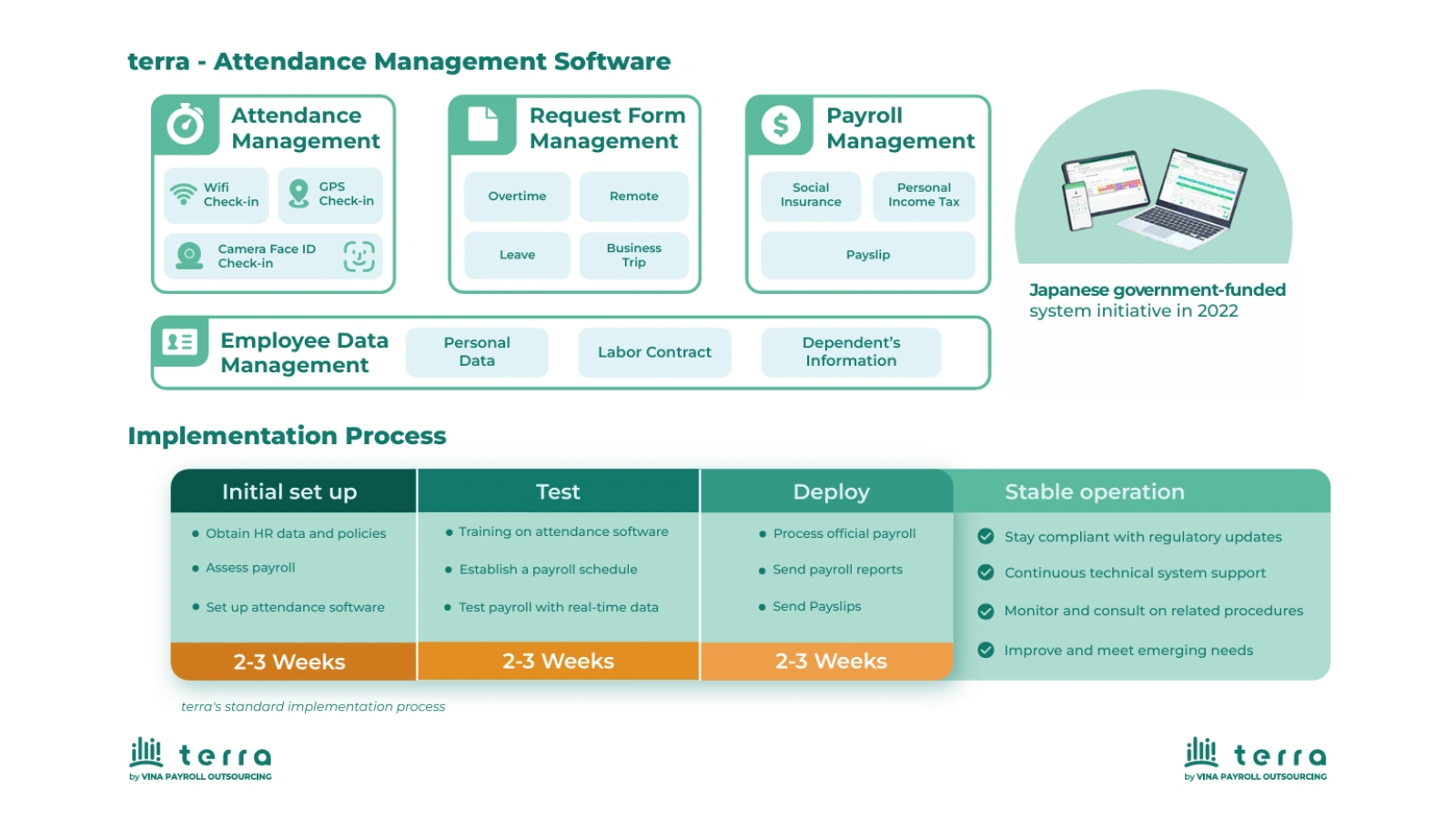
The 8-Week digital transformation roadmap with terra BPaaS Payroll
To solve this, terra implemented a structured 3-phase roadmap:
A Comprehensive Roadmap for terra BPaaS Payroll Deployment
1
Setup & Data Standardization (2 to 3 Weeks)
This is the “foundation” phase to ensure the system understands the specific needs of the business:
Deep HR Policy Audit: We reviewed work types, salary structures, unique allowances, and expat requirements.
System Configuration: All shifts, OT rules, and formulas were mapped according to the latest labor laws.
Goal: Eliminate systemic errors right from the start.
2
Testing & Transfer Training (2 to 3 Weeks)
Dual Support Model: The client was supported by two specialized teams: Customer Success for technical support and Payroll Research for tax, insurance, and payroll expertise.
Parallel Run: We calculated payroll using real data and compared it against old results to fine-tune accuracy.
Training: Hands-on sessions for everyone from leadership to interns.
3
Go-Live & Automated Operations (2 to 3 Weeks)
Multi-method Sync: Data from FaceID, Wifi, GPS, and Fingerprint scanners automatically flows into one source.
Proactive Reconciliation: The system sends monthly reminders to employees to check their shifts via the mobile app. Once the data is clean, terra calculates the payroll.
Multi-level Approval: The final payroll is sent to the client’s HR head for a final click, ensuring the business maintains ultimate control.
Automated Delivery: Payslips are sent instantly to personal emails and the mobile app.
Why does the terra process resonate with major enterprises?
1
Practicality
Our process is not built on theory. It is grounded in terra’s extensive experience managing thousands of complex payrolls across diverse industries.
2
Ongoing partnership
We never simply sell software and leave you to navigate it alone. terra provides a dedicated team of experts who work alongside your business during every monthly operational cycle.
3
Speed and accuracy
We can transition a heavy, manual HR system to a fully automated process in less than two months. This helps your business stay agile and ready for rapid growth.
4
Uncompromising security
terra is ISO/IEC 27001:2022 certified. Every service contract includes strict data privacy terms. We are always ready to sign a DPA upon request and ensure that information access is strictly limited to relevant personnel.
Proven results with terra BPaaS Payroll
The outcomes at Company A demonstrate that the BPaaS model is more than just a promise. The project delivered tangible impact:
of timekeeping data synchronized on a single system
90%+
drop in payroll-related inquiries after three cycles
The payroll workflow has been standardized across the entire enterprise.
Compliance issues regarding social insurance and Personal Income Tax (PIT) are handled promptly by our professional consulting team.
Sensitive data is protected under the highest international information security standard, ISO/IEC 27001:2022.
With a track record of supporting businesses of all sizes and operational models, terra has successfully solved the most complex challenges in timekeeping and payroll for distributed workforces. We are ready to partner with you to build a payroll process that is accurate, transparent, and perfectly tailored to your actual operational needs.
Contact terra today for a customized consultation!
Conclusion
Attendance management is a fundamental process, yet it remains a critical pillar for any enterprise, particularly in the high-stakes FMCG sector. When timekeeping is transparent and precise, employees gain a sense of security that empowers them to focus fully on their contributions to the organization.
Beyond employee morale, robust attendance and payroll management enable a business to maintain tighter control over its cash flow. This is a vital advantage during economic cycles that require strict cost optimization and disciplined spending. By offering a flexible and remote management solution, terra aims to help your business solve the attendance puzzle with absolute efficiency and peace of mind.
Frequently Asked Questions
FMCG companies can reduce payroll errors by implementing integrated payroll solutions that automatically sync attendance data with payroll systems in real-time. Manual processes and fragmented systems like Excel spreadsheets are prone to errors, especially when dealing with complex shift patterns, overtime calculations, and multiple workforce segments. By adopting a BPaaS (Business Process as a Service) model with a dedicated payroll provider, companies can standardize data collection, eliminate manual data entry, and ensure compliance with tax and social insurance regulations. This integrated approach helps prevent recurring errors and reduces the time HR teams spend on reconciliation.
Common attendance tracking problems in factories include incorrect overtime calculations, difficulty in summarizing flexible and rotating shifts by department, and fragmented data from different timekeeping methods. Factory staff often work complex shifts including broken shifts and heavy overtime, which traditional manual systems struggle to process accurately. These errors frequently lead to payroll discrepancies and require extensive manual reconciliation before each payroll cycle.
Excel is not suitable for payroll management because it relies on manual data entry and self-reporting, making it vulnerable to errors and proxy punching fraud. It consumes enormous amounts of HR time for verification and lacks real-time data synchronization with timekeeping systems. Additionally, Excel spreadsheets cannot automatically update legal changes in tax and social insurance calculations, increasing compliance risks.
BPaaS (Business Process as a Service) payroll outsourcing is a model where companies outsource their entire payroll process to a specialized provider while maintaining integration on a high-tech platform. Unlike traditional outsourcing, BPaaS provides seamless data flow from timekeeping to payout, ensuring transparency and real-time accuracy. This approach combines technological power with expert knowledge of tax and social insurance regulations, allowing businesses to maintain control while benefiting from professional expertise and automation.
Companies with around 300 employees often reach a critical tipping point where manual payroll processes become unsustainable. At this scale, the complexity of managing decentralized workforces with different work environments and attendance patterns makes automation essential for accuracy and compliance.
Disconnected payroll systems create risks including clerical errors from manual data exports and imports between separate attendance and payroll software, information security breaches during data transfers, and continued reliance on manual HR effort despite digital data recording. These fragmented systems fail to achieve true automation, meaning payroll accuracy still depends heavily on the HR team's manual verification and reconciliation work, which becomes unsustainable as companies scale.
Field sales and PG teams can be tracked through integrated systems that capture attendance at various points of sale and automatically consolidate this data with other workforce segments. Modern solutions eliminate the gaps in working days recording by automating data collection from multiple touchpoints and syncing it in real-time to the payroll system.