How a Japanese invested IT company in Vietnam used payroll outsourcing to resolve multi contract complexity, expat tax compliance, and hybrid attendance tracking.
Scaling an IT services company in Vietnam is rarely just a hiring challenge. For many Japanese-invested firms, payroll becomes one of the first operational bottlenecks as teams expand across full-time staff, remote employees, contractors, and expatriate specialists. What starts as a manageable internal process quickly turns into a complex web of multi-contract structures, tax obligations, attendance tracking, and compliance risks.
The payroll puzzle in Vietnam’s IT sector
Vietnam’s technology sector has matured rapidly over the past decade. The country now hosts hundreds of IT services firms, software development houses, and digital agencies employing a diverse mix of local talent and international professionals. Japanese invested companies, in particular, represent a significant share of this landscape. Managing Japanese expat payroll demands precision in compliance, reporting, and tax treaty application that most generic systems cannot deliver.
Yet as these companies grow, their payroll operations often remain anchored in methods designed for simpler times. The typical IT services company in Vietnam manages a workforce that includes full time Vietnamese employees, project based contractors, freelance specialists, and a cohort of Japanese expatriates. Each group carries its own contract structure, tax obligations, and attendance model.
This complexity pushes many IT firms toward payroll outsourcing in Vietnam as the only realistic path to accuracy. When handled manually, errors are not just likely but inevitable. For FDI companies, the stakes are especially high: payroll compliance failures such as inaccurate PIT calculations for expats can trigger penalties, damage trust with headquarters in Japan, and create friction between the company and local tax authorities.
Company profile
INDUSTRY
IT Services / Software Development
HEADQUARTERS
Ho Chi Minh City, Vietnam
TOTAL HEADCOUNT
~250 employees
PARENT COMPANY
Japan based IT Group
WORKFORCE COMPOSITION
195 full time + 40 contractors + 15 Japanese expats
WORK MODEL
Hybrid (office + remote)
IMPLEMENTATION TIME
8 weeks
SCOPE
Attendance, payroll, PIT, Social Insurance
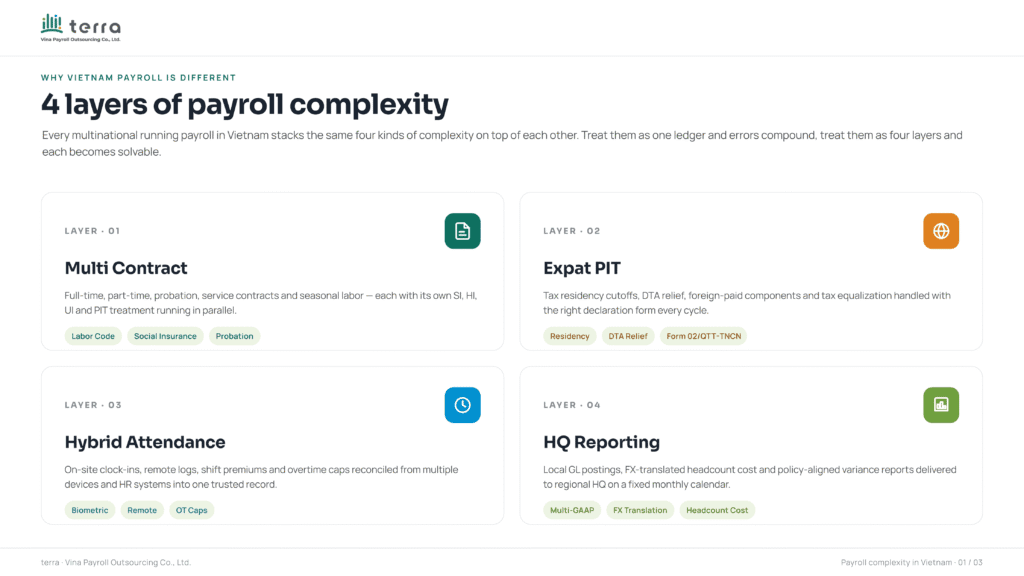
Four layers of payroll complexity
The 4 operational layers multinational companies must solve to run payroll accurately in Vietnam.
Company T (anonymized) had operated successfully for several years with a small HR team of three people managing all compensation and benefits work. However, as the company’s workforce diversified, the cracks in their manual processes became impossible to ignore.
The HR team identified four distinct challenges, each compounding the others:
1
Multi contract payroll on a single spreadsheet
Full time employees, monthly contractors, and project based freelancers were all tracked in one Excel file with different formulas per group. A single misplaced cell reference could cascade errors across dozens of records.
2
Japanese expat PIT calculation
Japanese expat payroll for 15 nationals on gross up salary packages required complex PIT calculations involving tax equalization, housing allowances, and home leave provisions. Each expat’s tax profile was unique, making standardization nearly impossible in Excel.
3
Hybrid work attendance gaps
With roughly 60% of employees working in a hybrid arrangement, the company lacked a unified method to track attendance. Office days used a fingerprint scanner. Remote days relied on self reported logs via email, creating discrepancies every month.
4
Compliance reporting to Japan HQ
The parent company required monthly payroll reports in a specific format. The HR team spent an additional two full days each cycle manually reformatting Vietnamese payroll data into the Japanese reporting template.
“We were spending more time verifying our own data than actually running payroll. Every month felt like an audit, and we still could not guarantee accuracy for our expat colleagues.”HR Manager, Company T
Why existing tools could not keep up
Before engaging terra, Company T had attempted two approaches to solve their payroll challenges. First, they invested in a popular standalone HR software. When that proved insufficient for expat tax handling, they layered on additional Excel spreadsheets to bridge the gaps. Neither approach delivered the accuracy or efficiency the company needed.
The fundamental issue was fragmentation. Data lived in multiple places, required manual transfers between systems, and depended heavily on the institutional knowledge of individual HR staff members. When one team member took leave, the entire payroll process slowed down.
Comparison: Manual vs. integrated approach
Challenge Area
Manual / Fragmented Method
terra BPaaS Approach
Multi contract payroll
Separate sheets per contract type, manual formula updates
Unified platform with contract type auto classification
Expat PIT (gross up)
HR calculates manually using tax tables, prone to outdated rates
Built in gross up engine updated per latest PIT circulars
Hybrid attendance
Fingerprint for office, email logs for remote; no single source of truth
Multi method sync: FaceID, GPS, WiFi, and mobile app check in
Social Insurance
Calculated separately, cross checked against payroll after the fact
Auto calculated within the same payroll run
HQ reporting
Manual reformatting from VN data to JP template, 2+ days per cycle
Files shared via email and cloud drives with broad access
ISO/IEC 27001:2022 certified, role based access control
The comparison made it clear that incremental fixes would not work. Company T needed a payroll outsourcing partner who could consolidate the entire workflow into one platform while bringing deep expertise in Vietnamese tax and labor law, particularly for Japanese expatriate cases.
One platform. Full service, zero gaps
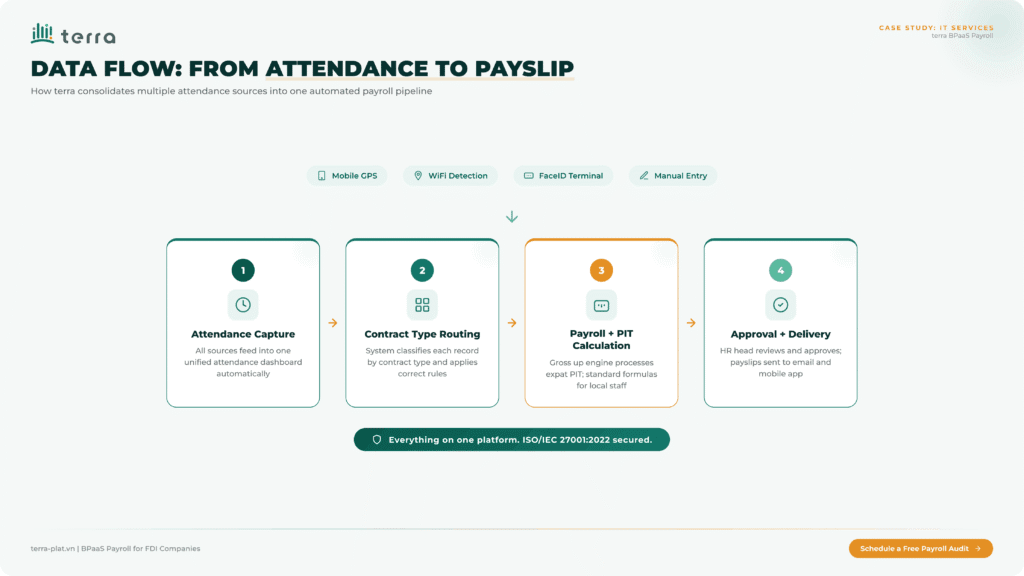
How terra transforms fragmented attendance records into one automated payroll workflow for hybrid and expat teams
terra proposed its payroll outsourcing model, BPaaS (Business Process as a Service), specifically designed for the complexity Company T faced. Unlike traditional software that requires the client’s HR team to operate the system independently, terra’s model combines a technology platform with a dedicated team of payroll and tax specialists who manage the process alongside the client.
This distinction matters. For Company T, the challenge was never about finding better software. It was about finding a partner who understood both the technology and the regulatory intricacies of managing Japanese expatriates in Vietnam.
Key capabilities deployed
1
Expat PIT Engine
terra’s platform includes a dedicated gross up salary calculation module that automatically applies the correct PIT rates, personal deductions, and allowance structures for each Japanese expatriate. The module is updated whenever the Vietnamese tax authority issues new circulars, eliminating the risk of outdated calculations.
2
Multi Contract Classification
Each employee record is tagged by contract type (full time, fixed term contractor, or freelancer), and the system applies the appropriate salary formula, Social Insurance rules, and reporting format automatically. No manual switching between spreadsheets.
3
Hybrid Attendance Consolidation
The platform accepts attendance data from multiple sources: FaceID terminals at the office, GPS based mobile check in for remote days, and WiFi detection for employees working from approved locations. All data flows into a single attendance dashboard before entering the payroll engine.
4
HQ Reporting Module
terra configured a custom export template that maps Vietnamese payroll data directly into the format required by Company T’s parent company in Japan. What previously took two days of manual reformatting now generates automatically at the end of each payroll cycle.
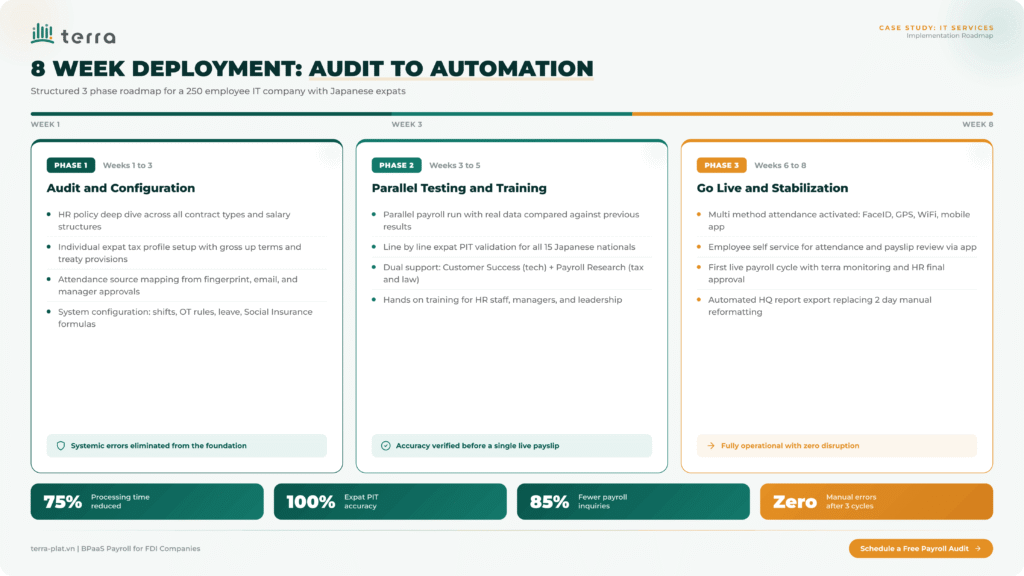
8 week deployment: From audit to automation
An 8 week deployment roadmap designed to transition complex payroll operations from manual processing to stable automation
terra structured the implementation into three phases. The timeline was designed to be thorough without disrupting Company T’s ongoing operations. Each phase had clear deliverables and checkpoints to ensure alignment between both teams.
1
Audit and configuration (Weeks 1 to 3)
HR Policy Deep Dive: terra’s consulting team reviewed all contract types, salary structures, allowance categories, and expat compensation packages to map every variable into the system.
Expat Tax Profile Setup: Each Japanese expatriate’s tax profile was configured individually, accounting for gross up terms, housing benefits, home leave, children’s education allowances, and applicable tax treaty provisions.
Attendance Source Mapping: The team cataloged all existing attendance methods (fingerprint, email logs, manager approvals) and designed the new multi method attendance architecture.
System Configuration: Shift patterns, overtime rules, leave policies, and Social Insurance formulas were programmed according to Vietnam’s current Labor Code and PIT regulations.
2
Parallel testing and training (Weeks 3 to 5)
Parallel Payroll Run: terra processed one full payroll cycle using real historical data and compared results against Company T’s previous calculations. Discrepancies were analyzed and resolved before going live.
Expat PIT Validation: Each expatriate’s PIT calculation was verified line by line against manual computations to ensure the gross up salary engine produced accurate results.
Dual Support Model: Company T received support from two terra teams: Customer Success (technical platform guidance) and Payroll Research (tax, insurance, and labor law expertise).
Hands On Training: Sessions covered the full workflow from attendance approval to payslip generation, tailored for HR staff, department managers, and leadership.
3
Go live and stabilization (Weeks 6 to 8)
Multi Method Attendance Activated: FaceID for office, mobile GPS check in for remote work, and WiFi detection were all connected to a single attendance dashboard.
Employee Self Service: Staff began reviewing their own attendance records and payslips through the terra mobile app, reducing HR inquiries significantly.
First Live Payroll: The initial automated payroll cycle ran with terra’s team monitoring every step. The HR team approved the final output before payslip distribution.
HQ Report Generation: The first automated export to Japan HQ was delivered on schedule, replacing the manual reformatting process entirely.
Measurable impact after three payroll cycles
Within three months of going live, the results validated the decision to move to terra’s BPaaS model. The improvements were immediate and measurable across every dimension of payroll operations.
~75%
less payroll processing time (from 8 days to 2 days per cycle)
100%
expat PIT accuracy across all 15 profiles
0
manual calculation errors after the third payroll cycle
DETAILED OUTCOMES
HQ report preparation: 2 full days saved per cycle, the first automated export replaced manual reformatting entirely.
All 15 Japanese expatriate PIT calculations are now fully automated. The gross up engine handles tax equalization, allowance categorization, and treaty application without manual intervention. Each calculation is traceable and auditable.
Attendance data from all sources is unified. Office, remote, and contractor attendance now flows into one system. The monthly reconciliation step that once required a full day of cross checking has been eliminated.
Employee payroll inquiries dropped by 85% after three cycles. With transparent payslips accessible via the mobile app and proactive attendance reminders, employees resolved most questions independently.
Payroll compliance for Social Insurance and PIT is managed proactively. terra’s Payroll Research team monitors regulatory changes and applies updates to the system before each payroll cycle, ensuring Company T is always current.
All payroll data is protected under ISO/IEC 27001:2022. Role based access control ensures that sensitive expat compensation data is visible only to authorized personnel.
What this case teaches about IT payroll in Vietnam
The experience of Company T illustrates a pattern common across Vietnam’s technology sector. IT companies often maintain lean HR teams that are expected to handle the same regulatory complexity as companies with much larger administrative departments. When Japanese expatriates are part of the equation, the compliance burden increases substantially.
The conventional response is to add more spreadsheets, more workarounds, and more hours. But this approach has a ceiling. Beyond a certain headcount and workforce diversity, manual processes cannot deliver the accuracy and consistency that both employees and regulators expect.
The BPaaS payroll outsourcing model offers an alternative: instead of choosing between expensive in house systems and basic vendor outsourcing, companies gain access to both a technology platform and a team of specialists who share responsibility for payroll accuracy. For IT firms managing hybrid workforces and international personnel, this combination addresses the structural challenge rather than just the symptoms.
“The difference is not just in the software. It is having a team that understands Japanese expat tax in Vietnam as deeply as we understand our own business. That expertise cannot be replaced by a spreadsheet.”General Director, Company T
About terra
Operated by Vina Payroll Outsourcing Co., Ltd., a member of the I-GLOCAL Japan group, terra inherits over 21 years of experience consulting for Japanese enterprises in Vietnam. terra provides BPaaS Payroll: a model that combines cloud technology with dedicated payroll and tax experts, delivering accuracy, compliance, and transparency from timekeeping through to payout.
terra BPaaS Payroll Solutions
Frequently Asked Questions
Payroll outsourcing costs in Vietnam vary depending on company size, workforce complexity, and service scope. For a 250-employee company with multiple contract types and expatriate staff, costs typically range from $500-$2,000 per month or a per-employee fee of $2-$10 monthly. The investment is usually offset by reducing internal HR headcount and eliminating compliance errors that could result in penalties.
PIT (Personal Income Tax) calculation for Japanese expats in Vietnam involves computing personal income tax based on gross salary, tax equalization clauses, and housing allowances. Japanese expats often receive gross-up salary packages designed to cover both their home country and Vietnam tax obligations, requiring complex calculations that account for tax treaties between Japan and Vietnam. Errors in these calculations can trigger penalties from Vietnamese tax authorities and create compliance issues with the parent company in Japan.
Hybrid work attendance tracking requires a unified system that combines office fingerprint scanners with digital logs for remote days. Manual methods like email self-reporting create inconsistencies and errors. A proper attendance management system integrates real-time tracking, automatic reporting, and synchronization with payroll to ensure accurate pay calculations regardless of work location.
According to the case study, payroll outsourcing implementation for a 250-employee company typically takes 8 weeks from start to full operation. This timeline includes data migration, system setup, staff training, and testing across all payroll components including attendance, PIT calculations, and social insurance reporting.
IT companies in Vietnam often employ diverse workforce structures including full-time employees, contractors, freelancers, and expatriates, each with different tax and contract requirements. As these companies scale, managing payroll manually becomes a significant operational bottleneck. Payroll outsourcing provides specialized expertise in multi-contract complexity, expat tax compliance, and hybrid attendance tracking that generic systems cannot deliver, allowing HR teams to focus on strategic initiatives rather than operational payroll administration.