
In this article, terra will delve into every aspect of 360 degree feedback, from its definition, benefits, and challenges to effective implementation strategies.
What is 360 degree feedback?
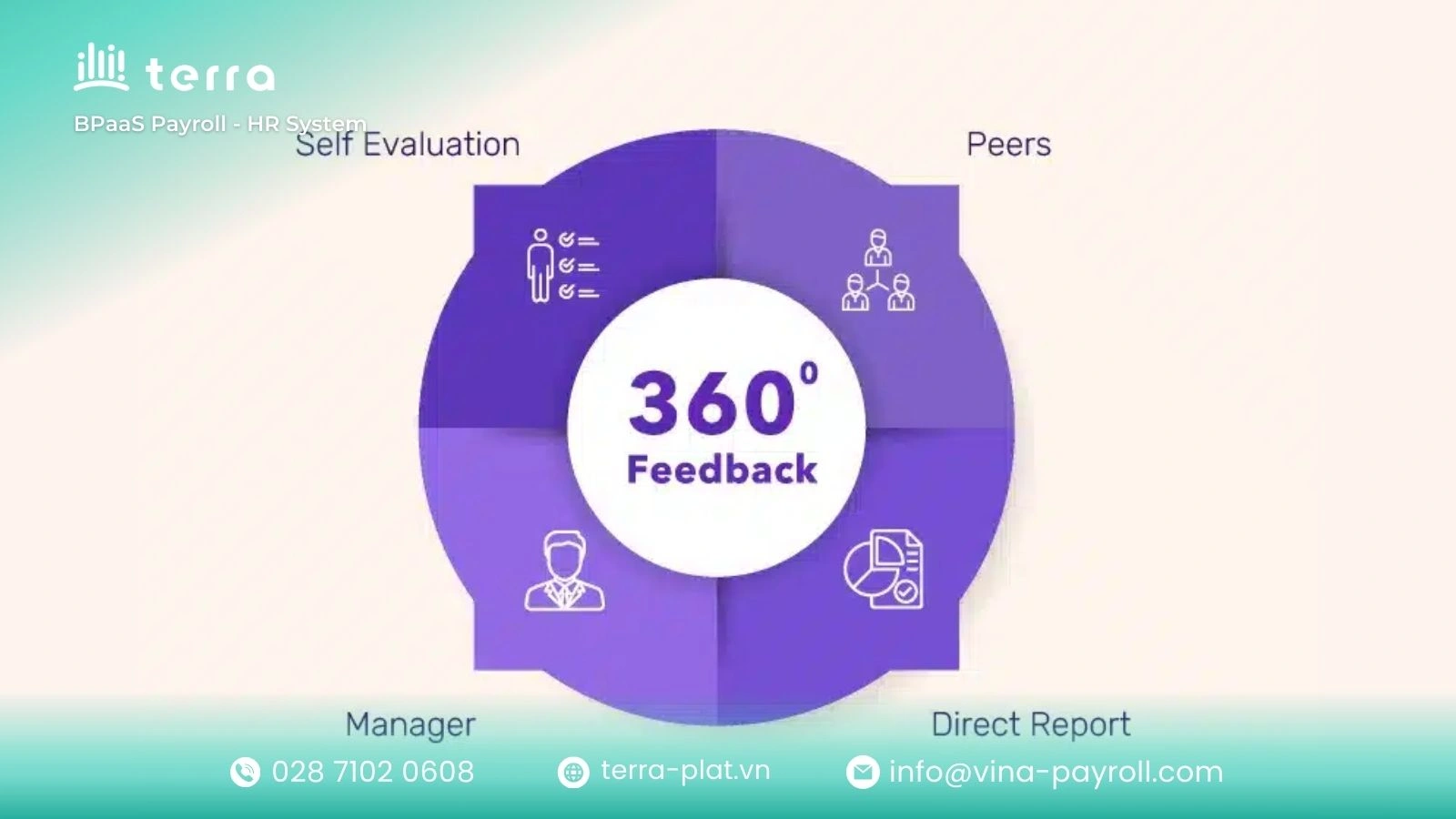
360-degree feedback, also known as multi-source feedback, multi-rater feedback, or review 360, is an employee evaluation method that gathers input regarding performance and areas for improvement from various sources.
The internal stakeholders who have a close working relationship with the employee being evaluated (the ratee) typically include:
- Direct supervisor.
- Peers.
- Direct reports.
- Self-assessment.
Additionally, feedback from external stakeholders such as customers, vendors, or suppliers may also be included. This extended scope of raters is sometimes referred to as 720-degree feedback.
360 feedback assessment is becoming increasingly popular for all employee groups, not just for leaders and managers as it once was, because it offers a holistic perspective on strengths and improvement areas.

The key benefit of a 360 feedback review
The core benefit of the 360 degree evaluation lies in its ability to provide a comprehensive and balanced view of how an employee works and interacts.
Rather than focusing solely on goals and achievements, the review 360 process shows employees how they function from different perspectives. Well-informed feedback from multiple sources uniquely contributes to employee growth and development.
- Employees realize how their behaviors and work practices affect different groups of people.
- They gain clarity on their strengths and specific areas needing improvement.
- This insight motivates employees to devote more effort to their current job success and achieve their long-term career goals. Understanding one’s Leadership style is often a key outcome here.

Comprehensive pros and cons of 360-degree feedback

While 360-degree feedback is a powerful development tool, it also presents specific challenges that organizations must navigate.
Advantages of 360-degree feedback
A well-implemented 360 feedback system can have a significantly positive impact on employees and, ultimately, the organization. These benefits include:
- Creating a strong competitive advantage: Focusing on leadership development and improving the behavior of managers will lead to a better competitive position for the organization.
- Improving customer service and increasing loyalty: Feedback from internal or external customers points to specific areas where employees can make changes that enhance the customer experience.
- Enhancing teamwork and driving higher productivity: Accountability for how individuals work with each other encourages stronger communication and collaboration, leading to better performance.
- Delivering more accurate assessments for large or remote teams: When people work independently, observations from others help fill in assessment gaps. A thorough 360 feedback assessment can effectively address this challenge.
- Strengthening the internal talent pipeline: As employees develop their skills and overcome challenges, the organization builds a larger pool of potential leaders. This growth is often supported by targeted Employee training.
- Lowering employee turnover and boosting engagement: Studies show that managers who received positive 360 degree feedback surveys fostered lower team turnover and higher service quality.
Disadvantages of 360-degree feedback
Expectations for multi-rater feedback must be realistic. It is only one part of a performance management system and cannot stand alone.
High time and cost requirements: The training and execution of the evaluation are costly in terms of time and administrative resources.
- Not suitable for all roles or organizational structures: Smaller companies may lack enough sources to provide objective and quality 360-degree feedback.
- Complex to design and execute effectively: Giving feedback is difficult and can cause conflict, leading to inaccurate ratings or unconstructive input, especially without proper guidance.
- Potential misalignment with strategic objectives: 360 feedback may focus on competencies or skills that are not aligned with the organizational strategy if not carefully calibrated.
- Limited impact if follow-up actions are not implemented: If senior leaders do not value and support the process, a lack of follow-up will decrease the likelihood of behavioral change.
How is 360 degree feedback used?

360 degree feedback is primarily used in two main ways within human resource management:
As a development tool
The primary purpose of 360-degree feedback is personal development.
- Goal: To help employees recognize their strengths, weaknesses, and perception gaps to create a personal development plan. This frequently involves refining their Leadership style.
- Usage: The assessment results are often kept confidential and shared only with the ratee and a coach or manager for action planning.
- Note: The ratee is typically allowed to select their raters (with manager approval) to ensure the feedback is constructive.
As a performance appraisal tool
The 360 degree evaluation can also be used for performance appraisal, though this is a less common and more sensitive application.
- Goal: To provide multi-faceted input for making decisions about compensation, promotion, or adjustments to the Labor contract.
- Usage: The 360 degree evaluation is embedded within the performance management system. Raters are chosen based on how closely they work with the ratee.
- Important Note: The purpose and use of the feedback must be clearly communicated to avoid raters giving overly positive feedback (grade inflation) out of fear of negatively affecting a colleague’s career.
Implementing a 360-degree feedback system: Best practices
Careful planning and execution are essential for a 360-degree feedback system to produce effective outcomes.
- Engage all relevant stakeholders: Ensure buy-in from senior decision-makers to guarantee support for resources, time, and participation.
- Clearly define success criteria: Define how you will measure the program’s success (e.g., survey completion rate, completion of improvement plans, positive behavioral change).
- Create urgency and reinforce participation with recognition: Set and communicate a clear submission deadline. Incentivize participation by making it mandatory or rewarding those who complete the survey.
- Build a structured follow-up plan: A 360 degree evaluation should not be a standalone event. Encouraging individual employees to take action and having official follow-up activities helps trigger and support necessary behavioral changes.
- Distinguish between development and evaluation goals: Always communicate clearly the purpose and use of the feedback to all involved parties. This helps raters feel secure and provide more honest feedback.
- Align feedback with organizational goals and competencies: The feedback must focus on the critical competencies required for the individual’s job and align with the organization’s strategy. This includes evaluating what constitutes an effective leadership style within the company.
- Relevant content of the 360 surveys: The questions and competencies evaluated in the 360 degree feedback survey should align with the unique values and competencies of your organization. A custom survey is often the best fit.
- Collect high-quality data (credible data): Ensure data credibility by having sufficient raters who are familiar with the subject. Furthermore, use a professional instrument to measure behaviors and provide raters with necessary employee training on how to give objective feedback.
- Establish accountability at every stage: The ratee should be accountable for receiving the feedback. Set up follow-up sessions with a manager or coach to discuss results.
- Census participation: Ensure wide participation. Management must be held accountable for the successful completion of the feedback process across their teams.
What should be included in 360-degree feedback?
360 degree feedback survey data typically focuses on the following categories of competencies, traits, and behaviors:
- Communication skills.
- Interpersonal/soft skills.
- Collaboration and teamwork.
- Leadership and management capabilities (e.g., assessing Leadership style).
- Innovation and creative abilities.
- Alignment with business goals and culture.
Note: Feedback must focus on behaviors and actions, rather than personal characteristics or traits. This ensures the 360 feedback assessment is objective and focused on areas the employee can actually improve upon.
How often should 360 feedback be used?
There is no single perfect frequency. The best schedule depends on the organization’s goals, culture, and resources:
- For development purposes:
Annually: The most common frequency. This allows enough time for employees to act on the 360 degree feedback and demonstrate change.
Biennially (Every two years): May suit organizations with a slower pace of change or resource constraints. - For performance appraisal purposes: It should be used as an annual input within the performance review cycle.
- For leadership positions: The review 360 is often conducted more frequently (e.g., annually) to ensure continuous development.
The most critical factor is ensuring there is sufficient time for follow-up actions and observable change before the next feedback cycle.
How do you do a 360 degree survey?
Managing the 360 degree feedback survey process becomes easier and more consistent when using specialized software.
- Establish the competency framework: Select a maximum of 4 core competencies for each role.
- Define behaviors: Define 3-4 behaviors (dimensions) for each competency. These will be the questions raters answer.
- Construct the survey: Use 360-degree software to create questions based on behaviors and include open-ended questions at the end.
- Select raters: The ratee proposes raters (supervisor, peers, direct reports), and the manager approves.
- Collect feedback: Send the survey via email and set a clear deadline.
- Data analysis and reporting: The software aggregates the data, compares ratings from different groups, and generates detailed reports, the core output of the 360 feedback assessment.
- Interpretation and action planning: The ratee reviews the report with a manager or coach to create a personal development plan, often incorporating insights gained from Employee training.
What a 360 degree survey does?
- Delivers a complete performance picture: Unlike traditional reviews that rely solely on a manager’s view, a 360 degree feedback survey synthesizes insights from peers, direct reports, supervisors, and self-evaluations. It can even extend to external partners like clients or suppliers.
- Enhances self-awareness: By contrasting self-perception with the observations of others, the process uncovers “blind spots,” helping employees understand how their behavior truly impacts those around them.
- Pinpoints strengths and skill gaps: The results clearly identify key assets to leverage and specific weaknesses to address, forming a solid foundation for targeted Employee training and professional growth.
- Cultivates accountability and teamwork: Implementing this method fosters a culture of open communication where constructive feedback is valued, leading to increased collaboration and personal accountability within the team.
- Supports data-driven HR decisions: It provides leadership with a diverse and objective dataset, reducing bias and aiding in strategic decisions regarding career development and succession planning.
What a 360 degree survey does not do?
- It should not be the sole source for making decisions about compensation or termination; these are typically addressed through standard performance reviews and stipulations in the Labor contract.
- It should not focus on job results (these should be measured by KPIs), but rather how to achieve those results.
- It should not evaluate fixed personality traits that are difficult for an employee to change.
HR Management system for modern businesses – terra HR System

While specialized recruitment software is excellent for talent acquisition, many businesses find greater value in a unified system. terra HR Management System is a comprehensive solution that integrates recruitment directly into the core HR workflow.
This all-in-one terra HR Solution provides a single hub for all employee data, so when you hire a candidate, their profile automatically transfers to payroll and management, eliminating errors and creating a seamless onboarding process.
- Core HR Management: This is the central heart of the terra HR Platform. It securely stores and manages all employee profiles, contracts, and insurance details, eliminating paperwork and providing instant, centralized access to all critical records.
- Automated Payroll Management: This module automates complex calculations for salary, Personal Income Tax (PIT), and social insurance, ensuring 100% compliance with Vietnamese regulations. It links directly to timekeeping data to generate accurate, individual payslips for every employee.
- Time & Attendance Management: Effectively track working hours, overtime, and diverse leave policies. This feature integrates with time clocks and allows employees to request time off, giving managers a clear, real-time view of attendance data.
- Performance & Goal Management: Set, track, and evaluate employee performance against clear objectives. This tool supports regular reviews and helps you make informed, data-driven decisions on promotions, employee training, and contract renewals.
Conclusion
With leadership commitment and careful planning, 360 degree feedback system is a worthwhile investment in employee development. By following best practices, your organization can avoid common pitfalls and maximize the positive impact of 360-degree feedback, building a strong team and gaining a competitive advantage.









