
Managing payroll on time isn’t just about paying people, it’s about trust, compliance, and operational discipline. In this guide, terra will break down how to build and maintain a reliable payroll schedule, from automation best practices to coordination tips, along with answers to the most common questions payroll teams face.
What is a payroll schedule

A well-structured payroll schedule helps reduce errors, minimize stress, and improve transparency. Employees can plan their finances confidently, managers can meet approval deadlines, and finance teams can better forecast cash flow and manage compliance obligations.
Payroll schedule definition
A payroll schedule is the fixed timetable your company follows to manage employee pay accurately and on time. It defines when key payroll activities take place, from collecting employee data, calculating wages, and obtaining approvals to finally disbursing salaries.
In essence, a payroll schedule outlines four critical milestones:
- Pay period: the date range employees work and earn wages.
- Cut-off date: the deadline for submitting timesheets, overtime, commissions, or tax updates.
- Processing window: when HR and finance review, calculate, and approve payroll data.
- Pay date: the day employees receive their pay in their bank accounts.
Think of it as a shared roadmap that keeps HR, finance, and employees synchronized, ensuring every payday happens smoothly and consistently. Depending on company policy, payroll schedules may be weekly, biweekly, semi-monthly, or monthly.
It’s important to note that a payroll schedule is not the same as a payroll cycle. While the payroll schedule defines when each step occurs, the payroll cycle describes the end-to-end process, from data collection to posting results in the accounting ledger. Both work together to ensure payroll accuracy and compliance.
The importance of a payroll schedule
A clear and consistent payroll schedule does more than just dictate payment dates, it underpins operational efficiency and employee satisfaction across the entire organization. By establishing predictable routines, companies can streamline approvals, reduce last-minute issues, and maintain compliance with pay frequency regulations.
Below are five key benefits of maintaining a robust payroll schedule:
- Predictable cash flow: Finance teams can anticipate upcoming expenses such as salaries, taxes, and benefits, avoiding last-minute funding challenges.
- Fewer errors: Defined cut-off dates prevent late submissions or unauthorized changes, keeping payroll data clean and accurate.
Happier employees: Consistent and timely paydays foster trust and reduce payroll-related inquiries. - Compliance support: Many jurisdictions regulate pay frequency and recordkeeping. A structured schedule helps ensure ongoing compliance.
- Operational efficiency: A repeatable payroll cadence reduces administrative workload and supports faster month-end closing.
Pro Tip: Publish your payroll schedule at the beginning of each fiscal year and include it in both your employee handbook and HRIS system to ensure company-wide visibility and alignment.
Common types of payroll schedule
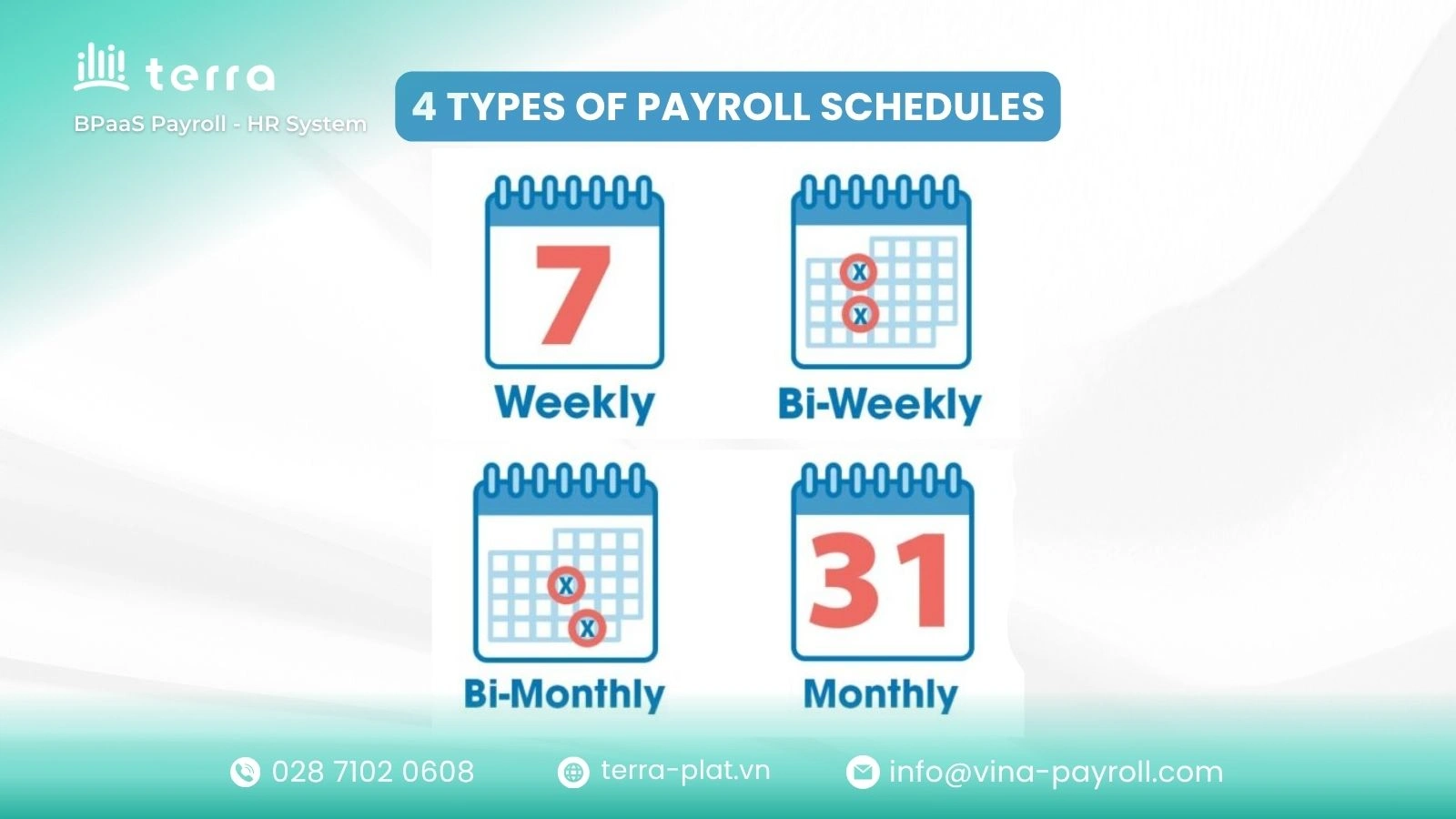
Choosing the right payroll schedule is essential for maintaining accuracy, efficiency, and employee satisfaction. Below are the four most common payroll schedules and how they differ in cadence, suitability, and impact on operations.
Weekly payroll schedule
A weekly payroll schedule means employees are paid once every week, typically on the same weekday. This format offers consistent income for staff with variable hours, making it ideal for teams that log time-based work or earn frequent overtime. Specifically:
- Cadence: 52 paydays per year.
- Best for: Hourly or shift-based teams in industries like hospitality, retail, and field services.
- Pros: Employees enjoy regular cash flow and clear weekly overtime calculations, which can boost motivation and retention among hourly staff.
- Cons: However, the high frequency creates heavier administrative workload, higher processing costs, and more frequent bank transactions, requiring efficient automation to stay sustainable.
Biweekly Payroll Schedule
A biweekly payroll schedule pays employees once every two weeks, often resulting in 26 pay periods per year. This structure balances regular pay for employees with manageable workload for HR and finance teams. Details:
- Cadence: Every other week (26 paydays per year).
- Best for: Organizations with both hourly and salaried employees across varied departments.
- Pros: It reduces administrative strain compared to weekly runs while maintaining consistency for employees. Overtime is also easier to track since most pay periods cover full workweeks.
- Cons: Certain months will have three paydays, which can complicate benefits deductions and monthly budget forecasts, something finance teams should plan for.
Semi-monthly payroll schedule
A semi-monthly payroll schedule offers predictable payment timing and aligns well with monthly accounting cycles. It simplifies cash management and reduces the number of payroll runs per year. Specifically:
- Cadence: Two fixed dates each month (commonly the 15th and the last day) → 24 paydays per year.
- Best for: Salaried staff, professional services firms, or businesses with stable headcounts.
- Pros: Easier integration with accounting periods, lower administrative effort, and predictable outflows make it a strong fit for established organizations.
- Cons: However, when overtime spans across calendar months, calculations can become tricky. Additionally, if payday falls on a weekend or holiday, payments may need to be processed earlier, requiring careful scheduling.
Monthly payroll schedule
The monthly payroll schedule is the simplest in terms of processing frequency and financial forecasting. It minimizes administrative work and ensures consistent alignment with month-end accounting. Details:
- Cadence: 12 paydays per year.
- Best for: Senior executives, contractors, or companies in regions where monthly pay is standard practice.
- Pros: Lowest operational costs, easiest reconciliation, and clear visibility of total payroll expenses each month.
- Cons: However, it can pose budgeting challenges for employees who rely on more frequent income. In some jurisdictions, it may also be non-compliant for hourly or lower-wage staff, so legal requirements must be verified in advance.
Main sections and dates in a payroll schedule

Establishing clear milestones ensures accuracy, compliance, and transparency across HR, finance, and employee communication. Below are the four key sections and critical dates every payroll schedule should include.
Cut-off dates
Cut-off dates mark the point when HR stops collecting new data for a given pay period, such as attendance, overtime, or tax changes, allowing the payroll team to calculate pay without late updates disrupting results.
Purpose: To finalize all input data so payroll can be processed accurately and on time.
It’s important to set firm deadlines for all relevant data sources, including time and attendance records, overtime approvals, commissions, allowances, new hires or terminations, bank detail updates, and tax code changes. Any data submitted after the cut-off should automatically roll into the next payroll cycle unless classified as an urgent correction.
Once data is frozen, align workflows between HR and finance to verify accuracy. Typically, timesheets are reviewed by managers first, checked by HR for policy compliance, and then forwarded to the finance or payroll team for validation, including variance analysis, exception reports, and cash requirement forecasting.
Payroll processing period
The payroll processing period is the timeframe when your payroll system performs all gross-to-net calculations, applies tax deductions and benefit contributions, and generates draft payroll registers for review.
This stage is critical for accuracy and audit readiness. Build in enough buffer time for exception handling, such as resolving missing work hours, fixing negative net pay, or managing garnishments. A structured processing period minimizes last-minute stress and ensures approvals are complete before disbursement.
Pay date (payroll disbursement)
The pay date is the official day employees receive their wages, either through direct deposit or issued checks. This is the most visible and impactful stage of the payroll schedule, as it directly affects employee satisfaction and trust.
If a pay date falls on a weekend or public holiday, clearly define in advance whether payments will be released before or after the holiday. Communicate this policy early and document it in your annual payroll schedule to avoid confusion or missed expectations.
Adjustment or correction period
Even with a strong process, occasional errors or late updates can occur. The adjustment period provides a short post-payday window to process off-cycle payments, for example, missed hours, retroactive rate changes, or urgent corrections.
During this time, payroll and accounting teams should not only process fixes but also track root causes to identify patterns. Doing so helps reduce recurring issues and strengthens overall payroll governance for future cycles.
How to set up a payroll schedule

A well-planned setup ensures smooth payroll cycles, reduces manual errors, and helps maintain compliance with labor laws and banking timelines. Below are five key steps to building a payroll schedule that’s accurate, predictable, and easy to maintain.
Define your pay period
Start by identifying the pay period, the time frame used to calculate employee earnings. This decision forms the foundation of your payroll schedule and influences every downstream activity.
Choose between weekly, biweekly, semi-monthly, or monthly pay periods based on your company’s workforce mix, cash flow predictability, compliance requirements, and employee preferences.
Clearly map out how overtime will be calculated and how public holidays or fiscal year-end closures may affect pay cycles. Setting these parameters early prevents confusion later and helps maintain payroll consistency year-round.
Choose a consistent pay date
A consistent pay date gives employees confidence and allows your finance team to forecast cash outflows with precision. Pick a specific weekday or calendar day and stick to it across all cycles.
For semi-monthly schedules, many businesses pay on the 15th and last day of the month; for biweekly schedules, it’s common to use Fridays. Consistency not only simplifies planning but also reinforces trust by ensuring employees always know exactly when to expect their pay.
Set a payroll cut-off date
The cut-off date marks the deadline for submitting all payroll inputs, including timesheets, leave requests, overtime records, commissions, and other variable pay data. This step ensures the payroll team has sufficient time to process and review information before payday.
Typically, the cut-off falls 2-5 business days before the pay date, though companies requiring early bank file submissions may need a longer lead time. Always factor in direct deposit processing requirements and internal approval steps to avoid last-minute delays.
Align processing and approval time
Effective payroll management depends on clearly defined responsibilities and approval workflows. Dedicate a specific window between the cut-off and pay date for HR and finance teams to process, verify, and approve payroll data.
Outline who approves what, for example, managers validate timesheets, HR reviews compliance and policy accuracy, payroll confirms calculations, and finance finalizes disbursement. Use a checklist covering new hires, terminations, variable pay, tax updates, benefit deductions, and retroactive adjustments to keep the process structured and error-free.
Document and communicate the schedule
Transparency is key to preventing misunderstandings and payroll-related inquiries. Once finalized, publish your payroll schedule in a clear, one-page format that includes pay periods, cut-off dates, processing windows, pay dates, bank holidays, and off-cycle rules.
Make the schedule easily accessible by posting it in your HRIS, internal communication channels like Slack or Microsoft Teams, and your employee handbook. Clear documentation not only builds trust but also helps new hires integrate seamlessly into your company’s payroll routine.
Tips for maintaining an on-time payroll schedule

Even small delays in data submission or approvals can ripple across departments, affecting both employees and compliance. The following best practices help you maintain an accurate, reliable payroll schedule month after month.
Automate data collection and calculations
Manual data handling is one of the biggest causes of payroll delays and errors. Integrate your time and attendance systems with your HRIS or payroll software to automatically sync working hours, leave records, and pay changes.
Automation minimizes manual entry, reduces exception rates, and ensures calculations are consistent across all departments. Over time, it also frees up HR and finance teams to focus on analysis and continuous process improvement rather than repetitive data work.
Establish clear cut-off and approval timelines
Set firm cut-off dates and approval deadlines to keep every payroll cycle on track. Define exactly when managers must submit timesheets and when HR and finance must complete their reviews.
Calendar reminders or automated workflow notifications help enforce accountability. To reinforce discipline, establish a transparent missed-cut-off policy and escalate late approvals when necessary. This ensures no team delays payroll for the entire organization.
Centralize HR and finance coordination
Strong coordination between HR and finance is critical to avoid last-minute surprises. Create a shared process for updating key data such as tax changes, bonuses, or leave adjustments.
A short 15-minute pre-payroll check-in between both teams can help verify that all updates are captured and potential risks are addressed before processing begins. Centralized communication not only speeds up approvals but also improves audit accuracy and accountability.
Build in buffers before holidays or fiscal deadlines
Public holidays, quarter-ends, and year-end closings often disrupt payroll timelines. To stay on schedule, plan buffer days into your payroll calendar.
If pay dates overlap with holidays or major accounting deadlines, shift your processing window earlier and communicate the revised schedule at least two payroll cycles in advance. Proactive communication prevents confusion and protects employee trust.
Conduct regular payroll audits
Routine payroll audits are essential for maintaining accuracy and compliance. Schedule quarterly reviews to detect discrepancies such as mis-coded earnings, outdated tax tables, or benefits mismatches.
Maintain an issues log that records root causes and corrective actions, this documentation helps prevent repeated payroll mistakes and strengthens internal controls. A consistent audit rhythm not only ensures on-time payroll but also reinforces long-term data integrity.
Frequently asked questions (FAQs) about payroll schedule

Below are some of the most common queries employers and HR professionals ask when managing payroll schedules, along with concise, expert-backed answers to help you maintain consistency and compliance.
- What’s the difference between payroll schedule and payroll cycle?
A payroll schedule refers to the calendar of key dates-cut-off, processing, and payday. In contrast, a payroll cycle covers the entire process from data collection and pay calculation to approvals, disbursement, and posting. The schedule is “when” payroll happens, while the cycle is “how” it’s executed. - Can different departments have separate payroll schedules?
Yes, but it adds complexity and operational risk. If departments must run separate cycles due to varying pay structures, keep at least one consistent payday and standardized cut-off and approval timelines. This minimizes confusion and simplifies reconciliation. - What happens if a company changes its pay frequency?
Notify employees at least one month in advance and update employment contracts, handbooks, and benefit proration formulas. Run a side-by-side test to ensure calculations remain accurate. Note that some jurisdictions require formal notice or employee consent before implementing frequency changes. - How do public holidays affect payroll schedules?
If payday falls on a weekend or public holiday, clearly state whether payments will be made on the preceding business day or the next working day. Coordinate with your bank to align file submissions and ensure timely fund transfers. - Who is responsible for managing the payroll schedule in a company?
Typically, the HR or Payroll team owns the master calendar. Finance co-manages cash flow forecasts and approval checkpoints, while department managers are accountable for approving timesheets on time. Alignment among these teams prevents last-minute delays. - How does payroll cut-off impact payment timing?
The cut-off date determines which items are processed in the current cycle. Submissions made after this date roll over to the next cycle, except in cases involving legal or compliance issues, which may justify an off-cycle run. - Can payroll schedules differ for full-time and part-time employees?
They can, especially when compensation models differ. However, aligning paydays—if not full cycles, simplifies employee communication and ensures smoother bank processing. - What tools can help automate payroll scheduling and processing?
A robust HRIS integrated with time & attendance and payroll modules streamlines automation. Add e-signature workflows for approvals and error alerts to reduce manual handling and late processing. - How should payroll teams handle missed or late submissions after the cut-off date?
Implement a clear “after cut-off” policy. Typically, missed items move to the next cycle unless they involve statutory or compliance-critical issues. Log every off-cycle run with its cause and resolution to maintain transparency and audit readiness. - What’s the risk of inconsistent payroll scheduling?
Irregular schedules can cause payment delays, employee dissatisfaction, compliance violations, and reporting discrepancies. Maintaining a consistent, transparent schedule not only builds trust but also strengthens your company’s financial discipline.
terra Payroll – Payroll service in Vietnam for FDI companies

Salary management and calculation are complex tasks that require precision and compliance with legal standards. To simplify this process, many companies choose payroll outsourcing services.
terra Payroll Service in Vietnam offers:
- Accuracy & compliance: Always updated with the latest laws.
- Time & cost savings: No need to invest in payroll software or dedicated HR staff.
- Data security: Advanced protection of sensitive information.
- Expert support: A team ready to handle complex payroll issues.
- Customized payroll solutions: Flexible packages suitable for different business sizes.
By using outsourced payroll services, companies can focus on core business activities while ensuring employee satisfaction and legal compliance.
To learn more about payroll outsourcing services in Vietnam, visit terra official website or contact the hotline at +84 28 7102 0608 for tailored consultation.
Conclusion
A clear, consistent payroll schedule keeps your operations smooth and employees confident. By automating data, enforcing cut-offs, and syncing HR with finance, you minimize errors and avoid delays. In the end, timely pay isn’t just about compliance, it’s about trust and reliability across your entire organization.









