
Every HR leader at a foreign invested company in Vietnam meets the same question at some point in 2026: keep building the HR team inside, or outsource HR functions and move the heavy administrative work to a specialist. The honest answer shifted this year. This guide gives HR and C&B leaders a working framework for HR outsourcing in Vietnam: what to keep, what to move, what it costs, and how to decide.
Why the HR outsourcing decision changed in 2026
The decision changed because four laws took effect between July 2025 and January 2026, each adding obligations in a different area. Social insurance, employment, personal income tax and personal data are now separate compliance tracks. Carrying all four inside one thin HR team is the new source of risk for FDI employers.
For years, the outsourcing question was framed around cost. Is it cheaper to run payroll internally or to pay a provider? That framing no longer fits the Vietnamese market. The volume of regulatory change in a single year moved the real question from price to risk exposure.
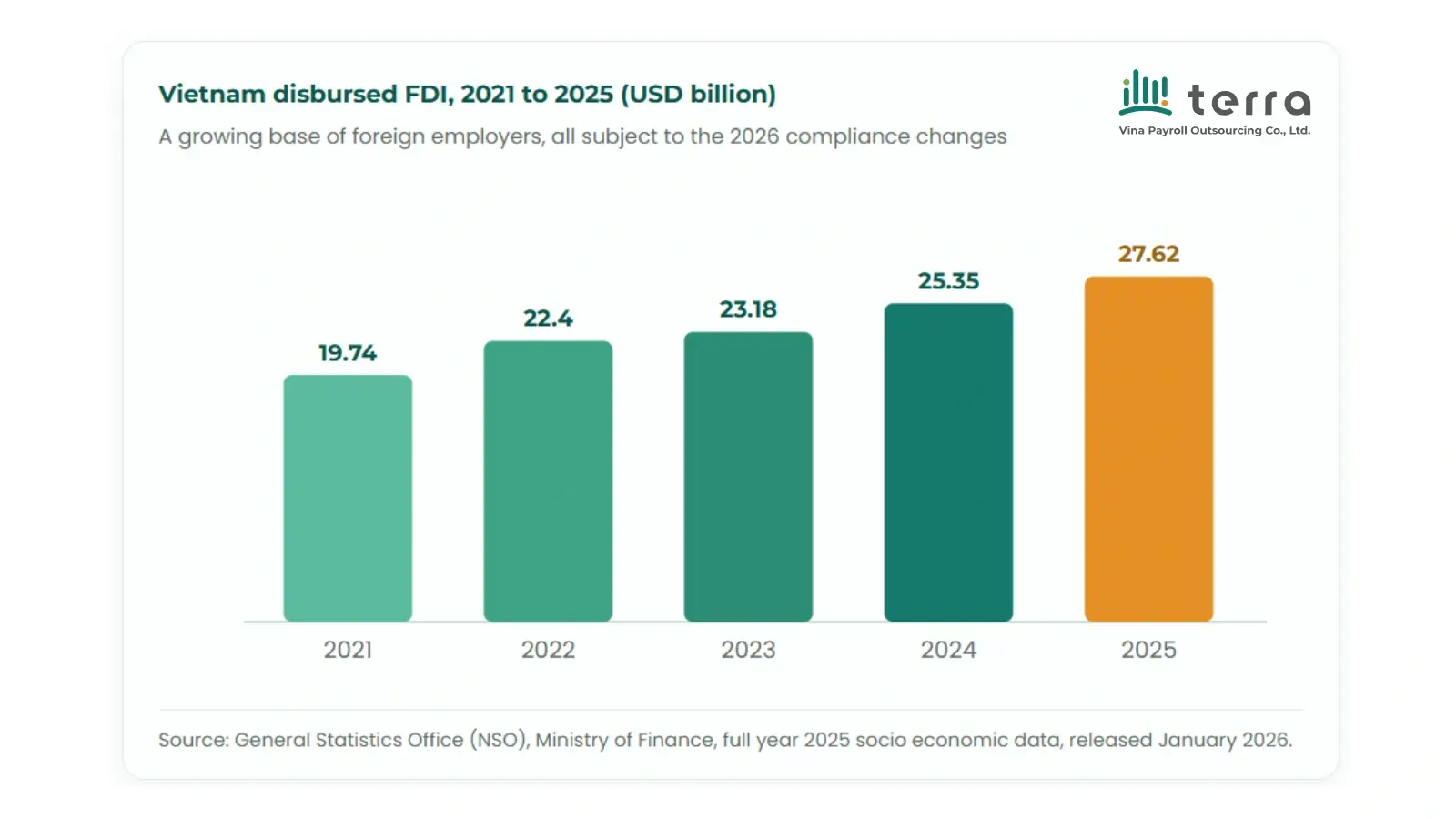
The pressure is rising at the same time as the foreign employer base. Vietnam disbursed USD 27.62 billion in foreign direct investment in 2025, up 9 percent year on year and the highest level in five years, according to the General Statistics Office. More foreign employers means more companies meeting Vietnamese labor, tax and insurance rules for the first time, in the same year those rules changed.
In FDI companies that run payroll on one C&B generalist, the first gap in 2026 usually shows up in social insurance scope. Under the Social Insurance Law (Law No. 41/2024/QH15), a reference level replaced the old base salary as the contribution basis, and coverage expanded to probationary contracts and non salaried executives. You can verify the current reference level and rates at the Vietnam Social Security portal. The person who handled this correctly in 2023 now has to relearn who must be enrolled.
The four 2026 changes every employer must track
Each law lands on a different team. Read across the table and the pattern is clear: a single HR function now needs current expertise in four regulatory areas at once.
These dates are time sensitive. The Social Insurance Law applies from 1 July 2025. The Personal Income Tax Law 2025 was passed on 10 December 2025, with salary provisions applying from the 2026 tax year and the full law from 1 July 2026, so payroll logic should already reflect the new deductions. Verify current thresholds at the Ministry of Finance before you apply them.
What HR functions can you outsource?
Not every HR function should leave the building. Work that is rules driven, deadline bound and penalty heavy belongs with a specialist. Work that shapes culture and talent belongs inside. Payroll, statutory filing and data administration are the strongest candidates to move first.
The most common mistake is treating the choice as all or nothing. In practice the smart structure is selective. The table below maps each function to a decision, based on how exposed it is to the 2026 laws and how much judgment it requires.
There is a specific failure mode worth naming here. Misclassifying a fixed hours worker as a service vendor, to avoid enrolment, now triggers retroactive social insurance collection from the contract start date under Law No. 41/2024/QH15, plus administrative penalties. The expanded coverage rules make this harder to get away with than it was under the previous law.
When to outsource HR functions: the decision signals
Forget rigid headcount thresholds. The real trigger is the gap between your internal capacity and your regulatory exposure. When one person covers payroll, tax, insurance and data, and a late filing carries real cost, the administrative layer has outgrown the team. Three or more signals below means it is time.
These signals are situational, not size based. A company of forty with a strong C&B function may keep more inside than a company of fifteen with a single overloaded generalist.
One boundary condition keeps this honest. The logic above applies to companies above roughly ten employees with mixed local and foreign staff. Below that, with stable headcount and simple pay, a lean in house setup can still be the lower cost option. Outsourcing earns its fee when complexity and risk rise, not at the first hire.
Map your real payroll cost before you compare options
Most cost comparisons skip the hidden compliance work. Model your gross to net payroll first, then weigh it against a service fee. terra can walk you through the numbers for your exact headcount mix.
HR outsourcing, payroll outsourcing or EOR: which do you need?
The three terms are not interchangeable. Payroll outsourcing handles salary, tax and insurance filing. HR outsourcing is broader and adds records, benefits and reporting. Employer of Record (EOR) goes furthest: the provider becomes the legal employer, which suits market entry without a local entity.
FDI leaders often arrive asking for one and needing another. The deciding factor is usually whether you already hold a local entity. If you do, payroll or HR outsourcing fits. If you are testing the market or hiring a handful of people before incorporating, EOR removes the need for an entity at all.
Most established FDI companies in Vietnam need payroll or HR outsourcing, not full EOR. EOR is a market entry tool, useful in the first year or two, and many companies move off it once they have an entity and a stable team.
In house vs outsourced HR: the real cost comparison
Compare total cost of ownership, not salary against invoice. In house cost includes compliance research, system updates, error penalties and turnover risk. Outsourcing converts that into one predictable fee while a specialist absorbs the legal updates. For most FDI SMEs in Vietnam, the outsourced model carries less risk per dong spent.
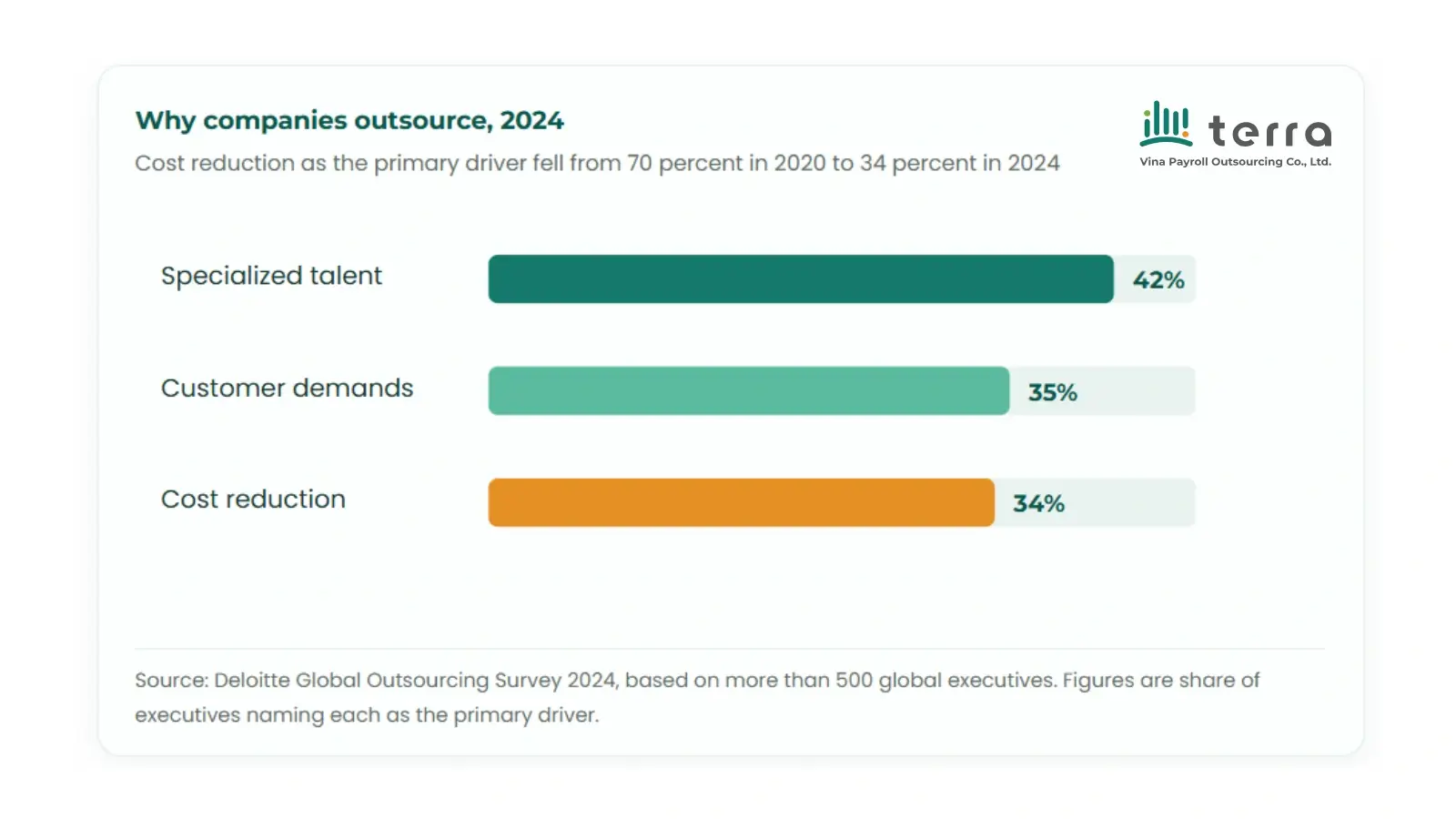
The reason to outsource has shifted, and the data shows it. In the Deloitte Global Outsourcing Survey 2024, access to specialized talent passed cost reduction as the top driver. Only 34 percent of executives now name cost as their main reason, down from 70 percent in 2020. For HR in Vietnam, the specialized talent in question is legal currency: people who track four laws so you do not have to.
One number worth sitting with
The penalty ceiling under the Personal Data Protection Law (Law No. 91/2025/QH15) reaches VND 3 billion, roughly USD 115,000, for serious violations. For many companies that single figure already exceeds a full year of HR service fees. Risk, not cost, is the real driver of the 2026 decision.
How much does HR outsourcing cost in Vietnam?
Pricing depends on the model. Payroll only outsourcing is usually charged per employee per month and sits at the lower end. Full Employer of Record pricing in Vietnam starts around USD 298 per employee per month, all inclusive (VinaTPT, 2026 estimate, verify current pricing). Headcount, the local to foreign staff mix, and reporting language all move the number.
Treat published figures as market ranges, not quotes. The drivers that change your price are headcount, the number of entities, the share of foreign staff with work permits and tax equalization, the reporting languages your parent company needs, and add ons such as benefits administration or insurance reconciliation. A clean, documented payroll costs less to run than a messy one, so process quality affects price too.
The wider market signals where this is heading. The global payroll outsourcing market is set to grow from USD 12.44 billion in 2025 to USD 16.87 billion by 2030, a 6.27 percent compound annual rate, with Asia Pacific the fastest growing region, according to Mordor Intelligence. The named driver in that research is the rising complexity of labor and tax law, the same force reshaping the decision in Vietnam.

What to look for in HR outsourcing in Vietnam
The right partner does more than run payroll. Look for current legal expertise across the four 2026 laws, bilingual reporting for your parent company, documented data handling under the new privacy law, and a named specialist team you can reach. Price matters, but legal currency matters more.
The Vietnamese market has established providers, some operating since the early 2000s, so the question is not whether help exists but whether a given partner stays current. A useful test in any sales call is direct: ask how they handled the most recent change, for example the move to the reference level under the Social Insurance Law, and what they changed in client payroll as a result. A vague answer is a warning sign.
Data handling deserves its own check. Because the Personal Data Protection Law names employment and recruitment as high risk processing, any provider touching employee data must meet the consent, minimization and deletion standards in Decree 356/2025/ND-CP. Confirm this in writing before you sign. To see how the broader provider field compares on payroll specifically, read more: top outsourced payroll services in Vietnam, terra-plat.vn/en/news/top-10-outsourced-payroll-services-in-vietnam.
How terra approaches HR outsourcing
terra runs payroll and HR for foreign invested companies through a Payroll BPaaS platform and local specialists who track every change in Vietnamese labor, tax, insurance and data law. The model keeps your strategy in house and moves the administrative load, and the risk attached to it, to an accountable team.
In practice that covers payroll processing and payslips, social insurance and personal income tax filing under the 2026 rules, employee data handling aligned with the new data law, and statutory reporting in both Vietnamese and English for your parent company. terra has supported more than 300 FDI companies in Vietnam (terra data). The point of the model is simple: your HR team stops chasing four ministries and gets back to talent and culture.
HR Outsourcing Services in Vietnam by terra
As labor regulations, personal income tax requirements, and social insurance policies continue to evolve, maintaining accuracy and compliance in HR operations has become increasingly challenging for businesses. This is especially true for foreign-invested enterprises (FDIs), fast-growing companies, and organizations with distributed workforces, where even minor errors in HR administration and payroll processes can result in unexpected costs, compliance risks, and a negative employee experience.
terra is a trusted HR & Payroll Outsourcing partner in Vietnam, delivering a Business Process as a Service (BPaaS) model that combines experienced HR specialists with proprietary technology. We help businesses manage HR administration and payroll processes through standardized, secure, and compliant workflows, allowing internal teams to focus on strategic growth and core business objectives.
Why businesses choose terra
- End-to-end HR Administration and Payroll services delivered through a unified solution
- Dedicated specialists with in-depth knowledge of Vietnam’s labor, tax, and social insurance regulations
- Timely updates on regulatory and policy changes to help minimize compliance risks
- Scalable solutions that adapt to changing workforce sizes and business requirements
Learn how terra can help your organization streamline HR operations, improve administrative efficiency, and reduce compliance risks through professional HR Outsourcing Services in Vietnam.
Decide whether your HR setup is built for 2026
If your administrative layer has outgrown your team, terra HR Outsourcing Services pair a specialist team that tracks Vietnamese labor, tax, insurance and data law with the systems to run payroll and compliance accurately each cycle. Book a working session to map which functions to keep and which to hand over.









