
An insurance claim for foreigners is the right of a foreign employee to withdraw the Social Insurance contributions paid in Vietnam once the labour contract ends. It is worth roughly two months of your insured salary for every year you contributed, and it is far easier to complete while you are still in the country. terra has handled more than 100 of these files. This guide sets out who qualifies, how much you get, what to prepare, where to file and how long it takes, under the rules in force from 1 July 2025. If you want the claim handled end to end, see terra’s one-time Social Insurance claim service for foreigners.
What is an insurance claim for foreigners?
Foreign employees working in Vietnam under a labour contract of 12 months or more, with a work permit or practising licence issued by a Vietnamese authority, must join compulsory Social Insurance. Since 1 January 2022 their contributions also go into the retirement and survivorship fund. When the contract ends and they stop participating, they can ask for that money back as a one-time payment.
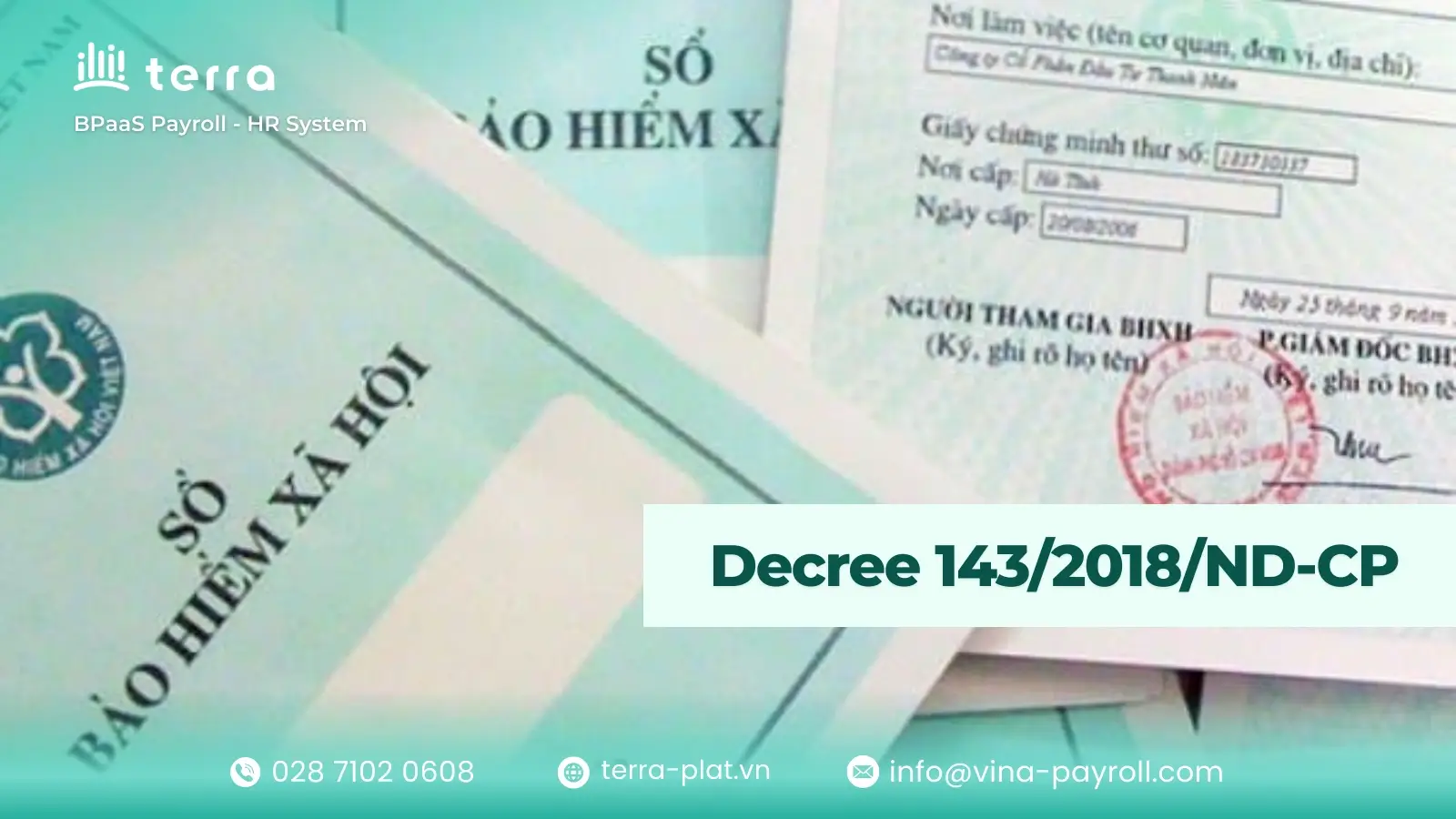
Legal basis. From 1 July 2025 the benefit is governed by the Law on Social Insurance No. 41/2024/QH15 and Decree 158/2025/ND-CP of 25 June 2025, which replaced Decree 143/2018/ND-CP. Eligibility for foreign employees sits in Article 70, Clause 2; the file in Article 78; the processing deadline in Article 79. Forms follow Decision 2222/QD-BHXH of 29 July 2025, which replaced Decision 166/QD-BHXH. Many guides online still cite the old decree, so check the date of anything you read.
Who is eligible for the one-time payment?
Under Article 70, Clause 2 of the Law, a foreign employee who has stopped participating in compulsory Social Insurance can claim the one-time payment on request in any of these cases:
- The labour contract has ended, or the work permit, practising certificate or practising licence has expired and is not renewed (point dd). This is the case that applies to almost every expat leaving a job in Vietnam.
- Reaching retirement age with fewer than 15 years of contributions.
- Meeting the pension conditions but no longer residing in Vietnam.
- Suffering from cancer, polio, decompensated cirrhosis, severe tuberculosis or AIDS, or having a working-capacity reduction of 81% or more.
Two points that are often misunderstood. First, unlike Vietnamese employees, a foreigner does not wait 12 months after leaving the job: you can file as soon as your former employer has closed your Social Insurance book. Second, you do not have to be outside Vietnam to file. The trigger is the end of the contract, not the day you leave the country.
One limit to know before you estimate the amount: contributions by foreign employees only count towards the retirement and survivorship fund from 1 January 2022. Years worked in Vietnam before that date do not add to the one-time payment, however long you were here.
How much will you get: a worked example
The payment is based on your average monthly salary declared for Social Insurance and the number of years that count. For a foreign employee the count starts on 1 January 2022, the date foreigners began contributing to the retirement and survivorship fund. Years worked in Vietnam before that date add nothing to the payout, however long you were here.
- Each year contributed from 1 January 2022: 2 months of the average declared salary. The 2014 date quoted in general guides applies to Vietnamese employees, not to foreign employees.
- Odd months from 1 to 6 count as half a year; from 7 to 11 count as a full year.
- Fewer than 12 months contributed: the payment equals the amount paid into the retirement and survivorship fund, capped at 2 months of the average salary.
The insured salary is capped at 20 times the reference level: VND 46.8 million per month until 30 June 2026 and VND 50.6 million from 1 July 2026, after Decree 161/2026/ND-CP raised the base salary to VND 2.53 million. If your contract salary is higher, the calculation still uses the cap.
The adjustment coefficient. Salaries from earlier years are indexed to today’s money before the average is taken, so a straight multiplication understates the payout. The Social Insurance authority republishes the coefficients every year; for claims settled in 2026 they are set by Official Dispatch 340/BHXH-CSXH of 3 February 2026.
| Contribution year | Coefficient for a 2026 claim | VND 40 million becomes |
| 2022 | 1.11 | 44.4 million |
| 2023 | 1.07 | 42.8 million |
| 2024 | 1.03 | 41.2 million |
| 2025 | 1.00 | 40 million |
| 2026 | 1.00 | 40 million |
The order of operations matters: index each year first, then apply the cap, then take the average. Doing it the other way round produces a number the Social Insurance office will not recognise, and a claim filed on a figure that does not match theirs is one of the reasons files come back.
Example. An engineer insured from 1 March 2023 to 31 May 2026 on a declared salary of VND 40 million has 39 months of contributions, rounded to 3.5 years. The one-time payment is 2 x 40 million x 3.5 = VND 280 million. The same engineer on a contract salary of VND 80 million would be calculated on the capped insured salary, not the contract figure.
Estimate from the salary your employer declared to the Social Insurance authority, not from your gross pay. For many expats the declared figure is lower than the contract salary. Ask HR for your contribution statements, then run your own numbers in the Social Insurance estimator on terra’s service page. The payment is exempt from personal income tax, so the amount decided by the authority is what lands in your account.
Before you leave: the 60-day plan
Every step of an insurance claim for foreigners is faster and cheaper while you are still in Vietnam. If your contract ends in the next two or three months, work backwards from your flight:
- Day 60 to 45. Confirm eligibility and estimate the amount from your contribution statements.
- Day 45 to 30. Ask HR in writing to report your departure and close the Social Insurance book. This is where most files stall, and it is the employer’s job.
- Day 30 to 14. Sign the authorisation letter at a notary in Vietnam if someone will file for you. Signed abroad, the same letter needs consular legalisation and adds two to four weeks. Keep one Vietnamese bank account open.
- Day 14 to 0. File the complete dossier, or hand the folder to your representative on your last working day.
The full fortnight-by-fortnight version, including what to do if your flight is in two weeks, is in terra’s 60-day plan for claiming Social Insurance before leaving Vietnam.
Leaving Vietnam in the next few months? Everything on this page
Two months of insured salary for every year you contributed, and one signature that must happen in Vietnam terra checks your eligibility, works with your former employer to close the book, and files the claim so the money reaches you even after you fly. Published fees: VND 10 million file fee at signing plus 15% of the amount withdrawn, charged only after the payment arrives. Both before VAT.
|
Documents for a foreigner’s one-time Social Insurance claim
Article 78 of the Law keeps the statutory file short: the Social Insurance book and a written request from the employee. In practice the office also wants proof that the contract ended and, where a representative files, the authorisation. Under Decision 2222/QD-BHXH the complete set is:
- Social Insurance book closed by your former employer, or your Social Insurance number if the book is already electronic.
- Claim form, Form 14-HSB.
- Passport: the original when you file in person, a notarised copy with Vietnamese translation when a representative files.
- Proof that the labour contract ended or the work permit expired: the termination decision, the mutual termination agreement or the expired permit.
- Power of attorney (Form 13-HSB) or a notarised authorisation contract if someone else files and collects the money for you.
- Bank account details for the payment.
- For claims on medical grounds only: the medical summary or the assessment of an 81% or higher reduction in working capacity.
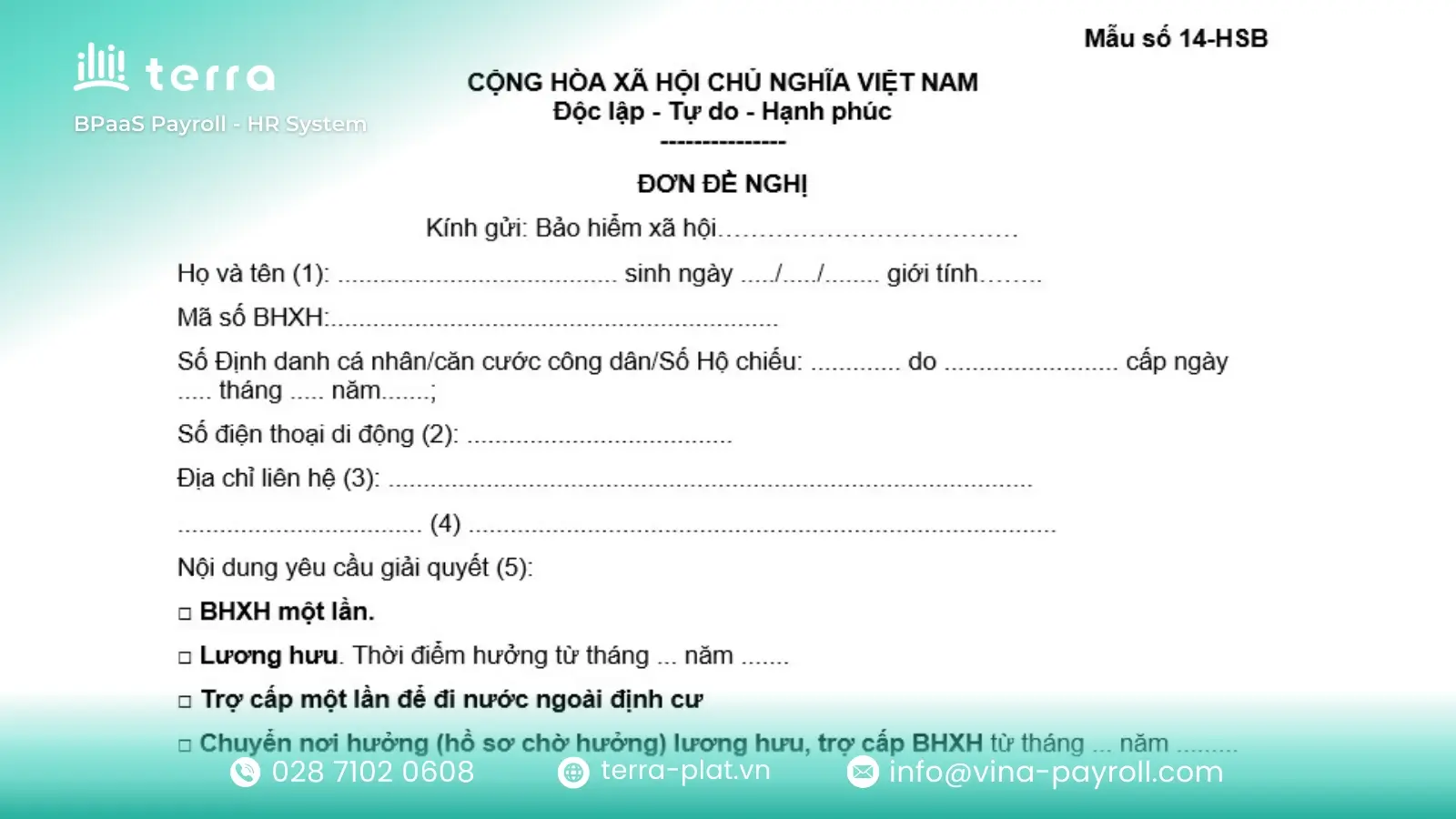
Free download: Form 14-HSB for the one-time Social Insurance claim (with English guidance)
Where to file and how long it takes
A complete file goes to the Social Insurance office of the province where your employer registered you. There are three routes:
- In person at the one-stop counter of the provincial Social Insurance office or the Public Administrative Service Centre.
- By registered post.
- Online through the National Public Service Portal. This route requires a Vietnamese level-2 electronic identity, which most foreign employees do not hold, so in practice the choice is between filing in person and filing through a representative.
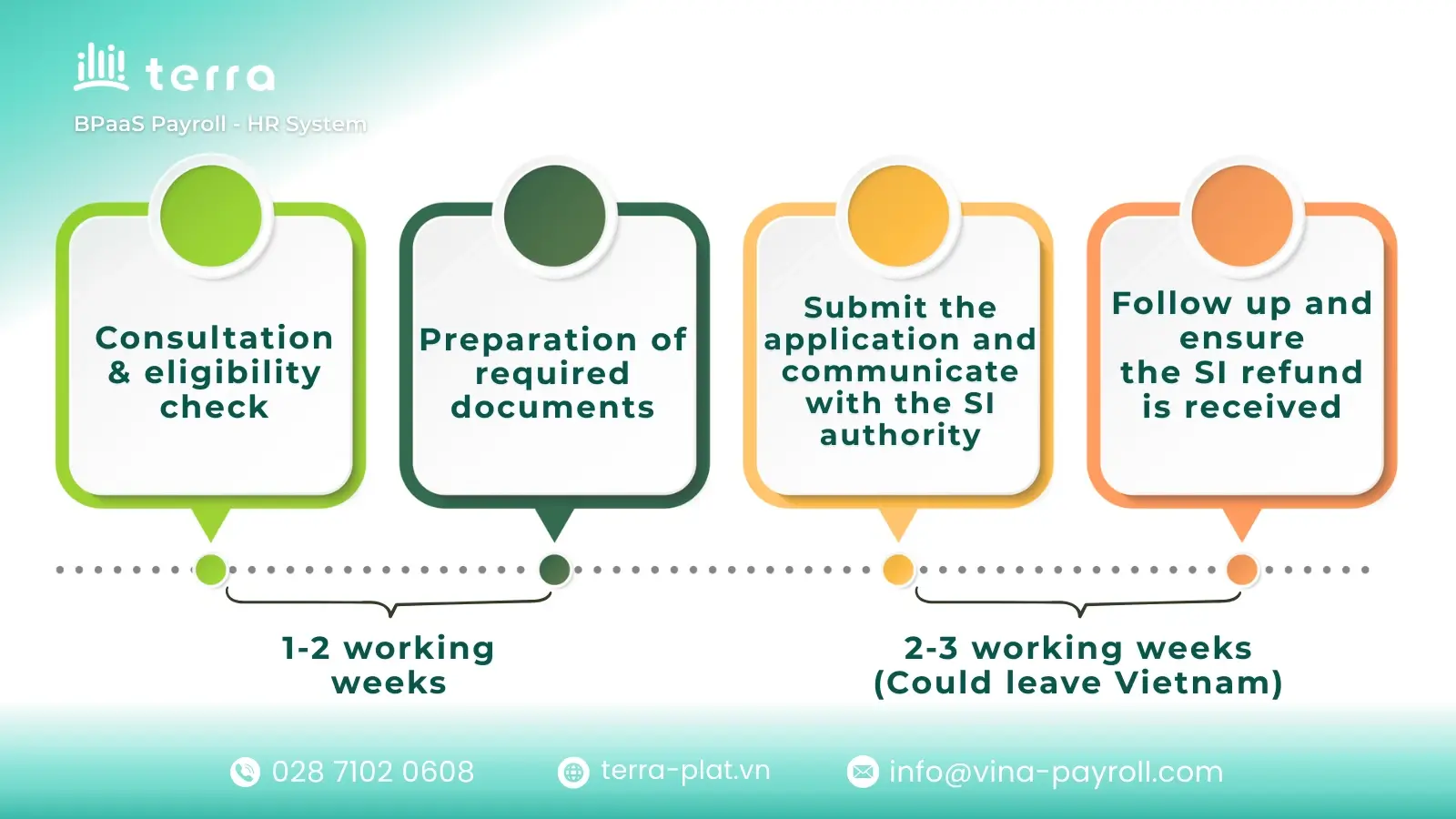
Processing time. Once the file is complete, the Social Insurance authority must decide within 7 working days and must reply in writing with reasons if it refuses (Article 79, Clause 3). The 4 to 6 weeks you will read about, including on terra’s service page, is the end-to-end time from engaging a representative to money in the account. Most of it is spent collecting documents and waiting for the former employer, not waiting for the authority.
terra runs the claim in four steps: eligibility check and estimate; closing the book with the former employer; signing the service contract and the power of attorney; filing, follow-up and payment.
Common difficulties for foreign employees
Three problems account for most of the delays terra sees in insurance claims for foreigners.
The former employer has not closed the book
By law the employer must report your departure and confirm your contribution period when the contract ends. In practice HR teams are slow once you have left the building, and a book that is not closed stops the claim completely. Ask for the closed book and your contribution statements in writing before your last working day, and name the person who will receive them if you have already gone. If the company has been dissolved, the book can still be closed through the Social Insurance office, but that is a separate procedure that adds weeks. For the employer’s side of the same period, see terra’s guide to exit procedures for foreign employees in Vietnam.

Missing proof that the contract ended
The office wants to see that your employment in Vietnam is over: a termination decision, a mutual termination agreement or the expired work permit. Employees who resigned informally, or whose employer never issued a written decision, have to go back and ask for one. Do this while HR still answers your emails.

Language at the Social Insurance office
Forms, notices and follow-up requests are in Vietnamese, and the office may ask for one more document after you have filed. A representative who reads Vietnamese and knows the local office’s habits saves the round trips. Files submitted through a representative are also checked more carefully, because the authority is tightening control over misuse of authorisations, so the authorisation itself must be done properly.

What terra charges
terra’s fee has two parts, both stated in the contract and quoted before VAT:
- A file processing fee of VND 10 million, payable when you sign the contract.
- A service fee of 15% of the one-time Social Insurance amount you receive, charged only after the money has reached your account.
If the claim is refused because you are not eligible, you pay only the file processing fee. On the worked example above, VND 280 million gross leaves about VND 228 million after terra’s fees, before VAT. Doing it yourself costs notary and translation fees, usually under VND 2 million, plus your time at the office; it works well if you will still be in Vietnam when the money arrives and your employer cooperates.
Already left Vietnam?
The claim is still possible. There is no deadline to file after leaving your job, and you can authorise an organisation in Vietnam to act for you. The difference is speed: a power of attorney signed abroad must be legalised at a Vietnamese embassy or consulate and translated, so expect the timeline to roughly double. If you are reading this before your flight, sign the authorisation in Vietnam and skip that step entirely.
terra’s one-time Social Insurance claim service
terra is a member of I-GLOCAL, a Japanese consulting group with more than 20 years of experience supporting foreign-invested companies in Vietnam. The team has completed more than 100 one-time Social Insurance files for foreign employees and knows the working style of each Social Insurance office and the extra documents they commonly request.
- Full handling from eligibility check to payment, including the follow-up with your former employer.
- Support in English, Vietnamese and Japanese throughout the process.
- Files checked before submission to reduce the risk of a returned dossier.
- Progress updates by email, even after you have left Vietnam, until the money is in your account.
- Published fees, with nothing added outside the contract.
Tell us your contract end date, your planned departure and your declared salary. terra will confirm whether you qualify and estimate the amount before you sign anything. See the full one-time Social Insurance claim service for foreigners.
The legal basis, and what older guides still get wrong
Most English language guides to this claim were written before July 2025 and have not been touched since. If a page tells you to file Form 13-HSB, or builds its answer on the 2014 Law on Social Insurance and Decree 143/2018, it is describing a procedure that no longer exists. That is not a small detail: a file built on a superseded form is one of the most common reasons a claim comes back.
| Point | The rule now | What older guides still cite |
| Governing law | Law on Social Insurance 2024, No. 41/2024/QH15, in force from 1 July 2025 | Law on Social Insurance 2014, No. 58/2014/QH13 |
| Rules for foreign employees | Decree 158/2025/ND-CP | Decree 143/2018/ND-CP |
| Claim procedure | Decision 2222/QD-BHXH, amended by Decision 313/QD-BHXH from 1 April 2026 | Decision 166/QD-BHXH |
| Claim form | Form 14-HSB, the version issued with Decision 313/QD-BHXH | Form 14-HSB, the pre-April 2026 version |
| Authorising someone else | An ordinary power of attorney. Form 13-HSB was abolished on 1 April 2026 | Form 13-HSB |
| Correcting your personal details | Form TK1-TS issued under Decision 366/QD-BHXH, applied from 1 May 2026 | An earlier version of Form TK1-TS |
| Years that count for a foreign employee | From 1 January 2022 | From 2014, which is the rule for Vietnamese employees |
| Cap on the insured salary | VND 50.6 million a month from 1 July 2026, after Decree 161/2026/ND-CP | Figures based on an earlier base salary |
Two practical consequences. First, check the date on any guide you follow, including this one, and check the form version before you sign anything. Second, the figures in older articles are not only out of date, they are usually built on the rule for Vietnamese employees, which starts the count in 2014. For a foreign employee the count starts on 1 January 2022, and that single difference changes the payout more than anything else you will read.
Can I claim while my visa is still valid?
Yes. The trigger is the end of your labour contract or the expiry of your work permit without renewal, not your residence status and not your flight date. Filing while you are still in Vietnam is the fastest route, because the authorisation can be notarised locally instead of legalised at a consulate abroad.
What happens if I come back to work in Vietnam after claiming?
You start a new contribution period from zero. The years you were paid out for are not restored, and they do not count towards a future pension. If there is a realistic chance you will return to Vietnam for the long term, that lost history is the real cost of claiming, not the service fee. Nothing has to be repaid, and claiming does not affect a future work permit.
My declared salary is lower than my contract salary. Which one is used?
The declared salary, always. The Social Insurance office calculates from what your employer reported and paid on, capped at 20 times the reference level. For many expats the declared figure sits well below the contract figure, which is why an estimate built from gross pay comes out too high.
I contributed for only eight months. Do I get anything?
Yes. Below 12 months of contributions the payment equals the amount actually paid into the retirement and survivorship fund, capped at 2 months of the average insured salary. It is a smaller figure than the two-months-per-year rule, but it is not zero.
Can the money be paid to a bank account outside Vietnam?
Payment is made to a Vietnamese bank account. Keep an account open until the payment lands, or nominate an authorised representative’s account in the authorisation document. Closing your Vietnamese account before the money arrives is a common and avoidable mistake.
Conclusion
An insurance claim for foreigners in Vietnam comes down to three things: a closed Social Insurance book, proof that the contract ended, and a properly signed authorisation if someone files for you. Under the Law on Social Insurance 2024 the right is clear, the file is short and the authority decides within 7 working days. The time is lost before filing, and almost all of it is saved by starting 60 days before your flight while you are still in Vietnam.
About the author terra Social Insurance team terra is the payroll and HR compliance service of Vina Payroll Outsourcing, a member of I-GLOCAL Group with more than 20 years advising foreign-invested companies in Vietnam. The team has completed more than 100 one-time Social Insurance files for foreign employees and updates this guide whenever the law or the Social Insurance authority’s practice changes. Last reviewed 15 September 2026. |
Request a free consultation
Send your contract end date, your planned departure date and your declared salary. terra replies within one business day with an eligibility assessment and an estimated amount, before anything is signed. You can also send the same details by email to info@vina-payroll.com.









