
Organizational structure defines how responsibilities, authority, and communication flow within a company. For managers, HR teams, and business owners, the right structure supported by terra improves efficiency, agility, and long term growth. If unclear roles, slow decisions, or poor coordination hold your organization back, the right structure can be a turning point.
What is organizational structure?
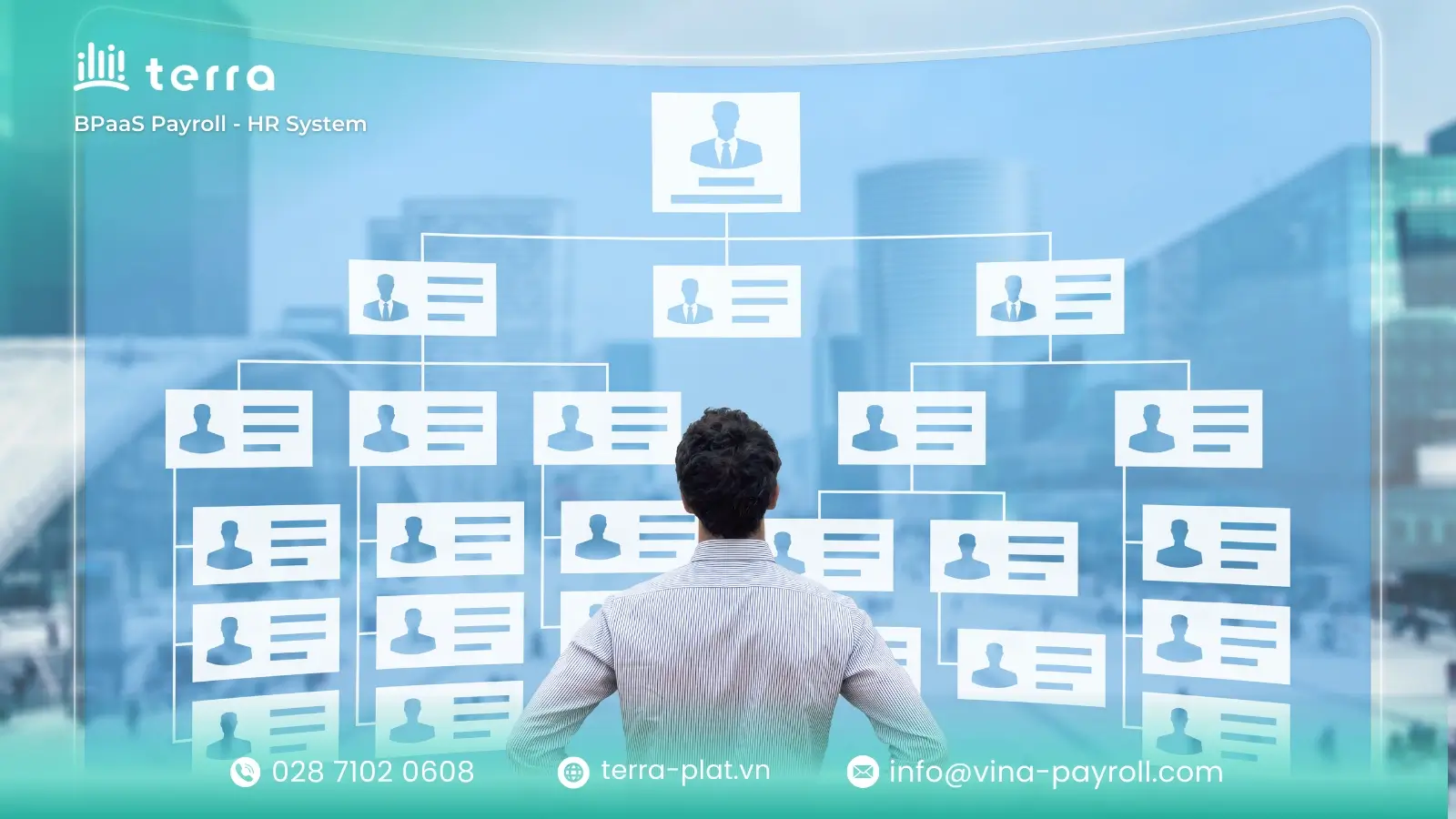
An organizational structure is a system that outlines how certain activities are directed in order to achieve the goals of an organization. These activities can include rules, roles, and responsibilities. It also determines how information flows between levels within the company.
Essentially, the organizational structure of a company acts as the skeleton that supports all business operations, ensuring that every employee knows who to report to and what tasks they are responsible for.
- From a horizontal perspective, the organizational structure specifies how tasks and functions are distributed across different departments or functional areas, such as Finance, Human Resources, Marketing, Sales, Controlling, and Production. This perspective focuses on specialization and division of labor, allowing each function to concentrate on its core expertise while contributing to overall organizational performance.
- From a vertical perspective, the organizational structure emphasizes hierarchical relationships and the distribution of authority within the organization. It defines reporting lines, levels of management, and the way responsibilities are delegated from top management to lower levels.
Example: Under a functional organizational structure, an enterprise organizes its operations into distinct functional units, including Finance, Human Resources, Marketing, and Production. Each unit is overseen by a functional manager who reports to the CEO.

Centralized vs. Decentralized Organizational Structures
The key distinction between these two models lies in how decision-making power is distributed within the organization.

Centralized Structure
In a centralized organizational structure, authority is concentrated at the top of the hierarchy. Strategic decisions are typically made by a single leader or a small group of senior executives, while lower-level employees are expected to follow directives from their superiors. This model creates a clear chain of command and well-defined responsibilities, which helps maintain consistency and control across the organization. However, centralized systems may slow down decision-making, especially in dynamic or rapidly changing environments.
Decentralized Structure
By contrast, a decentralized structure distributes decision-making authority across multiple levels of the organization. Mid-level managers, frontline supervisors, and even regular employees are encouraged to participate in decisions related to their areas of expertise.
This approach increases autonomy, accelerates responses to local conditions, and fosters innovation. In recent years, decentralization has become increasingly popular, particularly among technology startups that prioritize speed, flexibility, and adaptability.
The table below highlights the main differences between centralized and decentralized organizational structures.
| Criteria | Centralized Organizational Structure | Decentralized Organizational Structure |
| Decision-making authority | Decisions are made by top management or a small group of senior executives. | Decision-making power is distributed across multiple organizational levels. |
| Flow of authority | Authority flows strictly from top to bottom through a clear chain of command. | Authority flows more flexibly, allowing autonomy at departmental and team levels. |
| Speed of decision-making | Slower, as decisions must pass through upper management. | Faster, as managers and employees can make decisions locally. |
| Employee involvement | Limited involvement from middle management and frontline employees. | High level of employee participation and empowerment. |
| Organizational control | Strong control and consistency across the organization. | Control is shared; consistency relies on alignment rather than hierarchy. |
| Flexibility and adaptability | Less flexible, suitable for stable environments. | Highly adaptable, ideal for dynamic and fast-changing markets. |
| Innovation potential | Innovation may be constrained by hierarchical approval processes. | Encourages creativity and innovation through shared decision-making. |
| Communication flow | Primarily top-down communication. | Multi-directional communication across teams and levels. |
| Best suited for | Large, traditional organizations; military; highly regulated industries. | Technology firms, startups, diversified corporations, creative industries. |
| Real-world examples | Military organizations, traditional manufacturing firms. | Johnson & Johnson, Spotify, technology startups. |
What are the advantages of organizational structure?
A well-defined organizational structure plays a vital role in shaping how a company operates, grows, and competes in the market.
Improved efficiency and productivity
One of the key advantages of an organizational structure is improved efficiency. When roles and responsibilities are clearly defined duplication of work is minimized and resources are allocated more effectively. Employees can focus on their assigned tasks without overlap which increases productivity and operational effectiveness across the organization.
Clear authority and accountability
A strong organizational structure clarifies authority and accountability at every level. Employees understand their position within the hierarchy who they report to and who has the final decision making authority. This clarity reduces uncertainty, supports faster decision making and strengthens responsibility for outcomes.
Support for organizational growth and scalability
A well designed organizational structure supports sustainable growth. As a company expands it can add new teams, departments or roles in an organized manner without disrupting existing operations. This scalability allows the organization to grow while maintaining control coordination and efficiency.
Enhanced communication and collaboration
Organizational structures establish clear communication pathways within the company. Formal reporting and feedback channels help information flow smoothly between departments and management levels. As a result collaboration improves, silos are reduced and teams are better aligned with organizational priorities.
Stronger strategic alignment
By defining how departments and roles contribute to overall objectives an organizational structure ensures alignment between daily activities and long term strategy. Employees gain a clearer understanding of how their work supports business goals which enhances engagement performance and accountability.
Key elements of organizational structure
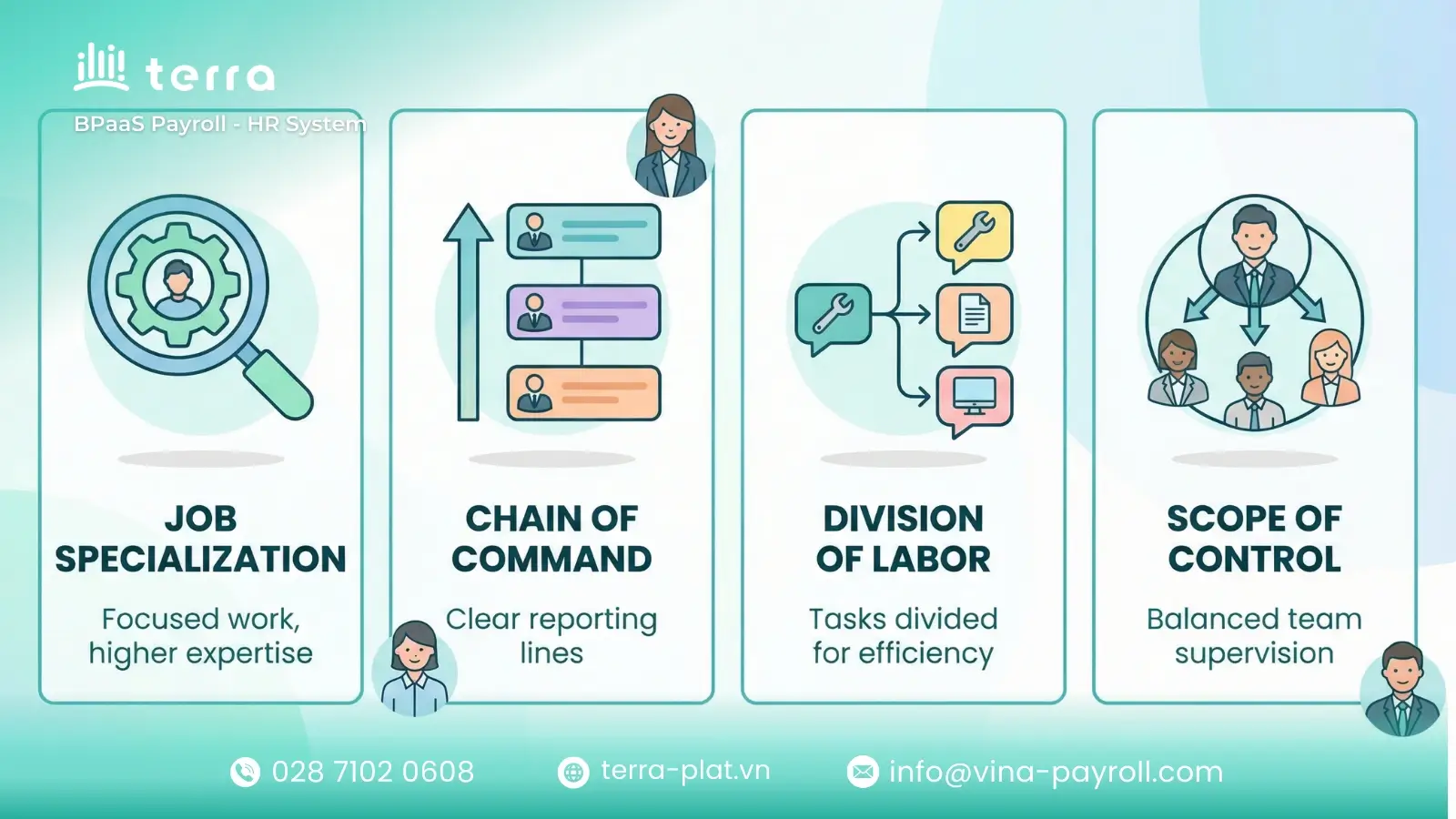
An effective organizational structure is built on several essential aspects that define how work is divided, coordinated and controlled within a company. The four most important aspects include job specialization, line of command division of labor and scope of control.
Job Specialization
Job specialization refers to the practice of breaking down complex organizational tasks into smaller and clearly defined jobs. By focusing on a specific set of responsibilities employees can develop deeper expertise and perform their roles more efficiently. This approach increases productivity and reduces errors especially in large organizations.
For example in a manufacturing company one employee may be responsible only for quality inspection while another focuses on machine operation. In an office environment a human resources team may assign separate specialists for recruitment payroll and employee relations rather than having one person handle all HR functions.
Chain of Command
The line of command also known as the chain of command describes the clear and continuous flow of authority within an organization. It establishes who reports to whom and ensures that employees understand where instructions originate and where accountability lies. A well defined line of command reduces confusion, prevents conflicting instructions and supports disciplined decision making.
For instance in a traditional corporate structure team members report to a team leader who reports to a department manager and ultimately to senior executives. This clarity is especially important in regulated or high risk industries where strict compliance and accountability are required.
Division of Labor
Division of labor involves separating a work process into distinct tasks with each task assigned to a specific individual or group. This aspect of organizational structure is fundamental to modern industrial and service based efficiency. By dividing work into specialized tasks organizations can complete complex processes faster and with greater consistency.
It is important to distinguish this concept from Job Specialization. Division of Labor is the overall allocation of different tasks within a process, while Job Specialization focuses on performing one specific task in depth and repeatedly to achieve higher expertise and productivity.
Span of control
Scope of control sometimes referred to as span of control describes the number of subordinates a manager can effectively supervise. A narrow scope of control allows managers to closely monitor employee performance and provide frequent guidance. A wide scope of control gives employees more autonomy and encourages faster decision making at lower levels.
For example in a startup environment a manager may supervise a larger team and rely on employee independence to maintain speed and flexibility. In contrast, a training intensive environment such as a factory with new workers may require a narrower scope of control to ensure quality and safety standards are met.
Factors influencing organizational structure
The organizational structure of a management system is not chosen randomly. It is shaped by a combination of objective and subjective variables that influence how authority, responsibility and communication are organized within a company. Understanding these variables helps organizations design a structure that supports performance efficiency and long term strategy.
Objective factors
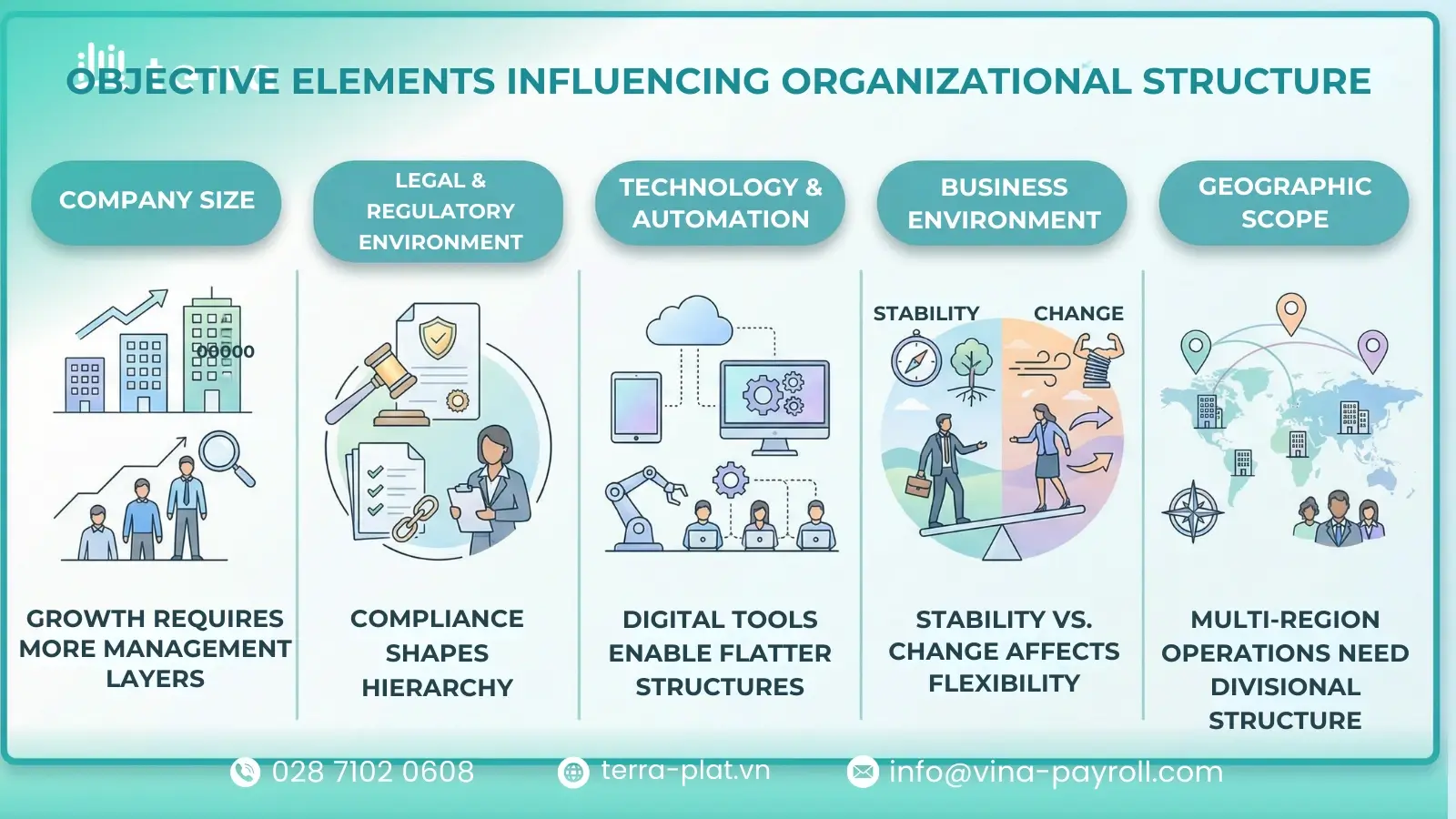
Objective elements originate from the external environment and are largely beyond the direct control of the organization. However, they play a critical role in shaping how the management system is structured.
Company Size
Company size is one of the most influential factors in determining organizational structure. Small businesses often operate with simple flat structures where owners or founders oversee most functions directly. As organizations grow larger they usually require additional management layers to coordinate activities and maintain control. For example a multinational manufacturing company typically adopts a hierarchical structure with multiple management levels to manage operations across regions and departments effectively.
Legal and Regulatory Environment
Government regulations and legal frameworks significantly influence organizational structure. Laws related to corporate governance, labor management, and administrative control require organizations to design management systems that ensure compliance. For instance, public sector organizations and state owned enterprises often have formal and highly regulated hierarchical structures.
Technology and Level of Automation
Advances in technology strongly affect how management systems are organized. Automation, artificial intelligence, and integrated HR management systems reduce the need for manual supervision and reporting. As a result, organizations can operate with fewer management layers and adopt flatter, more flexible structures. For example, companies using digital performance tracking systems can delegate decision making more effectively to teams.
Business Environment
The stability or volatility of the business environment also determines organizational structure. Organizations operating in stable and predictable markets often prefer formal and centralized structures to ensure consistency and control. In contrast, organizations in highly competitive or rapidly changing industries require flexible structures that allow faster decision making and adaptation. For example, financial institutions emphasize structured control, while digital marketing firms adopt flexible project based structures.
Geographic Scope of Operations
The geographic location and scope of business activities influence how organizations design their management systems. Companies operating in multiple regions or countries often adopt divisional or geographic structures to improve coordination and local responsiveness.
Subjective factors
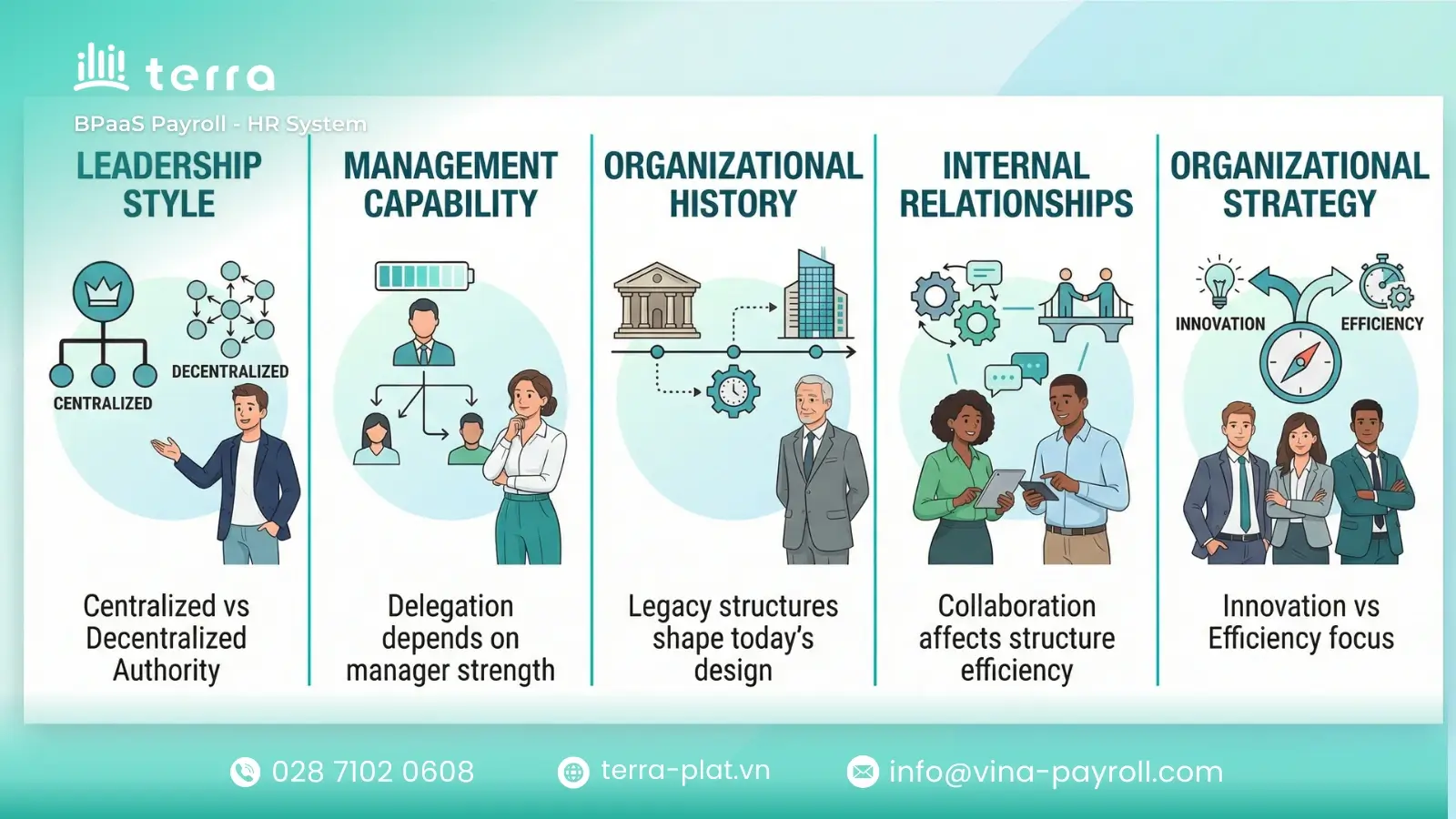
Subjective elements originate within the organization and reflect managerial decisions, internal capabilities, and strategic orientation.
Leadership Style
Leadership style has a direct impact on how authority is distributed. Leaders who value participation and collaboration often prefer decentralized and flat organizational structures that encourage employee involvement. Conversely, leaders with an authoritarian approach tend to favor centralized and hierarchical structures. For example, founder led startups often adopt open and flexible organizational models.
Management Capability
The competence, experience, and skills of managers influence how effectively authority and responsibility can be delegated. Organizations with strong managerial capability can implement decentralized structures successfully, while limited managerial capacity may require more centralized control.
Organizational History
Existing organizational structures often shape current designs. Many organizations inherit elements from previous structures, which can provide stability but may also limit adaptability if the structure is no longer suitable for the current business environment.
Internal Relationships
Relationships among departments, teams, and individuals affect how smoothly an organizational structure functions. Strong collaboration enhances coordination and performance, while internal conflicts can reduce the effectiveness of even well designed management systems.
Organizational Strategy
Organizational strategy is one of the most decisive subjective factors. Companies that prioritize innovation, creativity, and rapid growth often adopt team based or matrix structures. In contrast, organizations focused on cost control, efficiency, and standardization typically rely on functional or hierarchical structures.
Types of organizational structure
Understanding the classification of organizational structures is essential for selecting a management model that aligns with business size strategy and operating environment. Each type of organizational structure offers distinct advantages and limitations and is suited to different types of enterprises.
Divisional organizational structure
A divisional organizational structure divides the company into semi-autonomous units (divisions) based on products, markets, or geographic regions. Each division operates like a mini-company, with its own functional departments such as HR, Finance, Marketing, and Operations.
Instead of all decisions being made at headquarters, decision-making authority is pushed down to divisional leaders, allowing faster responses to market-specific needs.
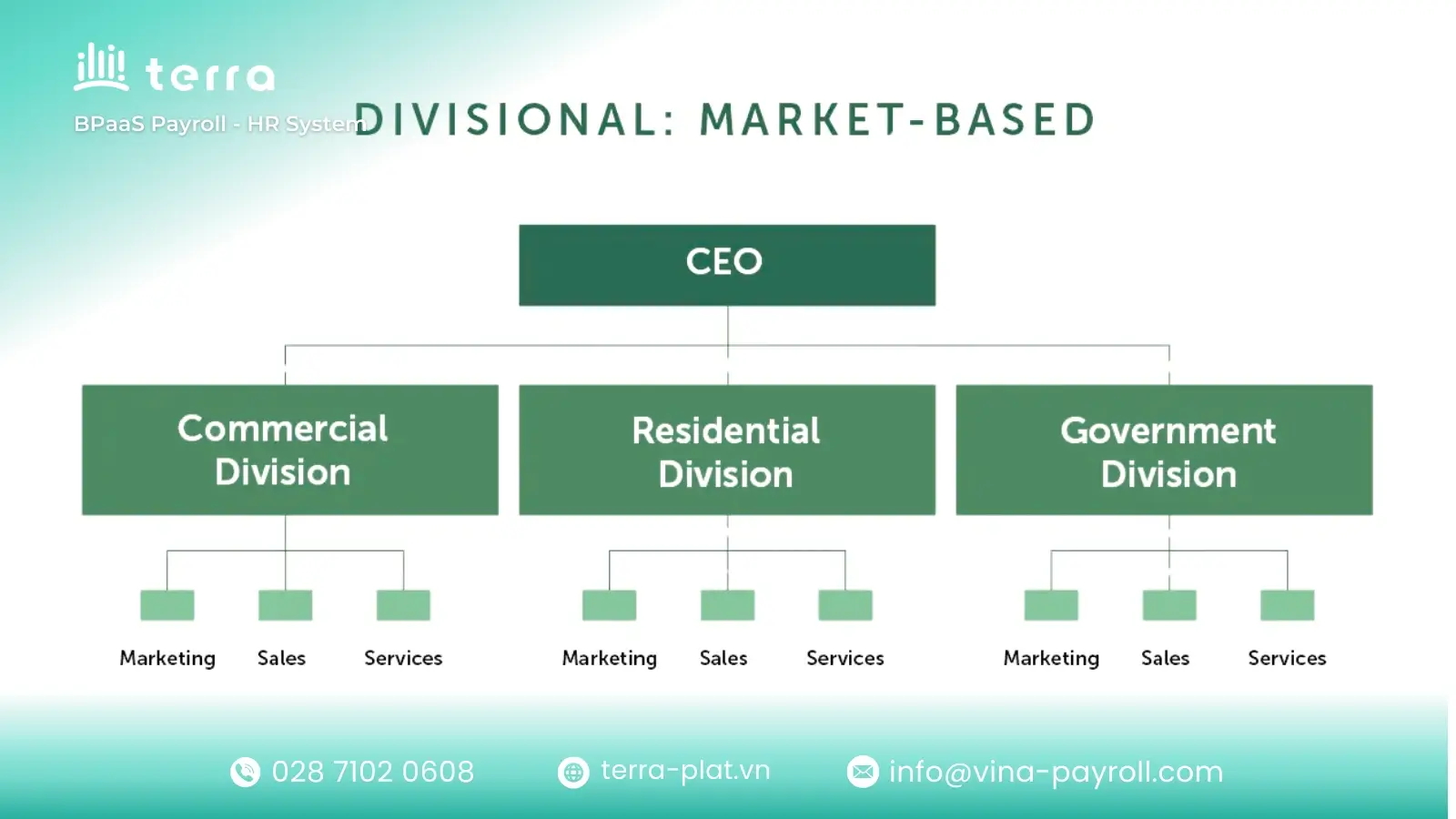
Market-based divisional organizational structure
In this variant, divisions are organized around different customer segments or markets, tailoring products, services, and strategies to meet unique customer needs. For instance, each division might focus on a specific demographic, industry, or buyer type, with dedicated teams handling sales, support, and innovation for that market. This creates specialized expertise but risks isolating divisions from shared company knowledge.
- Best for: Companies serving diverse customer segments with very different needs.
- Pros: High customer satisfaction and specialized expertise for each market.
- Cons: Risk of duplicating activities across divisions, increasing overhead costs.
- Example: A commercial bank with separate divisions for retail banking, corporate banking, and wealth management.
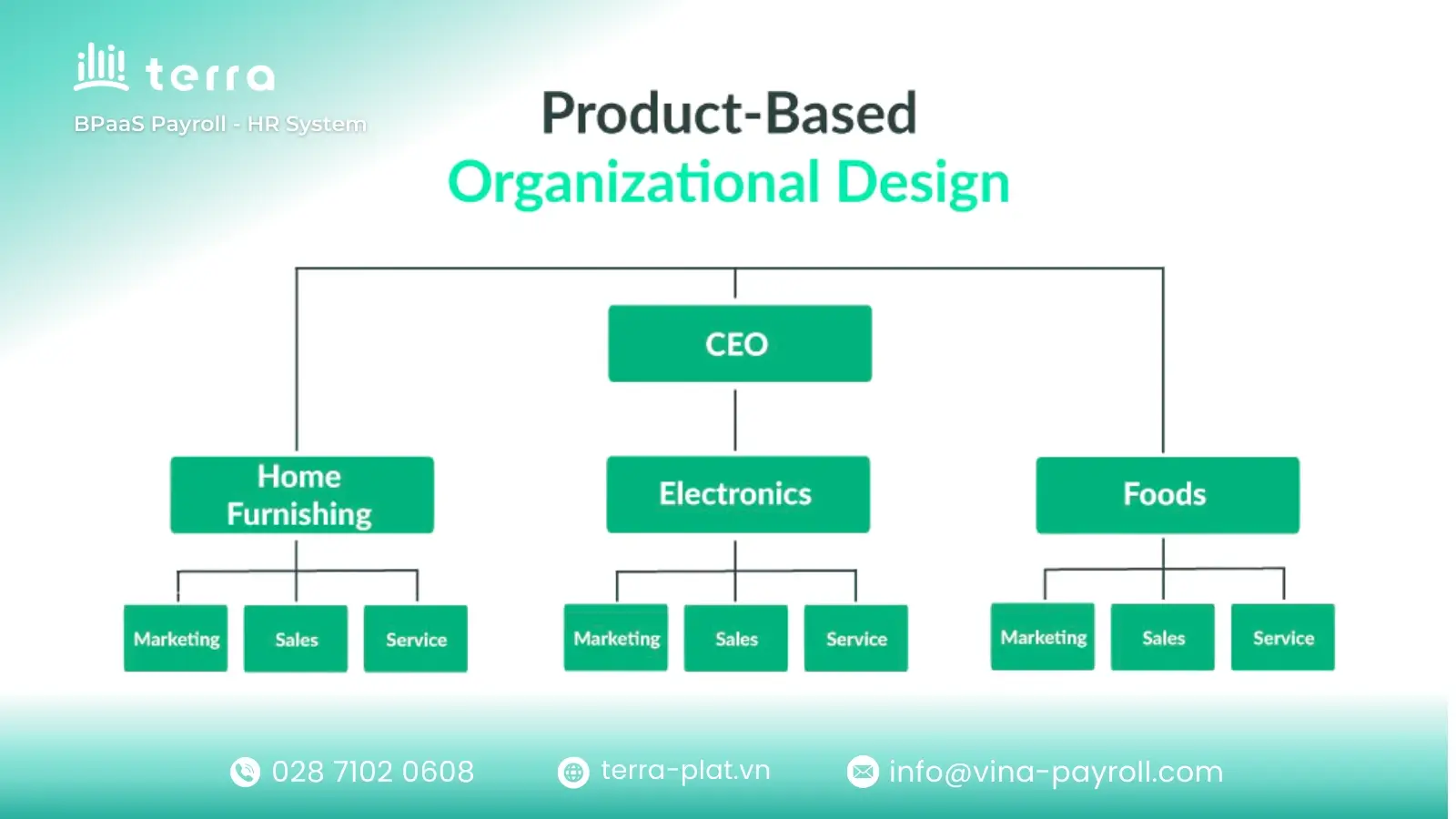
Product-based divisional organizational structure
Divisions are structured around individual product lines or categories. Each division manages the full lifecycle of its products, from development to marketing and sales, allowing focused innovation and quick adaptations to product-specific market changes. This is ideal for companies with varied offerings, but it can create “silos” where divisions compete internally rather than collaborate.
- Best for: Large companies with a wide range of distinct product lines.
- Pros: Speeds up product development cycles and ensures each product gets the attention it deserves.
- Cons: Can lead to “silos” where product teams don’t share knowledge with one another.
- Example: Samsung having separate divisions for smartphones, home appliances, and semiconductors.
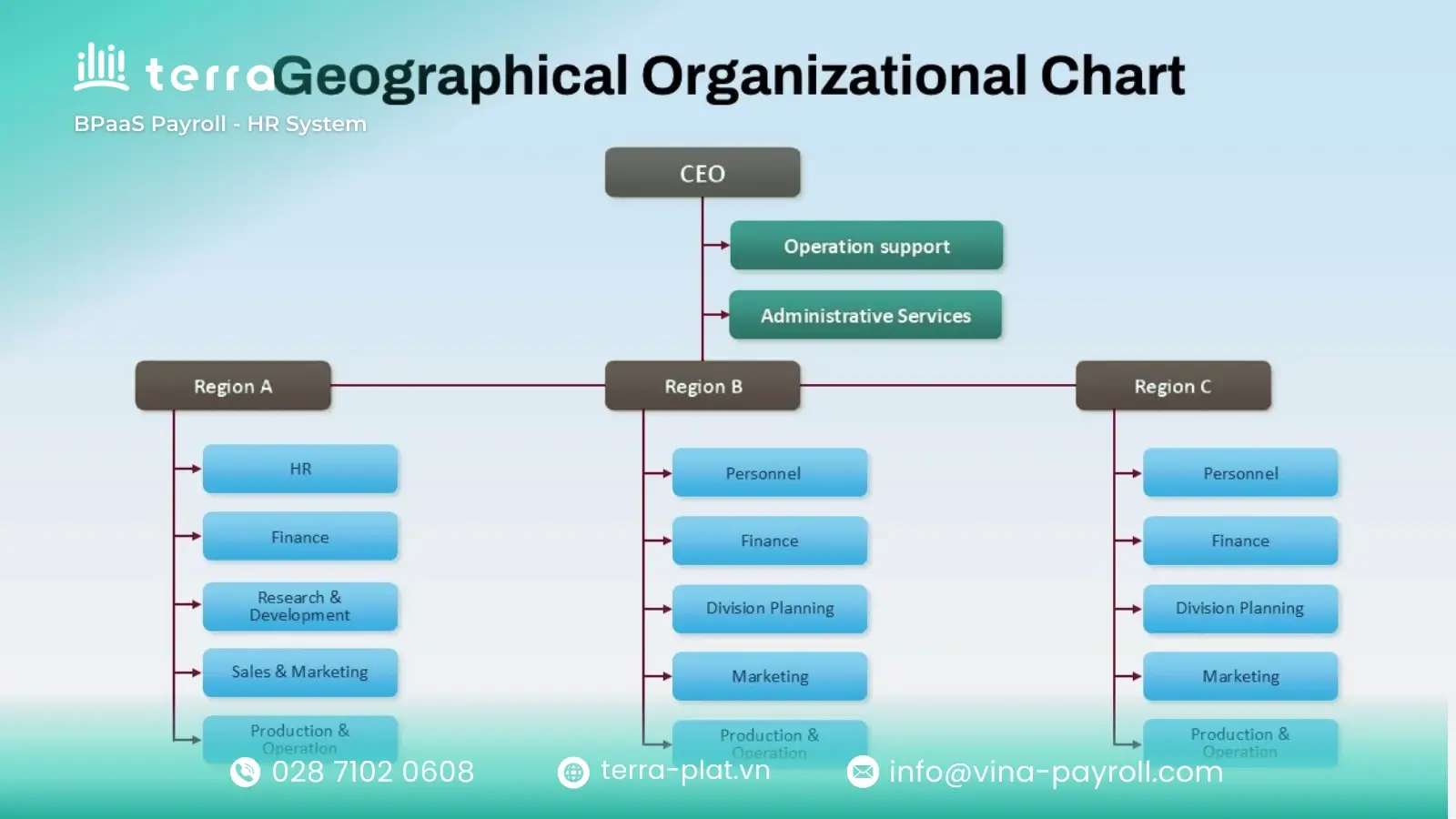
Geographic divisional organization structure
Divisions are based on physical locations or regions, adapting to local laws, cultures, customer preferences, and logistics. Each geographic unit operates semi-independently, with localized decision-making to respond to regional variations, while headquarters oversees global strategy. This enhances local relevance but challenges maintaining a consistent brand identity.
- Best for: Multinational corporations that need to adapt to local cultures, laws, and logistics.
- Pros: Improved response times to local market changes and better regional logistics.
- Cons: Difficult to maintain a unified corporate culture across vastly different regions.
- Example: Coca-Cola organizing its business into units like North America, Latin America, and Asia-Pacific.
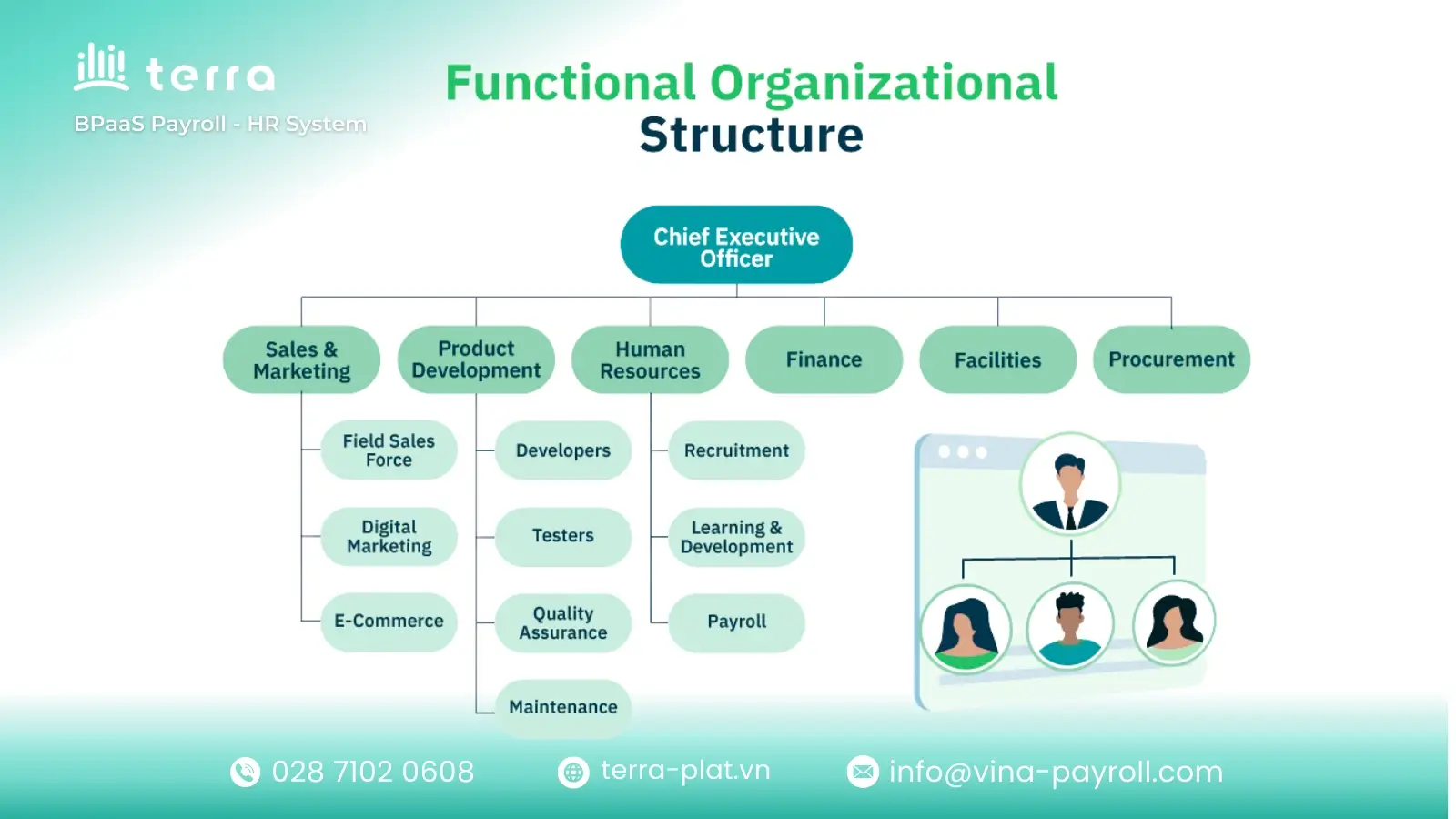
Functional Structure
The functional structure is a traditional, centralized model where employees are grouped by their specialized functions or skills, such as marketing, finance, operations, or HR. Authority flows top-down from the CEO through functional department heads, who oversee all activities in their area. This creates deep expertise within silos but can hinder cross-departmental collaboration. It’s straightforward and efficient for standardized operations, with clear hierarchies and specialized roles.
- Best for: Small to medium businesses or companies with a single core product.
- Pros: High level of operational efficiency and deep expertise within departments.
- Cons: “Silo” effect where departments (like Marketing and Engineering) fail to communicate effectively.
- Example: A manufacturing firm with separate departments for Production, Quality Control, and Finance.
Matrix Structure
The matrix structure is a hybrid model combining functional and project-based elements, where employees report to two managers: a functional head (for skills and career development) and a project/product manager (for specific initiatives). This creates a grid-like setup, fostering collaboration across functions but potentially causing conflicts over priorities. It’s dynamic, with resources allocated flexibly to projects, making it suitable for environments needing innovation and adaptability.
This is a Hybrid model where employees have dual reporting relationships – usually to both a functional manager and a project/product manager.
- Best for: Complex projects that require cross-departmental collaboration.
- Pros: Highly flexible and maximizes the use of skilled employees across various projects.
- Cons: Can cause confusion and power struggles due to the “two bosses” problem.
- Example: An aerospace company where an engineer reports to the Head of Engineering but also to a specific NASA project lead.

Project-Based Structure
In a project-based structure, the organization revolves around temporary teams formed for specific projects, with a hybrid/decentralized approach. Teams are assembled with cross-functional members, and once the project ends, members are reassigned. This emphasizes goal-oriented work and adaptability, but it lacks long-term stability. Authority is delegated to project managers, promoting innovation but requiring strong project management tools.
- Best for: Professional service firms like consulting or construction.
- Pros: Extreme focus on project goals and high adaptability.
- Cons: Lack of job security for employees once a project ends and less focus on long-term functional development.
- Example: A film production company that hires a crew specifically for one movie

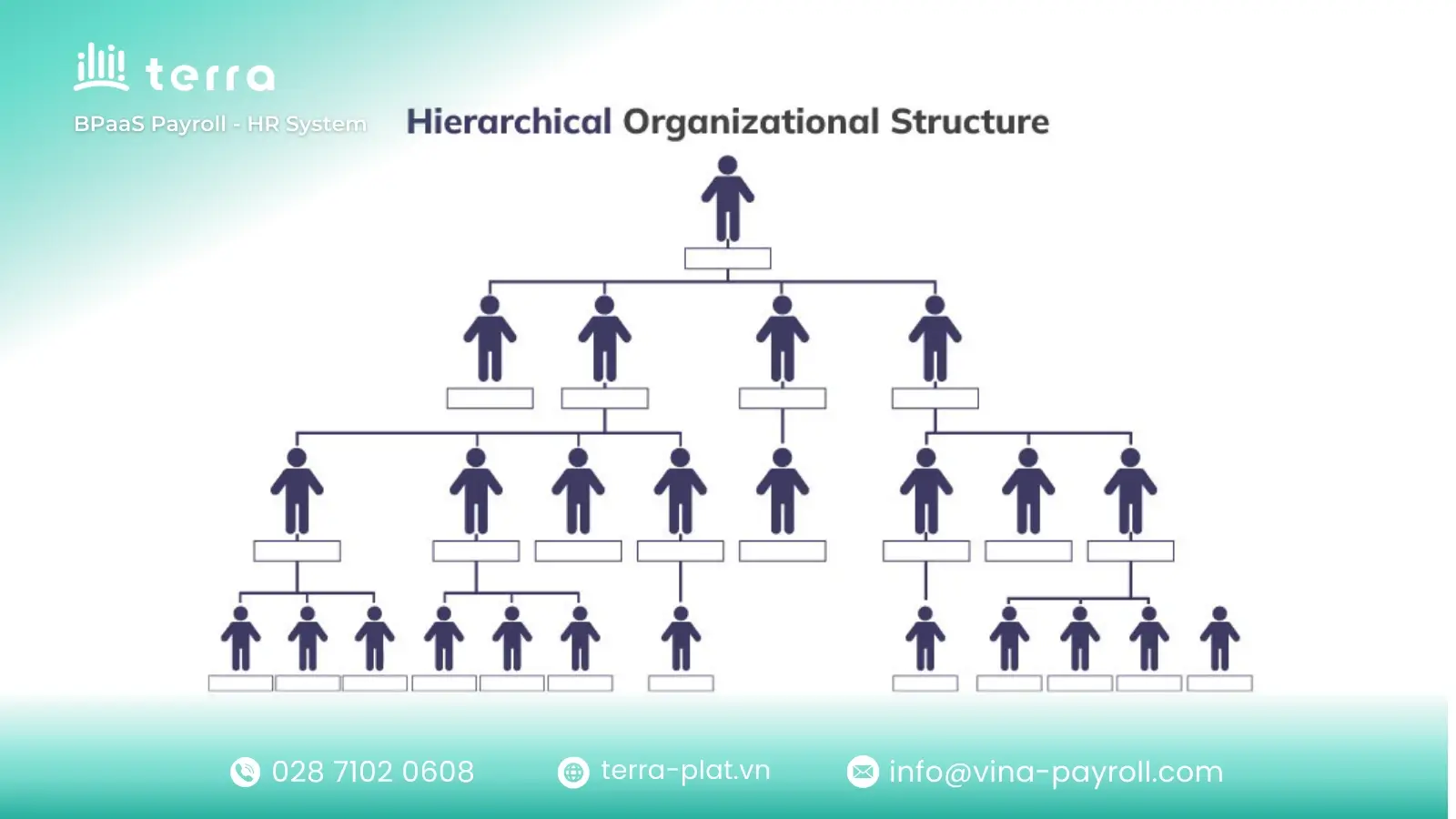
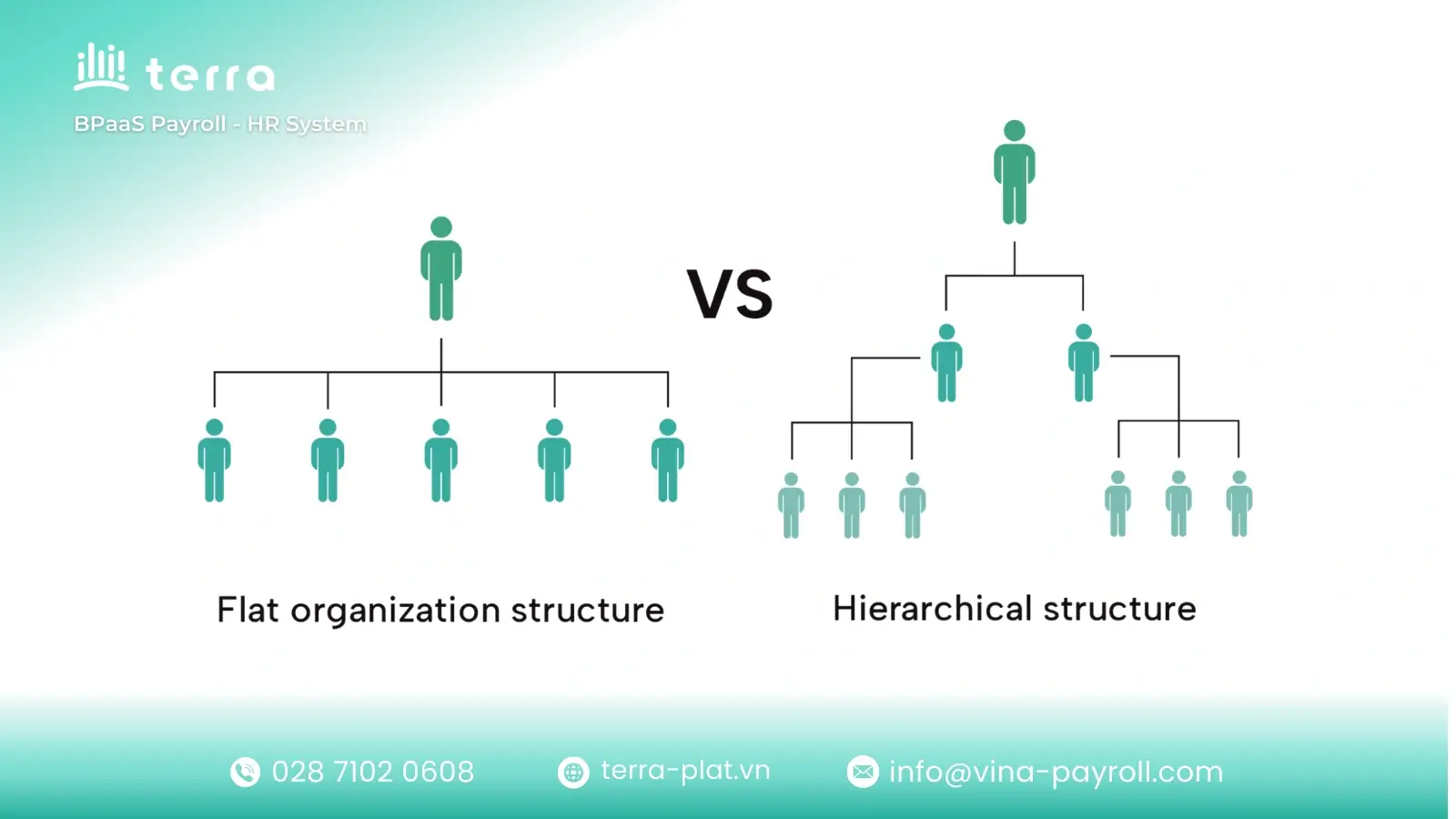
Hierarchical Structure
The hierarchical structure is a classic, centralized pyramid model with multiple layers of management, where each employee has one supervisor, culminating at the CEO. Information and decisions flow downward, ensuring clear authority and accountability. It’s rigid, with defined roles and promotion paths, but can be bureaucratic. This suits stable environments needing control.
- Best for: Large, stable organizations or government agencies.
- Pros: Clear lines of authority and a well-defined career path.
- Cons: Slow decision-making and can stifle innovation due to many layers of approval.
- Example: A traditional military organization or a long-standing government department.
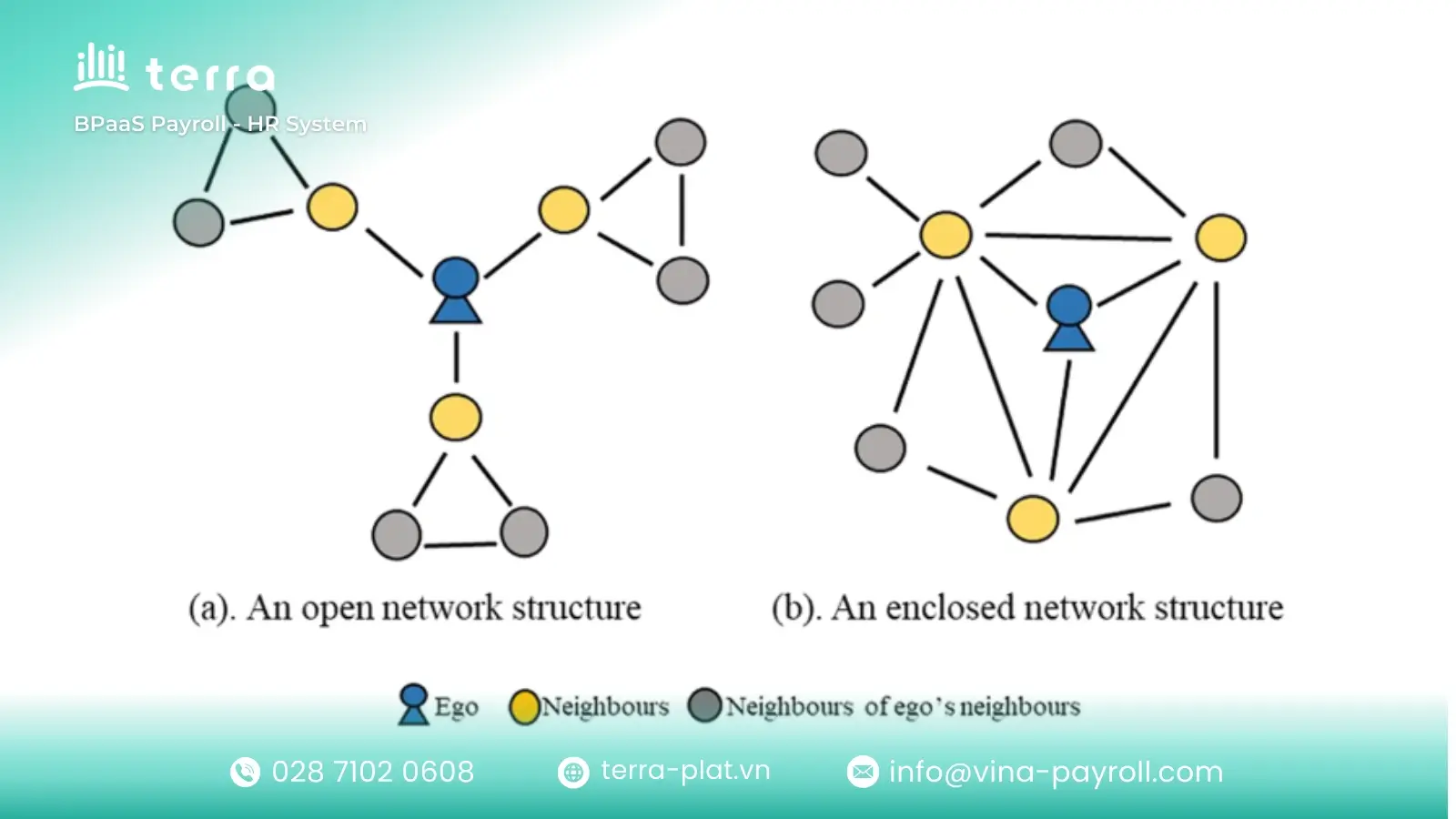
Network Structure
A network structure is decentralized, with a central core (e.g., headquarters) connected to external partners, vendors, freelancers, and suppliers forming a web-like ecosystem. The core focuses on strategy and coordination, outsourcing non-essential functions. This lean model relies on contracts and collaborations, offering scalability but depending on reliable partners.
- Best for: Businesses that want to stay lean and outsource non-core activities.
- Pros: Highly cost-effective and allows the company to focus on its core strengths.
- Cons: Less control over the quality and timing of external partners.
- Example: A clothing brand that handles design in-house but outsources manufacturing to factories in Asia and logistics to a third-party provider.
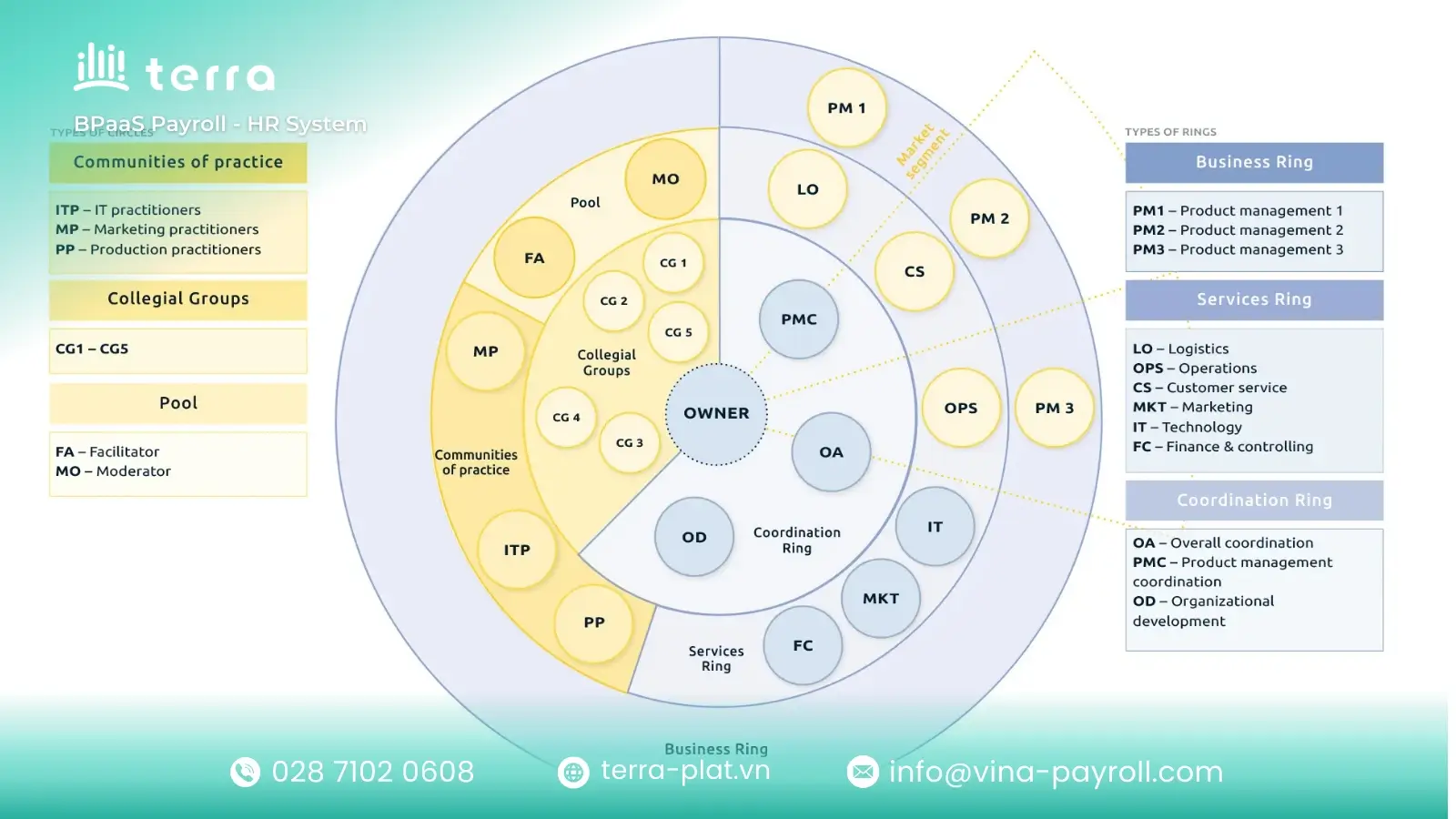
Circular Structure
The circular structure is a hybrid model placing leadership (e.g., CEO) at the center, with influence radiating outward in concentric circles of teams and employees. It emphasizes collaboration, shared vision, and equality, breaking traditional hierarchies. Decision-making is distributed, with leaders as facilitators, fostering unity but potentially confusing for those used to linear reporting.
- Best for: Companies that want to emphasize a sense of unity and shared vision.
- Pros: Promotes a feeling of equality and breaks down the “us vs. them” management mentality.
- Cons: Can be confusing for new employees who are used to traditional top-down reporting.
- Example: A well known real world example is W. L. Gore & Associates, the company behind Gore-Tex. Gore operates with a lattice style organization where leaders act as facilitators rather than bosses, and influence spreads outward through collaboration rather than formal authority.
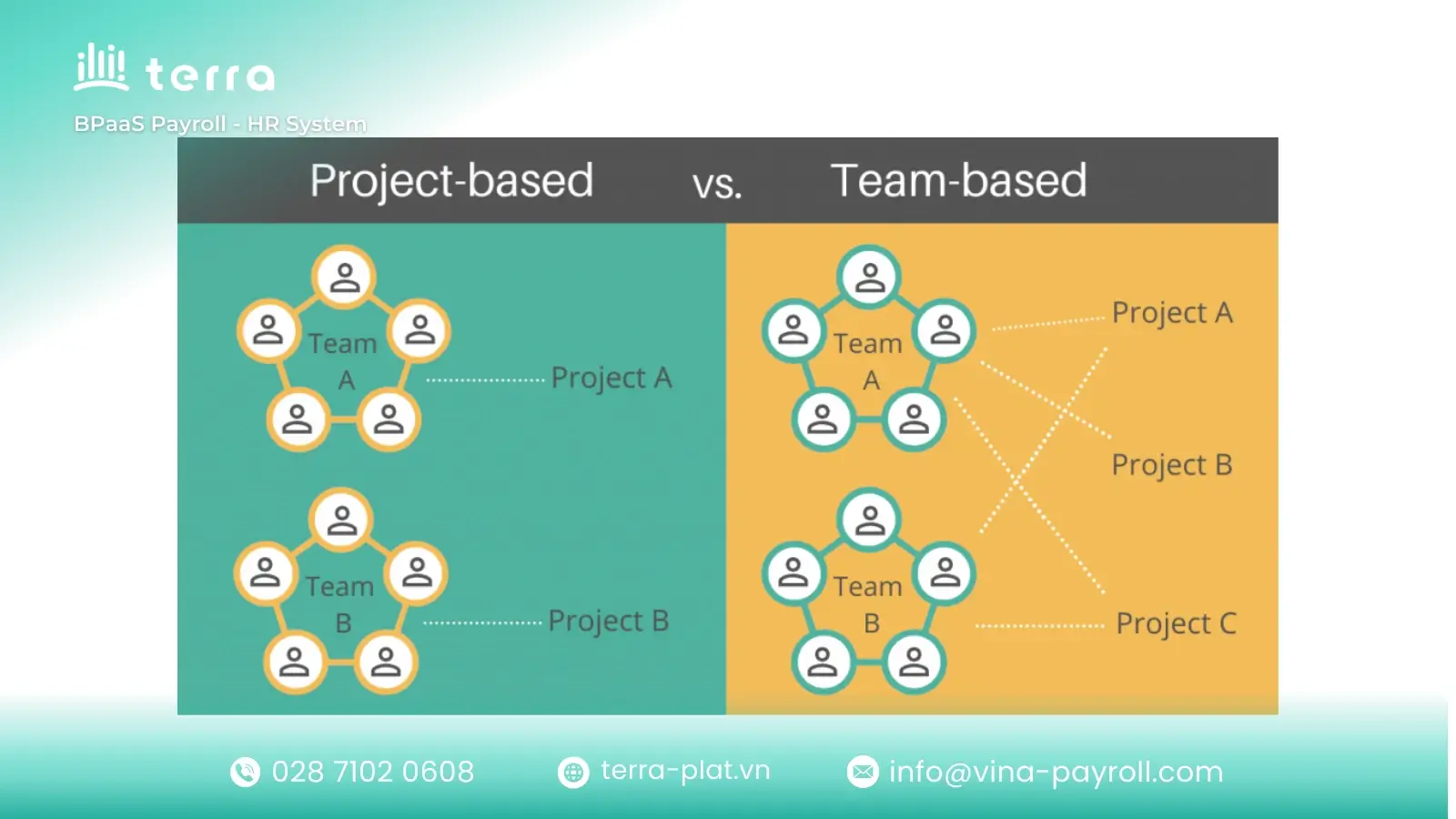
Team-Based Structure
A team-based structure is decentralized, organizing the company into self-managing teams or cross-functional groups working toward common goals. Teams have autonomy, often using agile methods, with minimal hierarchy. This promotes empowerment and quick responses but requires alignment to avoid inconsistencies.
- Best for: Tech companies and organizations using “Agile” methodologies.
- Pros: High employee morale, rapid problem-solving, and great flexibility.
- Cons: Requires high levels of trust and may lead to inconsistent results if teams aren’t aligned.
- Example: Software companies like Spotify, which organize their staff into “squads” and “tribes.”
Flat Structure
Also known as horizontal, the flat structure is decentralized with few or no middle management layers, where most employees report directly to top executives. This encourages open communication, quick decisions, and empowerment but can overwhelm leaders as the company scales. It’s simple and egalitarian, ideal for dynamic settings.
- Best for: Startups and small businesses in the early stages of growth.
- Pros: Fast decision-making and high levels of employee empowerment.
- Cons: Can become chaotic as the company grows, as one manager may end up with too many direct reports.
- Example: A 15-person tech startup where everyone communicates directly with the founder.
| Organizational Structure | Advantages | Disadvantages | Suitable Business Models | Practical Example |
| Functional Structure | High efficiency due to specialization Clear career paths Strong control and standardization | Slow decision making Poor cross department communication Low flexibility | Small to medium sized companies Stable industries Cost focused organizations | A manufacturing company with separate departments for production finance and HR |
| Divisional Structure | High accountability Faster decision making within divisions Better market focus | Higher operating costs Duplication of resources Risk of internal competition | Large enterprises Multiple products or markets | A global consumer goods company with divisions for food personal care and home products |
| Matrix Structure | Efficient resource sharing Encourages collaboration High adaptability | Role conflict Confusion in authority Increased management complexity | Project driven organizations Consulting firms Technology companies | An IT company where engineers report to both technical heads and project leaders |
| Project Based Structure | High flexibility Strong focus on results Encourages innovation | Job insecurity Knowledge loss after project ends Limited long term development | Construction firms Creative agencies R and D organizations | A construction company forming teams for each infrastructure project |
| Hierarchical Structure | Strong control Clear reporting lines Suitable for compliance heavy environments | Bureaucracy Slow response to change Limited innovation | Government organizations Traditional corporations | A government agency with strict reporting and approval processes |
| Network Structure | Cost efficiency High scalability Access to global talent | Dependency on partners Less control over quality Security risks | Digital companies Startups Platform based businesses | A software company outsourcing customer support and design to external vendors |
| Circular Structure | Encourages collaboration Improves transparency Reduces power distance | Unclear authority Difficult performance evaluation | Knowledge driven organizations Culture focused companies | A creative firm where leadership vision guides autonomous teams |
| Team Based Structure | High engagement Fast decision making Strong ownership | Requires mature employees Risk of role ambiguity Coordination challenges | Agile startups Innovative companies | A startup operating with autonomous product squads |
| Flat Structure | Fast communication High employee empowerment Low bureaucracy | Overloaded leaders Limited scalability Role confusion | Small startups Early stage companies | A startup where founders work directly with all employees |
How to choose the right organizational structure
Selecting from the various organizational structure types is a strategic decision that shapes your company’s future.
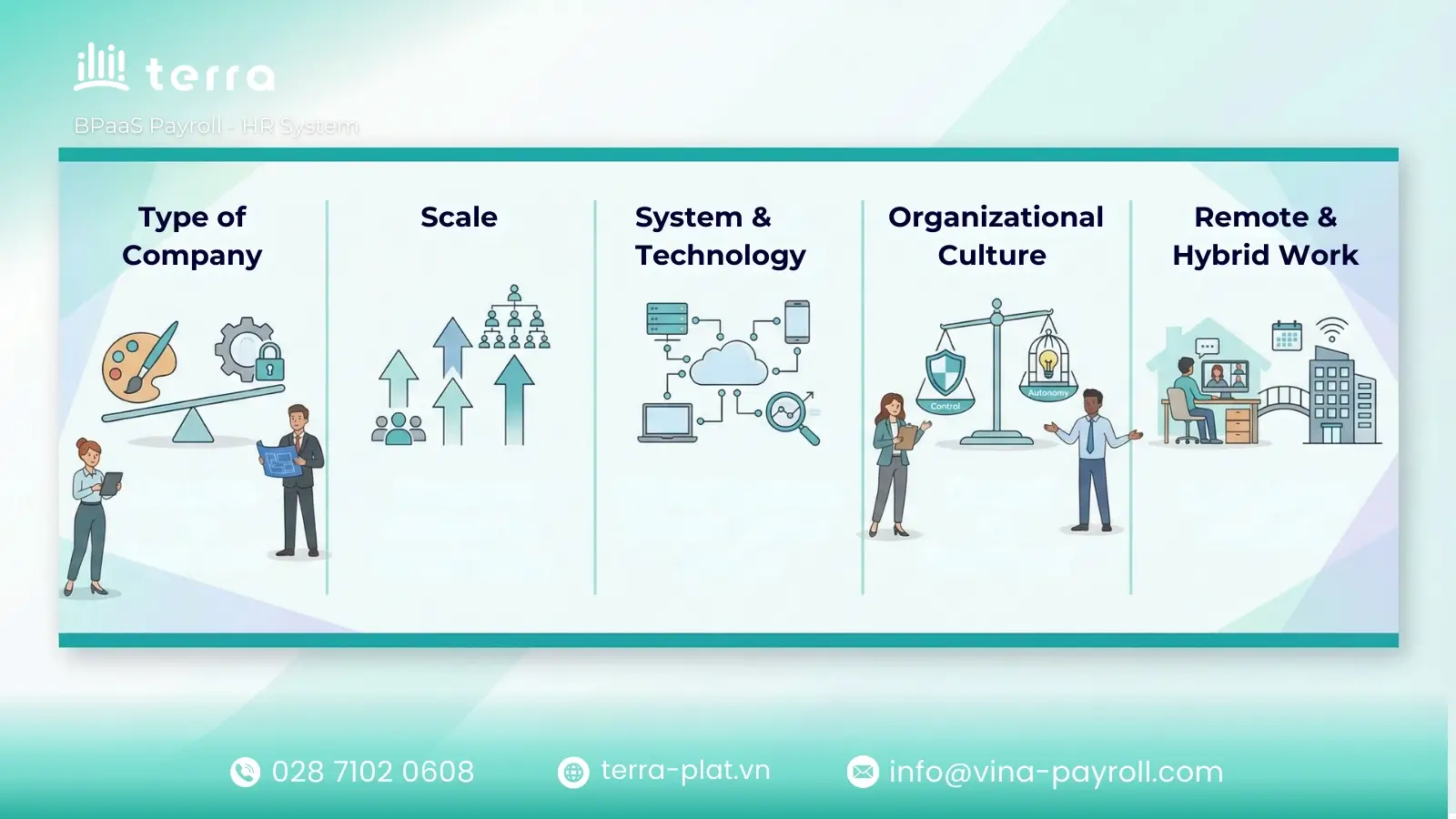
Type of company
The nature of your work dictates the structure. A creative agency needs the flexibility of a Matrix or Flat structure, while a pharmaceutical company requires the strict controls of a Functional or Hierarchical model for safety and compliance.
Scale
Scale is the biggest driver of structural change. A 5-person team thrives in a Flat structure. However, once you reach 50 or 500 people, you will likely need to transition to a Functional or Divisional model to maintain order and clarity.
System
The systems and technologies used within an organization directly impact how work is coordinated and managed. Advanced information systems automation tools and integrated HR platforms enable real time data sharing and reduce the need for hierarchical supervision. Organizations with mature digital systems can support decentralized decision making and flatter structures.
Your internal workflows and technological capabilities matter. If you use a terra hr management system, you can handle more complex models like the Matrix structure because the software manages the complicated reporting lines and payroll automatically.
Organizational culture
Organizational culture defines how employees interact, how decisions are made and how authority is perceived.
A culture of “command and control” is better suited for Centralized models like the Hierarchical Structure. If your culture values autonomy and “radical transparency,” a Team-Based or Circular structure will be more effective.
Post-COVID remote and hybrid work is a clear example. As teams became distributed across locations, many companies reduced management layers and adopted flatter structures to enable faster communication and empower employees to make decisions without constant approvals.
Key considerations when designing an organizational structure
Creating the right organizational structure of a company is not a one-size-fits-all task. It requires balancing several strategic pillars to ensure the business remains agile and focused.
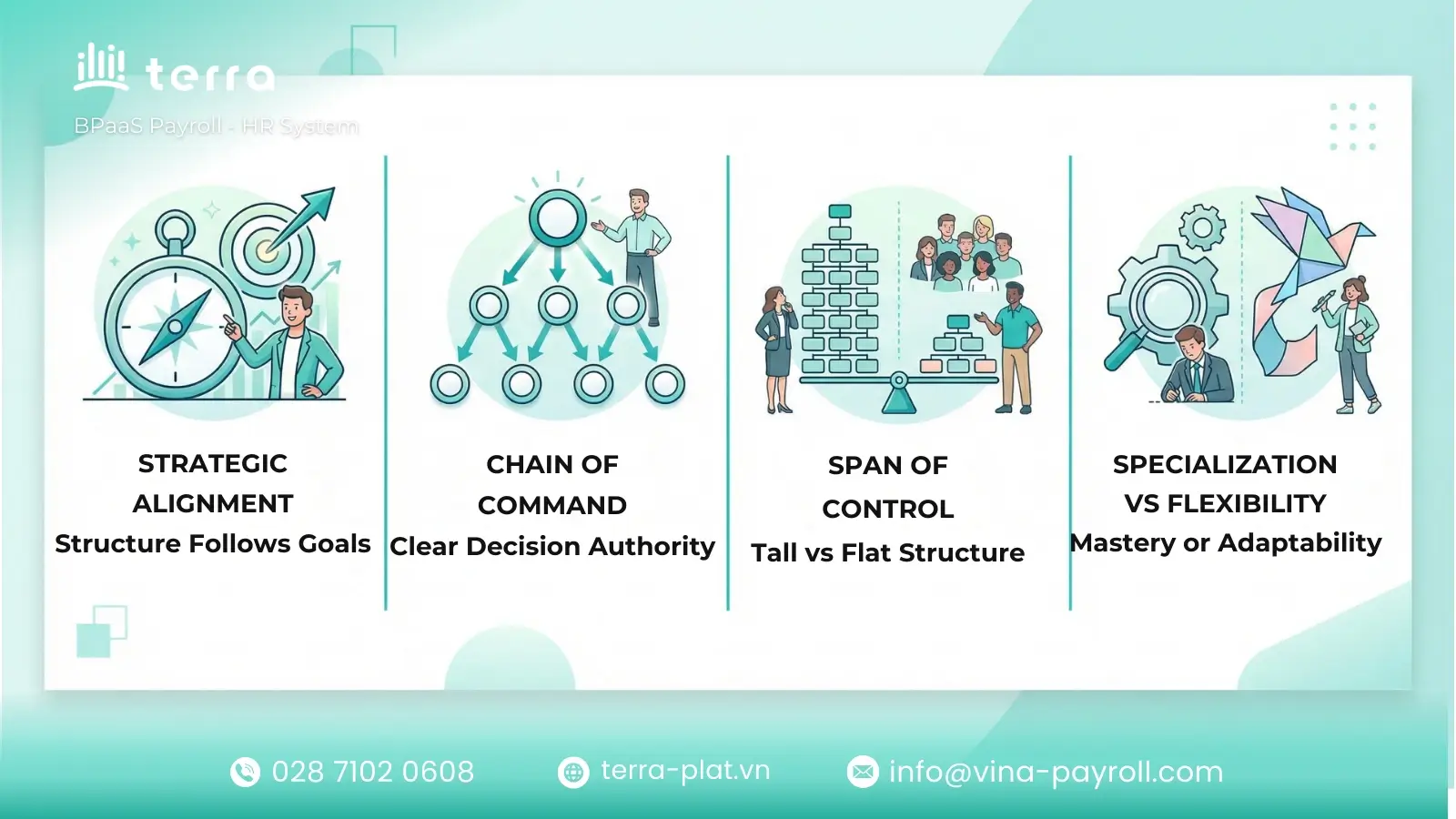
Strategic Alignment and Business Goals
The most important factor is your corporate strategy. Your structure must be a direct reflection of what you want to achieve. For instance, if your goal is rapid innovation in the tech sector, a rigid hierarchical model will likely fail. Instead, a more fluid type of organizational structure like a Matrix or Team-Based model would be more appropriate.
Defining the Chain of Command
You must clearly establish who has the authority to make decisions. This involves determining the “Chain of Command” to avoid confusion. In a centralized model, the authority stays at the top, whereas in a decentralized model, it is pushed down to department heads. Without a clear chain, employees may receive conflicting instructions, leading to a drop in productivity.
Determining the Span of Control
This factor refers to how many subordinates a single manager can effectively oversee. A narrow span of control leads to a “tall” organizational structure with many layers of management, which is common in high stakes industries like aerospace. A wide span of control creates a “flat” structure, encouraging employee autonomy and faster communication.
Specialization vs. Generalization
Leaders must decide how specialized each role should be. High specialization (Job Specialization) works well in manufacturing where repetition leads to mastery. However, in creative industries, “Role Flexibility” might be more valuable to allow employees to contribute across different areas of a project.
How to design an organizational structure chart effectively
Once the conceptual factors are addressed, the focus shifts to the practical design of the organizational chart. This visual tool is essential for transparency and operational flow.
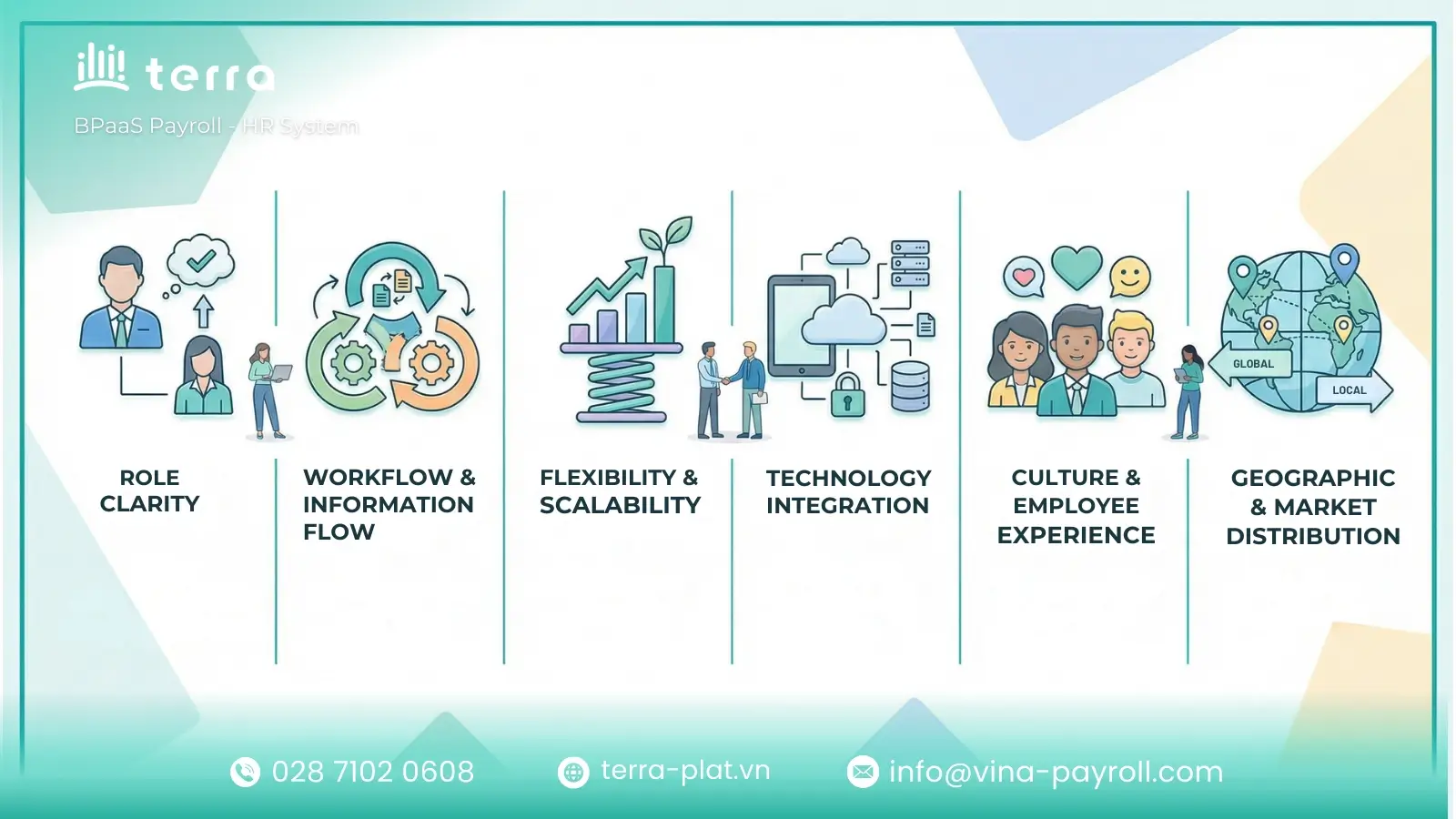
Clarity of Roles and Responsibilities
Each role in the organizational chart should have clearly defined responsibilities to avoid overlap and confusion. Employees must understand who they report to and who has decision making authority.
For example in a functional structure the chart should clearly separate departments such as marketing finance and operations with defined leadership roles for each function.
Workflow and Information Flow
A chart should not just show who is the boss; it should show how information moves. Consider the “Horizontal Perspective” where different departments like Marketing and Sales need to collaborate. If the organizational structure types you are considering create “silos” that block information, your chart will become a barrier rather than a bridge.
Flexibility and Scalability
Your chart should be a living document. Consider whether the structure can handle a 20% increase in headcount over the next year. A product based divisional structure is often highly scalable because you can simply add a new “product wing” without disrupting the existing ones.
Technology Integration
Modern organizations do not run on paper. When deciding on a structure, consider how your internal systems will support it. A software solution can automate the reporting lines and performance tracking, making it easier to manage complex types of organizational structure like a Matrix or Network model. Digital tools ensure that the “Chart” reflects the real time reality of the company.
Corporate Culture and Employee Experience
The structure must fit the “vibe” of the workplace. A company that prides itself on “Radical Candor” and transparency will struggle within a strict Hierarchical Structure. For such a culture, a Circular or Flat structure is often a better fit as it minimizes the perceived distance between the CEO and the frontline staff.
Geographic and Market Distribution
If your company operates in multiple countries, your chart must account for time zones and local regulations. A modern platform helps manage these complexities by providing a centralized hub for data while allowing for regional variations in the organizational structure of a company.
Example: Imagine a global retail brand. They might choose a Geographic Divisional Structure to ensure that the marketing team in Vietnam can react quickly to local holidays like Tet, while the headquarters in the US maintains control over the core brand identity. This hybrid approach ensures both local agility and global consistency.
Steps to build a successful organizational structure
Successful restructuring requires a balance between strategic vision and tactical execution. Below are the critical stages every leader should navigate.
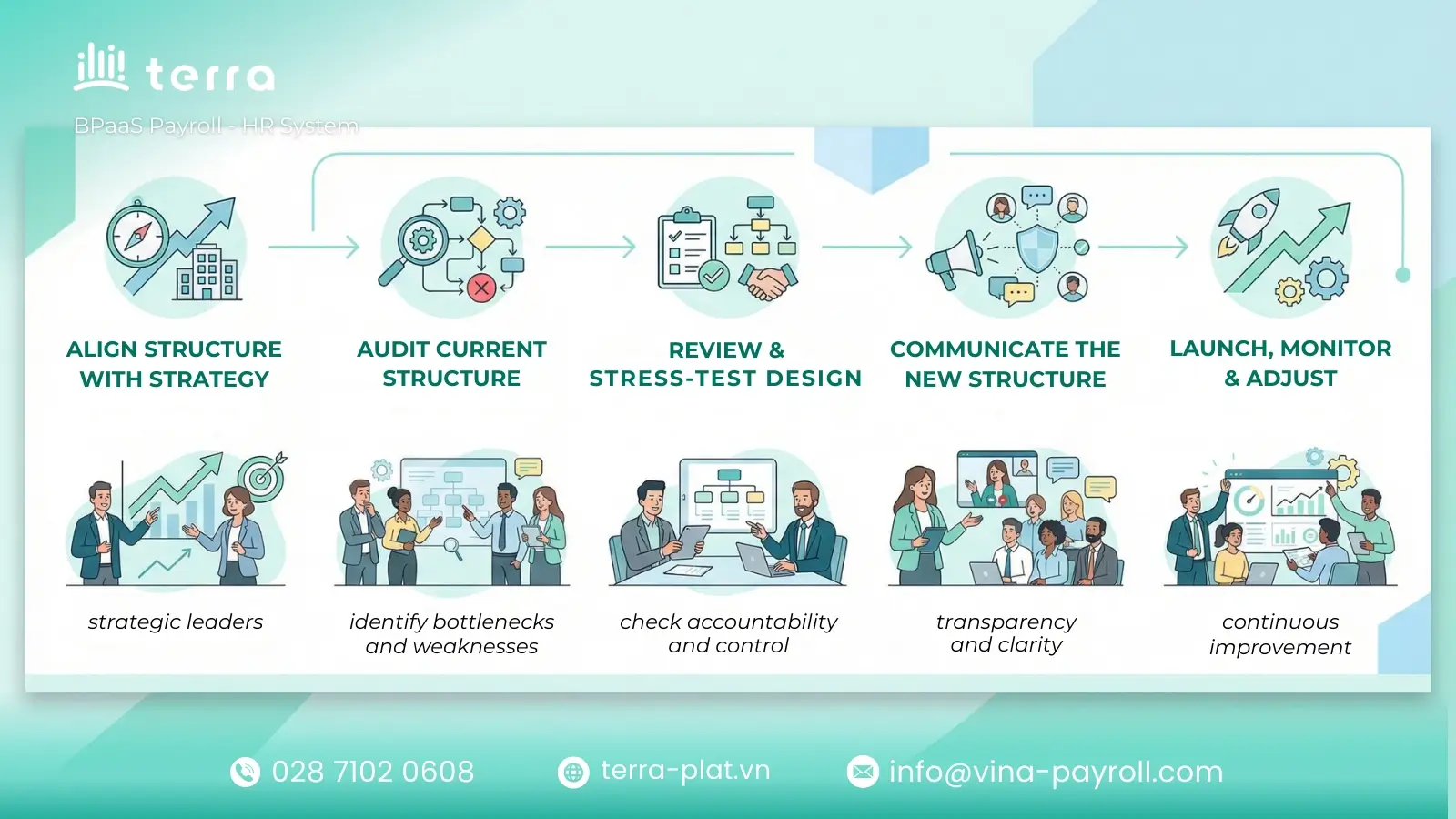
Align structure with business strategy
Structure should always follow strategy. Before choosing a type of organizational structure, you must define your long-term business goals. If your strategy focuses on operational excellence and cost leadership, a centralized functional structure is often the most efficient. However, if your strategy is built around customer intimacy or rapid innovation, a decentralized type of organizational structure such as a Matrix or Team-Based model is more effective.
Example: A luxury fashion brand moving into e-commerce may need to shift from a purely geographic structure to a product-based divisional structure to ensure their digital offerings receive specialized focus and resources.
Assess your current organizational structure
You cannot fix what you do not understand. Perform a thorough audit of the existing organizational structure of a company to identify bottlenecks. Common signs of structural failure include slow decision-making, frequent departmental conflicts, and employees who are unclear about their reporting lines.
Using a management system can provide invaluable data during this phase. By analyzing performance metrics and employee turnover rates across different departments, leadership can pinpoint exactly where the current system is breaking down and which organizational structure types might solve those specific issues.
Design and validate the new structure
Once a new model is selected, it must be “stress-tested.” Leaders should review the proposed organizational structure types to ensure there are no gaps in accountability. This includes checking the “Span of Control” for every manager and ensuring that the “Line of Command” is logical and direct.
Example: If a company is moving to a Matrix structure, they must review how they will handle conflicting priorities between functional managers and project managers. This proactive review prevents “power struggles” once the new structure is live.
Communicate the new structure clearly
Communication is the bridge between a plan and its successful execution. Employees need to understand why the change is happening and how it affects their daily work. Transparency reduces anxiety and builds buy-in.
Organizations can use the platform to publish the new digital organizational chart, allowing every employee to see their new place within the company “skeleton.” Providing a visual, interactive map of the new organizational structure helps eliminate confusion from day one.
Implement and refine continuously
Implementation is not a one-time event but a continuous process. After the official launch, leadership must monitor how the new organizational structure performs in the real world. Is information flowing faster? Are projects being completed more efficiently?
If certain departments are still struggling with “silos,” management can make small, iterative adjustments rather than waiting for another major overhaul. This agility is what separates successful companies from those that remain stagnant.
Organizational structure example
To better understand how this structure works in practice, consider the following example.
Example 1: Divisional Organizational Structure in a Global Consumer Goods Company
A multinational consumer goods corporation with operations in more than 40 countries uses a Divisional organizational structure based on product categories.
The organization is divided into three main divisions: Food and Beverage, Personal Care, and Home Care. Each division has its own marketing, finance, supply chain, and sales teams, functioning as a semi independent business unit.
Divisional presidents are responsible for profit and loss performance and make most operational decisions independently, while corporate headquarters retains control over overall strategy and brand governance.
This structure enables the company to respond quickly to market trends and consumer preferences within each product category.
Centralized or Decentralized: Decentralized with centralized strategic control
Example 2: Matrix Organizational Structure in a Technology Company
A global technology company with 5,000 employees applies a Matrix organizational structure to manage complex product development projects.
Software engineers belong to functional departments such as Engineering, Data Science, or Quality Assurance. At the same time, they are assigned to cross functional product teams led by product managers.
Employees report to both a functional manager for career development and a project manager for daily execution. This allows efficient use of specialized talent across multiple projects while maintaining technical standards.
This Matrix structure supports innovation and scalability but requires clear role definitions to avoid authority conflicts.
Centralized or Decentralized: Hybrid
Example 3: Team Based Organizational Structure in a SaaS Startup
A SaaS startup with 120 employees adopts a Team Based organizational structure organized around product squads.
Each squad includes product managers, developers, designers, and customer success specialists who share responsibility for a specific product feature or customer segment.
Teams operate with high autonomy, making day to day decisions independently, while leadership focuses on vision, priorities, and performance metrics.
This structure accelerates innovation and increases employee ownership, making it suitable for fast growing digital businesses.
Centralized or Decentralized: Decentralized
Frequently asked questions about organizational structure
Below are answers to the most frequent questions regarding how to optimize the organizational structure of a company for modern business needs.
What is the best organizational structure?
There is no single “perfect” model that fits every business. The “best” type of organizational structure is the one that most closely aligns with your company’s current scale, strategic objectives, and industry demands.
For example, a small creative agency might thrive with a Flat structure that encourages rapid idea sharing, while a global manufacturing firm requires a more rigid Functional or Hierarchical structure to maintain safety and quality standards across thousands of employees. The key is to ensure that your chosen organizational structure facilitates, rather than hinders, the achievement of your business goals.
A corporation is expanding into several areas while maintaining a centralized organizational structure at its headquarters, resulting in delayed reactions and missing market possibilities. How might the organizational structure be modified to facilitate greater flexibility?
When a corporation expands into new products, regions, or customer segments while keeping all decisions centralized at headquarters, delays and missed market opportunities are common. Local teams often lack the authority to respond quickly to customer needs or competitive changes.
For example, a global retail company expanding into Southeast Asia can establish a regional division with authority over pricing, marketing campaigns, and supplier selection, while headquarters retains control over brand strategy and financial governance. This adjustment reduces reaction time and improves market responsiveness without losing strategic alignment.
How can organizations update structures gradually?
Abrupt structural changes can lead to employee burnout and operational chaos. A more effective approach is to adopt a “phased transition” or a Hybrid model. Organizations can start by creating cross-functional teams for specific high-priority projects before committing to a full Matrix structure.
For instance, you can digitally re-map one department’s reporting lines in the software to test a new organizational structure before rolling it out company-wide. This allows leadership to identify friction points and adjust the “skeleton” of the company in a controlled, data-driven manner.
What are symptoms that an organization’s structure has gotten overly complex?
When organizational structure types become too layered or convoluted, several red flags appear:
- Analysis Paralysis: Decisions that should take days end up taking months because they require approval from too many management levels.
- Conflicting Instructions: Employees receive different directions from various managers, a common issue in poorly managed Matrix structures.
- Redundant Roles: You find multiple people or departments performing the same tasks because the horizontal communication has failed.
- Information Silos: Critical data stays trapped within one department, preventing other teams from working effectively
How does culture affect organizational structure effectiveness?
Culture is the invisible force that determines whether a structure succeeds or fails. If your organizational structure is designed to be a “Team-Based” model but your corporate culture is built on internal competition and secrecy, the teams will fail to collaborate. Conversely, a highly disciplined, “Command and Control” culture will feel lost in a Flat structure where they are expected to be self-managed.
How terra HR Systems support an effective organizational structure
An organizational structure can only work effectively when roles, responsibilities, data and workflows are clearly connected. A modern HR system like terra HR System acts as the operational backbone that transforms an organizational chart from a static design into a living and measurable management system.
terra HR System supports organizational structures by ensuring consistency, transparency and scalability across all people related processes.
- Centralized workforce data: A single source of truth for employee roles departments reporting lines contracts and insurance ensuring organizational clarity at all times.
- Flexible authority control: Role based permissions that support centralized decentralized and hybrid organizational structures without losing governance.
- Workflow automation: Digitized approval processes for attendance leave overtime and payment requests that eliminate bottlenecks while respecting reporting lines.
- Payroll and compliance integration: Automatic calculation of salary tax and social insurance fully aligned with Vietnamese regulations across all departments.
- Real time workforce visibility: Instant insights into attendance labor costs overtime and department level data to support structural optimization.

Discover how terra HR System enables a clear, scalable organizational structure across your enterprise. Request a personalized demo to see how core HR processes are seamlessly integrated on one centralized platform.
Conclusion
Choosing the right type of organizational structure helps businesses stay aligned with strategy, scale smoothly, and adapt to change. When supported by a unified HR platform like terra, the organizational structure of a company becomes clearer, more flexible, and easier to manage in practice.









