
Navigating the regulatory environment in Vietnam requires more than just administrative effort, it demands a precise understanding of evolving labor laws and tax reforms. This guide terra provides a deep dive into the Vietnam payroll for expats, updated PIT regulations for 2026, mandatory insurance obligations to ensure your business remains compliant.
| Question | Quick answer |
| Do expats pay Social Insurance in Vietnam? | Yes. Mandatory for expats with a 12-month+ labor contract and a valid Work Permit. Rates (from July 1, 2025): Employee 9.5%, Employer 20.5%. |
| What is the PIT rate for expats? | Tax Residents: Progressive rates from 5% to 35%. Non-Residents: A flat rate of 20% on Vietnam-sourced income. |
| What are the 2026 PIT Law changes? | Effective July 1, 2026: Tax brackets reduced from 7 to 5. Personal deduction increased to VND 15.5 million/month. |
| Can expats receive a salary in foreign currency? | Yes. Permitted if specified in the labor contract and compliant with SBV (State Bank of Vietnam) foreign exchange regulations. |
| Which expat allowances are tax-exempt? | One-time relocation fee, one round-trip airfare per year, and children’s tuition (from Kindergarten to High School). |
What does expat payroll in Vietnam actually cover?
In Vietnam, expat payroll encompasses four core pillars: the gross salary, mandatory statutory deductions (PIT and Social Insurance), diverse allowances/benefits, and rigorous tax reporting obligations.
While the 2019 Labor Code provides the foundation, specific decrees like the Social Insurance Law 2024 and the 2025 PIT Amendment (effective July 2026) introduce nuances that differ significantly from local employee payroll.
Who counts as an expat for payroll purposes in Vietnam?
To accurately manage payroll for expats, businesses must first define the legal status of their foreign workforce. Generally, an expat for payroll purposes is a foreign national holding a valid Work Permit (or WP exemption) and an executed labor contract with a Vietnam-based legal entity.
It is crucial to distinguish these individuals from “digital nomads” or remote workers employed by offshore companies without a local presence; the latter are subject to different tax residency triggers and do not fall under the standard domestic payroll system.

Gross salary structure for foreign employees
The gross salary serves as the total compensation before any statutory deductions and acts as the primary basis for calculating both Social Insurance contributions and Personal Income Tax.
Minimum wage requirements for expats
According to Decree 293/2025/ND-CP, which implemented a 7.2% increase, the minimum wage levels are as follows:
| Region | Monthly Minimum Wage (2026) |
| Region I (HCMC, Hanoi urban) | 5,320,000 VND |
| Region II (HCMC, Hanoi rural, Da Nang) | 4,730,000 VND |
| Region III (Provincial cities) | 4,140,000 VND |
| Region IV (Remaining areas) | 3,700,000 VND |

Can expats be paid in foreign currency?
Under Article 95 of the Labor Code 2019 and Circular 32/2013/TT-NHNN, this is permitted for foreign employees provided three conditions are met: The currency is clearly stated in the contract, the funds originate from a legal source, and all statutory payments (PIT/Insurance) are declared and converted into VND based on the State Bank of Vietnam’s exchange rate at the time of payment.
What goes into the gross salary of an expat in Vietnam?
The composition of an expat’s income usually goes beyond a simple fixed salary to include various taxable and non-taxable elements. Typically, the gross amount includes the base salary, taxable allowances (such as responsibility or seniority pay), KPI bonuses, and 13th month salary provisions.
While the average salary in Vietnam for expats is higher than the national mean, HR teams must carefully categorize these items on the salary slip to optimize tax liabilities.
Personal income tax for expats in Vietnam
The applicable PIT rate for foreigners in Vietnam is not a fixed percentage for everyone; instead, it is determined by your tax residency status. Specifically, tax residents are subject to a progressive tax scale ranging from 5% to 35% on their global income (after deductions), whereas non-residents are subject to a flat tax rate of 20% on all income earned within Vietnam.
As of 2026, staying compliant requires a precise understanding of how these rates apply to your specific employment contract and duration of stay.

Tax residency: The most important determination
Before processing any salary slip, HR must verify the expat’s tax residency. An individual is considered a tax resident if they are present in Vietnam for 183 days or more within a calendar year (or 12 consecutive months from arrival) or if they have a “regular residence” in the country.
Residents are taxed on their global income at progressive rates, whereas non-residents are taxed only on Vietnam-sourced income at a flat rate.
PIT rates for tax resident expats
The year 2026 is a transitional period for tax law in Vietnam, requiring HR teams to manage two different sets of progressive scales.
- Until June 30, 2026: The current 7-level progressive scale (5% to 35%) applies.
- From July 1, 2026: The new 5-level scale under the 2025 PIT Law takes effect, designed to simplify the tax burden.
Personal deductions (Updated):
- Self-deduction: 15.5 million VND/month (Increased from 11M).
- Dependent deduction: 6.2 million VND/month/person (Increased from 4.4M).
PIT rate for non-resident expats
For those who do not meet the residency criteria, the calculation for payroll for expats is simplified but often more costly. Non-residents are subject to a flat 20% tax rate on all Vietnam-sourced income, with no personal or dependent deductions allowed. For example, if a non-resident’s gross income is 50,000,000 VND, their PIT is a straight 10,000,000 VND.
Gross-to-net salary calculation example for a tax resident expat
To visualize the gross to net salary Vietnam foreigner process, consider an expat resident with a gross salary of 80,000,000 VND and no dependents (using pre-July 2026 rates):
- Gross salary: 80,000,000 VND
- Social insurance (9.5%): ~4,446,000 VND (Capped at 20x Basic Salary)
- Personal deduction: 11,000,000 VND
- Taxable income: 80,000,000 – 4,446,000 – 11,000,000 = 64,554,000 VND
- PIT (progressive scale): Calculated per bracket.
- Net salary: Gross – Insurance – PIT.
Non-taxable allowances for expats in Vietnam
Strategically structuring payroll for foreigners in Vietnam involves utilizing tax-exempt benefits. Key non-taxable items include one-time relocation allowances, one round-trip airfare per year for the expat to their home country, and school fees for the expat’s children (up to high school) paid directly to the school. Housing allowances are also partially exempt, provided they do not exceed 15% of the total taxable income.
Double taxation agreements and how they apply
To prevent the burden of paying taxes in two different jurisdictions, businesses must understand how Double Taxation Agreements (DTA) function within the Vietnamese legal framework. Vietnam has signed DTAs with over 80 countries and territories, providing significant tax relief for international experts. However, a common misconception among FDI firms is that these benefits are applied automatically.
In reality, to enjoy tax exemption or reduction under a treaty, the taxpayer must proactively prove their eligibility. According to the current Law on Tax Administration, DTA benefits are not automatic. Instead, the expat or the employing entity must submit a “Notice of Eligibility for Tax Treaty Benefit” along with a Residence Certificate (legalized and translated) to the local tax authorities.
The 15-day rule for compliance:
A critical procedural requirement is the timing of the submission. You must file the DTA notification dossier at least 15 days prior to the tax finalization deadline or the date the tax liability arises. Failure to meet this window can result in the denial of treaty benefits, forcing the expat to pay the full local PIT rate.
Common DTA partner countries for FDI in Vietnam:
If your international talent comes from a country with a high volume of Foreign Direct Investment in Vietnam, there is a high likelihood of an active DTA. Common partner countries include:
- Asia: Japan, South Korea, Singapore, China.
- Europe: Germany, France, the Netherlands, the United Kingdom.
- Oceania: Australia.
By correctly leveraging these agreements, companies can significantly optimize their payroll for expats and reduce the overall cost of international assignments while staying 100% compliant with Vietnam’s tax laws.
Social insurance for expats in Vietnam: Updated July 2025
Mandatory social insurance for expats Vietnam has undergone significant shifts since the implementation of Decree 143/2018. As of July 2025, any expat with a labor contract of 12 months or more and a valid work permit must participate in the compulsory social insurance scheme.

Contribution rates from July 2025
Starting from July 2025, the rates for mandatory social and health insurance are structured to provide comprehensive coverage for international talent while maintaining a cap on the total monthly burden.
| Insurance category | Employee contribution | Employer contribution | Total contribution |
| Social Insurance (BHXH) | 8.0% | 17.5% | 25.5% |
| Pension & Death Fund | 8.0% | 14.0% | 22.0% |
| Sickness & Maternity | 0% | 3.0% | 3.0% |
| Occupational Accident & Disease | 0% | 0.5% | 0.5% |
| Health Insurance | 1.5% | 3.0% | 4.5% |
| Unemployment Insurance | N/A | N/A | N/A |
| Grand Total | 9.5% | 20.5% | 30.0% |
Key regulatory reminders for 2026:
- The Contribution Cap: Both the 9.5% employee and 20.5% employer contributions are subject to a statutory ceiling. This cap is calculated as 20 times the base salary. With the base salary set at 2,340,000 VND (effective through 2026), the maximum monthly salary used to calculate contributions is 46,800,000 VND.
- Unemployment Insurance Exemption: It is critical to note that under current Vietnamese labor laws, foreign employees are not required (and not eligible) to participate in the Unemployment Insurance (BHTN) scheme.
- Mandatory Enrollment: Contributions are compulsory for all expats holding a labor contract of 12 months or more and a valid Work Permit/WP Exemption.
When do expats start and stop contributing?
The lifecycle of social insurance for expats in Vietnam is strictly tied to the legal validity of their employment status. Understanding the exact triggers for starting and stopping contributions is essential for maintaining a compliant payroll for expats.
- Commencement of contributions: Enrollment in mandatory social insurance begins on the effective date of a labor contract with a term of one year (12 months) or more, provided the employee holds a valid Work Permit or a Practice Certificate/License issued by Vietnamese authorities.
- Cessation of contributions: The obligation to contribute stops immediately when the labor contract is terminated or when the Work Permit expires without being renewed.
- The 10-day compliance window: Upon the termination of the labor contract, the employer is legally obligated to complete the SI book closure procedure. This must be initiated within 10 days from the date the employment ends to ensure the expat’s contribution record is finalized and ready for any future claims or withdrawals.
One-time social insurance withdrawal for expats leaving Vietnam
One of the most significant benefits of the Vietnamese social insurance system for international talent is the one-time lump-sum withdrawal. Unlike many jurisdictions where pension contributions are locked until retirement, expats in Vietnam have the right to reclaim their contributions when they conclude their term in the country.
Eligibility and conditions:
Foreign employees are entitled to a one-time social insurance payment if they fall into one of the following categories:
- Their labor contract or Work Permit expires, and they do not intend to continue working in Vietnam.
- They terminate their labor contract or reach retirement age but do not meet the minimum contribution years for a monthly pension.
Required documentation:
To process a claim, the following dossier is typically required:
- The original Social Insurance Book (fully finalized/closed).
- An application form for lump-sum social insurance benefits.
- Copies of the passport and valid visa/temporary residence card.
- Documents proving the termination of employment (e.g., resignation acceptance letter or contract liquidation).
The process:
The application should be submitted to the local Social Insurance agency where the company is headquartered. Once the dossier is accepted, the agency is required to process and settle the payment within 10 working days.
Navigating the paperwork for a withdrawal can be complex while managing an international move. For expert assistance with your claim, visit terra Social Insurance Claim Service to ensure a smooth and timely reimbursement of your benefits.
Shadow payroll: When does it apply?
In the world of global mobility, shadow payroll is a critical compliance mechanism used to ensure that an expatriate’s tax obligations are met in the country where they are physically working, even if their compensation is delivered elsewhere. In Vietnam, this is not a “second” payment, but rather a “shadow” reporting process designed to track and remit the correct amount of personal income tax expat Vietnam to the local authorities.

The core purpose: Ensuring PIT compliance
The primary objective of a shadow payroll is to ensure that the Vietnamese government collects the appropriate amount of PIT on income earned within its borders. According to Vietnamese tax law, if an individual is physically working in Vietnam, that income is considered Vietnam-sourced income, regardless of whether the funds are deposited into a bank account in London, New York, or Tokyo. Without a shadow payroll, an FDI company risks severe penalties for tax evasion or under-reporting.
Who needs to prioritize shadow payroll?
This mechanism is most relevant for FDI companies operating under a secondment model. You should implement a shadow payroll if:
- Offshore payment: Your expatriate employees remain on the home country’s payroll and receive their fixed salary in foreign currency outside of Vietnam.
- Local economic benefit: The expat is performing services that benefit the Vietnamese legal entity.
- Intercompany recharging: The parent company “recharges” or invoices the Vietnamese subsidiary for the cost of the expat’s salary and benefits.
How does it work in practice?
When a shadow payroll is active, the HR or finance team in Vietnam calculates the tax liability based on the expat’s total global compensation (including offshore bonuses and benefits). Even though the Vietnam entity doesn’t physically hand over the cash to the employee, it “shadows” the payment on its books to:
- Calculate and remit monthly/quarterly PIT.
- Report the income in the annual tax finalization.
- Ensure that the salary slip accurately reflects the taxes paid to the Vietnamese General Department of Taxation.
By maintaining a robust shadow payroll system, FDI firms can navigate the complexities of international assignments while staying 100% compliant with the evolving 2026 tax regulations.
Expat payroll compliance checklist for HR teams
Managing payroll for expats requires a proactive approach to compliance that spans from the initial offer letter to the final tax finalization. To help FDI companies mitigate risks and ensure a seamless experience for international talent, we have compiled this essential compliance checklist based on the 2026 Vietnamese regulatory landscape.
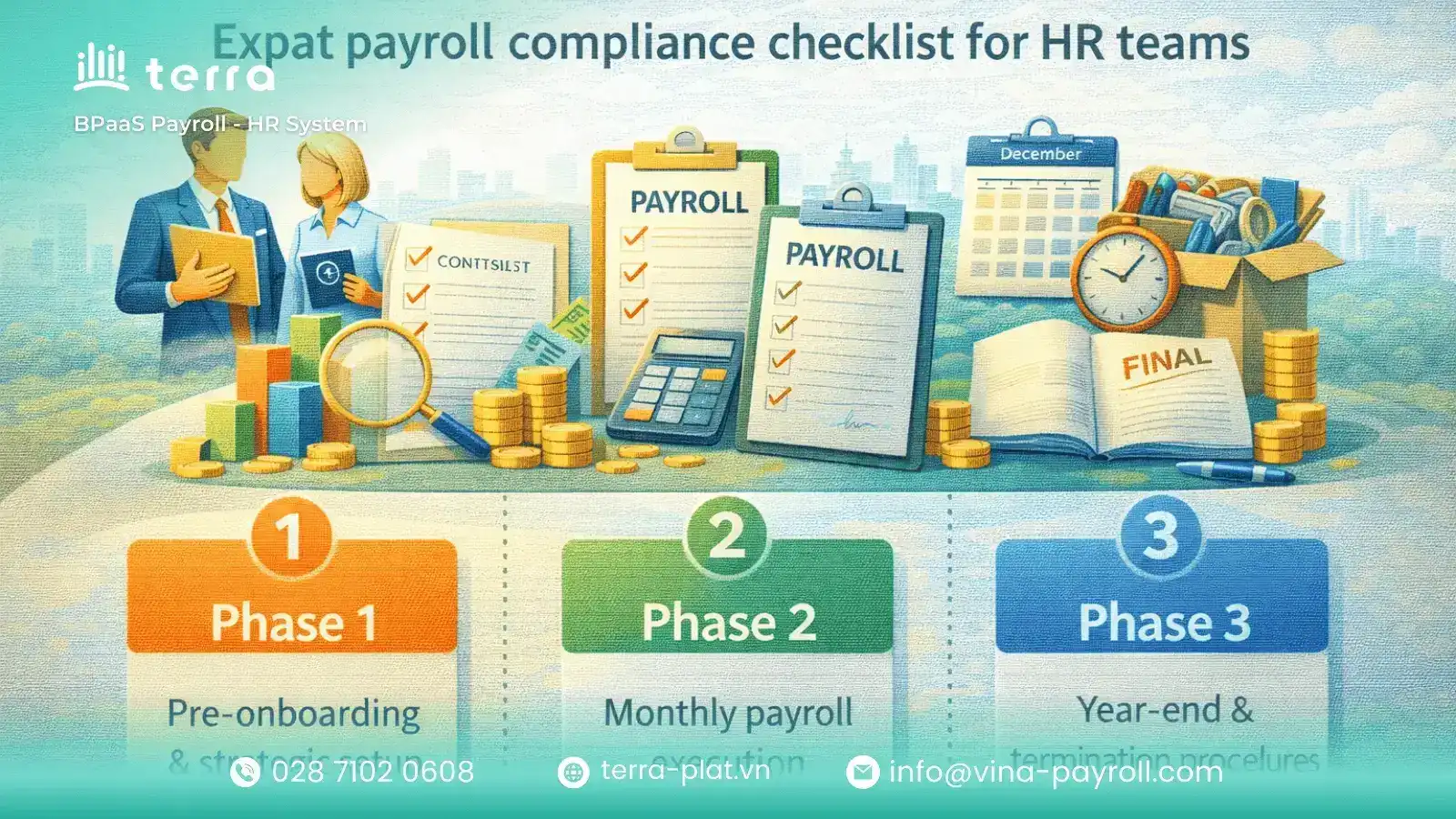
Phase 1: Pre-onboarding & strategic setup
Before the foreign employee even arrives in Vietnam, HR teams must lay the groundwork for a compliant Vietnam expat salary structure.
- Determine tax residency status: Assess the expected duration of stay to determine if the expat will be a tax resident (183-day rule) or a non-resident, as this dictates the applicable PIT rate for foreigners in Vietnam
- Verify double taxation agreements (DTA): Check if the expat’s home country has an active DTA with Vietnam to identify potential tax exemptions or credits.
- Optimize allowance structure: Design the compensation package to include tax-exempt benefits such as one-time relocation, school fees, and one annual round-trip airfare. Ensure housing allowances stay within the 15% non-taxable threshold.
- Register for personal Tax ID (MST): Apply for the expat’s unique tax identification code immediately upon contract signing to facilitate legal reporting.
Phase 2: Monthly payroll execution
During each payroll cycle, precision is key to avoiding penalties during future labor or tax audits.
- Calculate social insurance (SI) per 2025/2026 rates: Apply the updated contribution rates (Employee: 9.5% / Employer: 20.5%) effective from July 2025.
- Monitor the SI contribution cap: Ensure contributions do not exceed the ceiling of 46.8 million VND (based on 20 times the 2026 base salary of 2,340,000 VND).
- Apply correct PIT brackets: Use the appropriate progressive tax scale (or the flat 20% for non-residents) based on the gross to net salary Vietnam foreigner calculation.
- Issue bilingual salary slips: Provide a detailed salary slip in both English and Vietnamese to ensure transparency and fulfill local labor record-keeping requirements.
Phase 3: Year-end & termination procedures
Closing the tax year or an employment contract requires meticulous documentation to protect both the company and the individual.
- Execute PIT finalization: For expats who authorize the company to act on their behalf, ensure all filings are submitted by the March 31st deadline. For those departing mid-year, finalization must occur within 45 days of their exit date.
- Finalize SI book closure: Upon contract termination, HR must complete the social insurance book closure within 10 working days to allow the expat to claim their lump-sum withdrawal.
- Review statutory reports: Conduct a final audit of all monthly filings to ensure consistency across the year’s payroll records before the annual reporting cycle closes.
Frequently asked questions about expat payroll in Vietnam
Navigating the intersection of local labor laws and international compensation can be challenging. Below are the most common questions HR managers and foreign professionals ask regarding payroll for expats in 2026.
Does an expat need to file a PIT themselves or does the employer do it?
The responsibility for tax finalization depends on the expat’s income structure and their duration of stay in Vietnam.
- Employer finalization: If an expat has only one source of income from a Vietnamese entity and provides a written authorization, the employer can finalize the personal income tax expat Vietnam on their behalf. The deadline for this is typically March 31st of the following year.
- Self-filing: An expat must file their own tax return directly with the tax authorities if they have multiple income sources globally or if they choose not to authorize the company.
- The departure rule: If an expat concludes their assignment and leaves Vietnam before the end of the calendar year, they are legally required to complete their tax finalization personally within 45 days of their departure date.
What happens if an expat’s work permit expires mid-year?
The expiration of a work permit has an immediate impact on social insurance for expats in Vietnam. Once the permit expires and is not renewed, the mandatory insurance contribution obligation ceases.
However, the PIT obligation remains active for any income earned during the year. HR must ensure that the SI book is closed within 10 days of the permit’s expiration to allow the expat to begin the lump-sum withdrawal process if they plan to leave the country.
Can expats claim tax deductions for home country taxes paid?
Yes, provided there is an active Double Taxation Agreement (DTA) between Vietnam and the expat’s home country. This is not an automatic deduction; the expat must provide certified proof of tax payment from their home country’s tax authority. This prevents “tax on tax” scenarios and ensures the PIT rate for foreigners in Vietnam is applied fairly based on global treaties.
How does an expat paid in USD handle PIT and social insurance in Vietnam?
While Vietnamese law (Circular 32/2013/TT-NHNN) allows expats to receive a fixed salary in USD, the government only accepts statutory payments in the local currency.
- Conversion rate: All income received in foreign currency must be converted into VND using the average interbank exchange rate announced by the State Bank of Vietnam at the time the income is generated.
- Payment: The calculated PIT and Social Insurance amounts must be remitted to the State Treasury in VND. Your salary slip should clearly show both the original foreign currency amount and the converted VND values used for tax reporting.
Does terra handle payroll for both local and expat employees in the same system?
Absolutely. One of the primary advantages of terra’s BPaaS (Business Process as a Service) model is its ability to manage a diverse workforce within a single, unified environment. Our system is pre-configured with the latest 2026 regulatory updates, allowing HR teams to:
- Process local and expat payroll simultaneously without data fragmentation.
- Automatically apply the different insurance caps and tax scales for each group.
- Generate compliant, bilingual salary slips at the click of a button.
- By centralizing payroll for foreigners in Vietnam alongside local staff, terra ensures consistent compliance and real-time reporting for FDI enterprises.
How terra handles expat payroll for FDI companies

Foreign Direct Investment (FDI) companies in Vietnam face a unique set of challenges, from navigating the fluctuating average salary in Vietnam to complying with rapidly evolving labor codes. To solve these complexities, an increasing number of international firms are moving away from traditional models and adopting terra BPaaS Payroll Solutions.
By combining automated technology (SaaS) with expert human outsourcing (BPO), terra offers a “safe, accurate, and efficient” ecosystem that allows FDI firms to focus on their core business activities.
Robust regulatory compliance and risk mitigation
Vietnam’s tax and labor laws are subject to frequent updates. Terra provides automated, up-to-date compliance with the latest regulations concerning Personal Income Tax (PIT) and Social Insurance (SHUI).
This ensures 100% accuracy in calculating salaries for both executive high paying jobs and hourly blue collar jobs, significantly reducing the risk of legal penalties and ensuring the firm is always “audit-ready” according to the Law on Enterprises.
Operational efficiency and cost savings
By utilizing terra’s outsourced payroll services, clients have reported a 50% reduction in manual HR interventions and a 75% reduction in payroll audit preparation time.
This BPaaS model eliminates the need for maintaining an expensive in-house HR team, saving on recruitment and training costs while providing a scalable employee payroll database system that grows alongside the business.
Integrated technology and modern features
A standout advantage for FDI firms is the free access to the “terra HR System” included with payroll services. This all-in-one platform centralizes operations by covering:
- Centralized payroll data storage: Seamlessly manage attendance, leave, and personnel records in one place.
- Advanced tracking: Support for GPS-based attendance and facial recognition for high-precision timekeeping.
- Gold-standard security: The platform is ISO/IEC 27001:2022 certified, ensuring that your payroll data storage system meets international data protection requirements.
Specialized expertise for multinational teams
With a deep portfolio of FDI clients across multiple industries, terra understands the bureaucratic nuances of the Vietnamese market. The platform offers bilingual support (Vietnamese & English), making it the ideal partner for multinational management teams who require 24/7 dedicated support to handle complex, unexpected payroll issues promptly.
Conclusion
Managing payroll for expats in Vietnam is a high-stakes task that requires constant vigilance over changing tax laws and insurance caps. By structuring a clear gross to net salary Vietnam foreigner framework and staying ahead of 2026 legislative updates, companies can ensure seamless operations and maintain their reputation as a top-tier employer for global talent.









