
Updated September 2026. If your contract in Vietnam ends in the next two or three months, Social Insurance when leaving Vietnam is one of the few exit tasks that puts money back into your account: two months of your average insured salary for every year you contributed from 1 January 2022.
The catch is timing. Every step is faster and cheaper while you are still in the country. This 60-day plan sets out what to do in each fortnight, what it costs, and what to hand over if you run out of time. It follows the Law on Social Insurance 2024 (No. 41/2024/QH15), in force since 1 July 2025, and the fee terms published on terra’s one-time Social Insurance service page.
Social Insurance when leaving Vietnam at a glance
| Question | Short answer |
|---|---|
| Can I claim before I fly? | Yes. Your right starts when the labor contract ends or the work permit expires without renewal (Article 70, Clause 2, Point đ). You do not need to have left the country. |
| How much? | 2 months of your average insured monthly salary for each year contributed. For foreign employees, only years from 1 January 2022 count. |
| How long? | 7 working days by law once the file is complete (Article 79, Clause 3). 4 to 6 weeks in practice, because most of the time goes into collecting documents. |
| What documents? | Social Insurance book, Form 14-HSB, notarized passport copy with Vietnamese translation, proof the contract ended, and a notarized power of attorney if someone files for you. |
| When to start? | 60 days before your flight. The one step that must happen in Vietnam is signing the authorization. |
| What does terra charge? | VND 10 million file processing fee at signing, plus a service fee of 15% of the amount withdrawn, charged only after the money reaches you. Both before VAT. |
2 months of average insured salary for each year contributed from 1 January 2022 | 7 working days for the decision once the file is complete (Article 79, Clause 3) | VND 50.6 million monthly cap on the insured salary from 1 July 2026 |
Can you claim Social Insurance when leaving Vietnam?
Yes. A foreign employee can claim one-time Social Insurance as soon as the labor contract ends, or the work permit expires and is not renewed. That is Article 70, Clause 2, Point đ of the Law on Social Insurance 2024.
Unlike a Vietnamese employee, you do not wait 12 months after your last working day, and you do not have to be outside Vietnam to file.
The right applies to anyone who was compulsorily insured: foreign nationals working in Vietnam under a labor contract of 12 months or more, with a work permit or practising licence issued by a Vietnamese authority (Article 2, Clause 2). Two groups were never enrolled, so there is nothing to claim:
- intra-company transferees;
- employees who had already reached Vietnamese retirement age when the contract was signed.
If you are unsure which group you are in, check the rules on Social Insurance contributions for foreign employees first.
The condition most people get wrong The trigger is the end of the contract, not the day you fly Your right starts when the labor contract ends or the work permit expires without renewal. Leaving the country is not a condition, and staying on after the contract ends does not delay it. |
If you move straight to another employer in Vietnam, your contributions continue and no claim is possible. If you leave without filing, the claim survives, but you move onto the slow route described later in this plan. For the full eligibility rules and procedure, see terra’s guide to one-time Social Insurance withdrawal for foreigners in Vietnam.
Before your work permit or residence card expires
If your work permit is running out and will not be renewed, that expiry is itself the trigger for your claim. Article 70, Clause 2 treats the expiry of a work permit without renewal the same way it treats the end of a labor contract. You do not need to resign first, and you do not need to have left the country.
What has changed is the timing pressure around the renewal decision. Under Decree No. 219/2025/ND-CP, in force since 7 August 2025:
- an extension is filed at least 10 days and no more than 45 days before the work permit expires;
- a work permit can now be extended only once.
That window sits inside this plan, in the same fortnight as the eligibility check.
| Day of the plan | Work permit | What it means for the claim |
|---|---|---|
| Day 60 to 45 | Renewal window opens 45 days before expiry | Decide renew or leave. The claim only exists if the permit is not renewed |
| Day 45 to 10 before expiry | Application must be filed in this window | Filing an extension pauses the claim, because you stay insured |
| Fewer than 10 days to expiry | Too late to extend | The expiry becomes your trigger. Start the claim steps below |
| After expiry | Return it within 15 days to the issuing authority | Employer duty or yours. Keep a copy before handing it over |
The one-extension rule is the part worth taking seriously, and it is newer than most advice online. A renewal that used to be routine is now a decision with a ceiling on it. The people who discover that ceiling late are the ones who end up planning an exit in three weeks rather than in sixty days.
Your residence card follows the permit rather than the other way round. It does not survive on its own once the permit ends and the sponsorship is withdrawn. If you intend to stay in Vietnam after the job finishes, arrange a different basis for residing here before the permit lapses, not after.
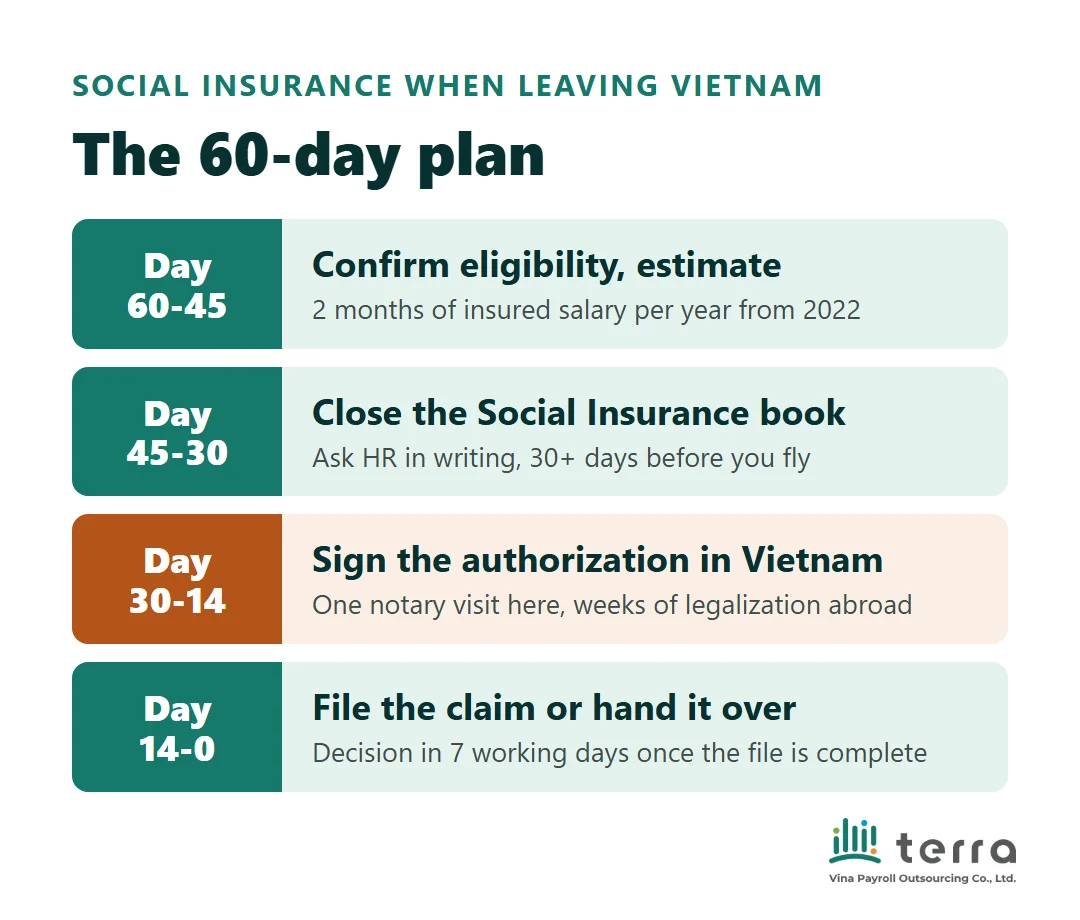
Day 60 to 45: confirm eligibility and estimate your amount
Two months of average insured salary per contributed year is the figure to hold on to when you estimate Social Insurance when leaving Vietnam (Article 70, Clause 3, Point b). Two smaller rules shape the number:
- Under one year of contributions: you receive the contributions actually paid, capped at two months of average salary (Point c).
- Odd months are rounded: 1 to 6 months count as half a year, 7 to 11 months count as a full year (Article 5, Clause 6).
Two further rules cut the number for foreign employees specifically.
Only years from 1 January 2022 count. Foreign employees started paying into the retirement and survivorship fund on that date under Decree 143/2018/ND-CP, now replaced by Decree 158/2025/ND-CP. Years worked in Vietnam before 2022 do not count toward the lump sum, however long you were here. The 2014 starting point you may read elsewhere applies to Vietnamese employees.
The insured salary is capped at 20 times the reference level: VND 46.8 million per month until 30 June 2026, and VND 50.6 million from 1 July 2026 after Decree 161/2026/ND-CP raised the reference level to VND 2.53 million. Verify the reference level at the date of your decision.
Worked example VND 40 million insured salary, March 2023 to May 2026: VND 280 million An engineer insured from 1 March 2023 to 31 May 2026 at an average declared salary of VND 40 million has 3 years and 3 months of contributions, rounded to 3.5 years. The gross entitlement is 2 × 40,000,000 × 3.5 = VND 280 million. The same engineer with a contract salary of VND 80 million would still be calculated on the capped insured salary, not the contract figure. |
Do not estimate from your gross pay. Estimate from the salary your employer declared to the Social Insurance authority, which for many expats is lower than the contract salary and is capped. Ask HR for your annual contribution statements, then run the numbers in the estimator on terra’s service page. This is the week to decide whether the claim is worth a service fee or a do-it-yourself afternoon.
Day 45 to 30: close the Social Insurance book

The single most common reason a file stalls is not the claimant. It is the former employer. Either the Social Insurance book has not been closed, or the termination decision was never issued in writing. Both are the employer’s job, and both take longer than HR expects once you have left the building.
For Social Insurance when leaving Vietnam, this fortnight decides whether the rest of the plan runs on time.
By law the file itself is short: the Social Insurance book and a written request from the employee (Article 78, Clause 1). The request is Form 14-HSB under Decision 2222/QD-BHXH of 29 July 2025, as amended by Decision 313/QD-BHXH, which introduced a new version of the form from 1 April 2026. In practice the office also wants:
- proof that the contract ended: the termination decision or the expired work permit;
- a notarized copy of your passport with a Vietnamese translation.
What HR has to do in this window: report your departure to the Social Insurance authority, close the book with your final month of contributions, and hand you the book and printed statements.
Ask for this in writing at least 30 days before your flight, and name the person who will receive the book if you have already gone. If your former employer has been dissolved or is not responding, the book can still be closed through the Social Insurance office, but that is a separate procedure and it adds weeks. For HR readers, terra’s exit procedures for foreign employees in Vietnam lists every filing the employer owes in the same period.
Day 30 to 14: sign the authorization in Vietnam
Signing an authorization in Vietnam takes one visit to a notary office and costs a few hundred thousand dong. Signing the same document after you have left means legalization at a Vietnamese embassy or consulate, a certified translation, international courier, and typically two to four extra weeks.
This is the step that makes Social Insurance when leaving Vietnam either simple or painful, and it is the reason the plan starts 60 days out.

Changed on 1 April 2026 The old authorization form 13-HSB has been abolished Decision 313/QD-BHXH, applied from 1 April 2026, removed the agency’s standard authorization form. The right to authorize someone did not change: the authorization is now an ordinary power of attorney under civil law, notarized in Vietnam or legalized if signed abroad. Many guides online still show the old form. |
The authorization names a representative to file the claim, deal with the Social Insurance authority, and receive the decision on your behalf. terra prepares the document in Vietnamese, English and Japanese and books the notary appointment. You sign once, in person, with your passport.
In the same fortnight, settle the bank question. The Social Insurance authority pays into a Vietnamese bank account, and payment to certain foreign accounts is possible through the representative but adds checks. Keep one Vietnamese account open until the money has landed.
In terra’s files, closing the bank account on the last day in Vietnam is the second most expensive mistake after the unsigned authorization (internal observation from terra client files, 2025 to 2026).
Leaving Vietnam in the next few months? Two months of insured salary for every year from 2022, and one signature that must happen in Vietnam terra checks your eligibility, works with your former employer to close the book, and files the claim so the money reaches you even after you fly. Published fees: VND 10 million file fee at signing plus 15% of the amount withdrawn, charged only after the payment arrives. Both before VAT.
|
Day 14 to 0: file the claim or hand it over
A complete file goes to the Social Insurance office of the province where your employer registered you. There are three routes:
- in person at the office;
- by registered post;
- online through the National Public Service Portal, which requires a Vietnamese level-2 electronic identity that most foreign employees do not hold.
In practice the choice is between filing in person and filing through your representative.
Check the file against this leaving Vietnam checklist before it goes in. One missing page means the office returns the file and the clock restarts.
| ☐ | Social Insurance book with every period closed |
| ☐ | Form 14-HSB, new version from 1 April 2026, signed |
| ☐ | Notarized passport copy with Vietnamese translation |
| ☐ | Termination decision or the expired work permit |
| ☐ | Vietnamese bank account details in your own name |
| ☐ | Notarized power of attorney, if a representative files |
If you are leaving before the file is complete, hand the folder to your representative on your last working day, together with the signed authorization. From that point nothing else requires your presence.
How long does it take and what does it cost?
Seven working days. That is the statutory time for the Social Insurance authority to decide a one-time claim once it has a complete file, and it must reply in writing with reasons if it refuses (Article 79, Clause 3).
The 4 to 6 weeks you will read about, including on terra’s service page, is the end-to-end time from engaging a representative to money in the account. Most of it is spent chasing the employer and the notary, not waiting for the authority.
Doing it yourself costs notary and translation fees, usually under VND 2 million, plus your time at the office. terra’s pricing is published on the service page and repeated here so you can compare:
- a file processing fee of VND 10 million, payable when you sign the service contract;
- a service fee of 15% of the amount withdrawn, charged only after the Social Insurance payment reaches your account.
Both are quoted before VAT. If the claim is refused because you do not qualify, your cost stops at the VND 10 million file fee.
On the VND 280 million example above, the fees would be VND 10 million plus VND 28 million, that is VND 38 million before VAT, leaving about VND 242 million.
The lump sum itself is not subject to Personal Income Tax (PIT): one-time Social Insurance allowances are excluded from taxable income under Circular 111/2013/TT-BTC, Article 2, Clause 2, Point b, a treatment carried into the PIT Law 2025 framework (No. 109/2025/QH15, Decree 253/2026/ND-CP). Your final-year PIT finalization is a separate filing with its own deadline. terra’s guide to PIT finalization for foreigners in Vietnam explains how to run both so they close before you leave.
What if your flight is in two weeks?
You leave on the 30th. HR has not closed your book, and you have signed nothing. In two weeks you can realistically do three things, and they are enough:
- sign the authorization at a notary;
- hand a notarized passport copy and your contract documents to your representative;
- instruct HR in writing to close the Social Insurance book and deliver it to that representative.
Social Insurance when leaving Vietnam on short notice therefore comes down to that one notarized signature. The filing itself can then happen after you have gone, without embassy legalization, because the authorization was signed in Vietnam.
Do not postpone your departure for the claim. Postpone closing your Vietnamese bank account instead, and give your representative a way to reach you for the one or two questions the office may raise.
If you have already left without signing anything, the claim is still possible. You sign the authorization at a Vietnamese embassy or consulate, or have it legalized locally and translated, and the representative proceeds from there. Expect the timeline to roughly double.
Do it yourself or use a service?
Do it yourself if you will still be in Vietnam when the money arrives, you read Vietnamese or have someone who does, and your employer cooperates. Use a service when any one of those three is missing. The table sets out where each option breaks down.

| Your situation | Do it yourself | Through a representative |
|---|---|---|
| Staying in Vietnam 6 or more weeks after your last day | Works well | Optional |
| Leaving within 6 weeks | Risky, one returned file and you are gone | Recommended, sign before you fly |
| Employer slow, dissolved or unresponsive | Hard without Vietnamese and time | Representative chases the employer and the office |
| Already abroad | Not possible without a representative | Possible with consular legalization, slower |
| Cost | Notary and translation, usually under VND 2 million | VND 10 million plus 15% of the amount withdrawn, before VAT |
terra’s one-time Social Insurance service has completed more than 100 withdrawals for foreign employees, as part of I-GLOCAL Group with over 20 years in Vietnamese tax and accounting, and works in Vietnamese, English and Japanese. The eligibility review is free.
Start the 60-day plan this week
Social Insurance when leaving Vietnam is a 60-day project, not a last-week errand. Confirm eligibility and estimate your amount first, get the book closed while HR still answers your emails, and sign the authorization before you fly.
Free eligibility review Send your contribution statements and get the estimate checked before you commit terra has completed more than 100 one-time Social Insurance withdrawals for foreign employees. A specialist replies within one working day, in English, Vietnamese or Japanese.
|









