
In the modern corporate landscape, managing compensation for a diverse workforce requires more than just a simple spreadsheet, it demands a robust employee database payroll system. As businesses scale, the ability to centralize sensitive information becomes the line between operational efficiency and costly compliance failures.
What is a payroll database?
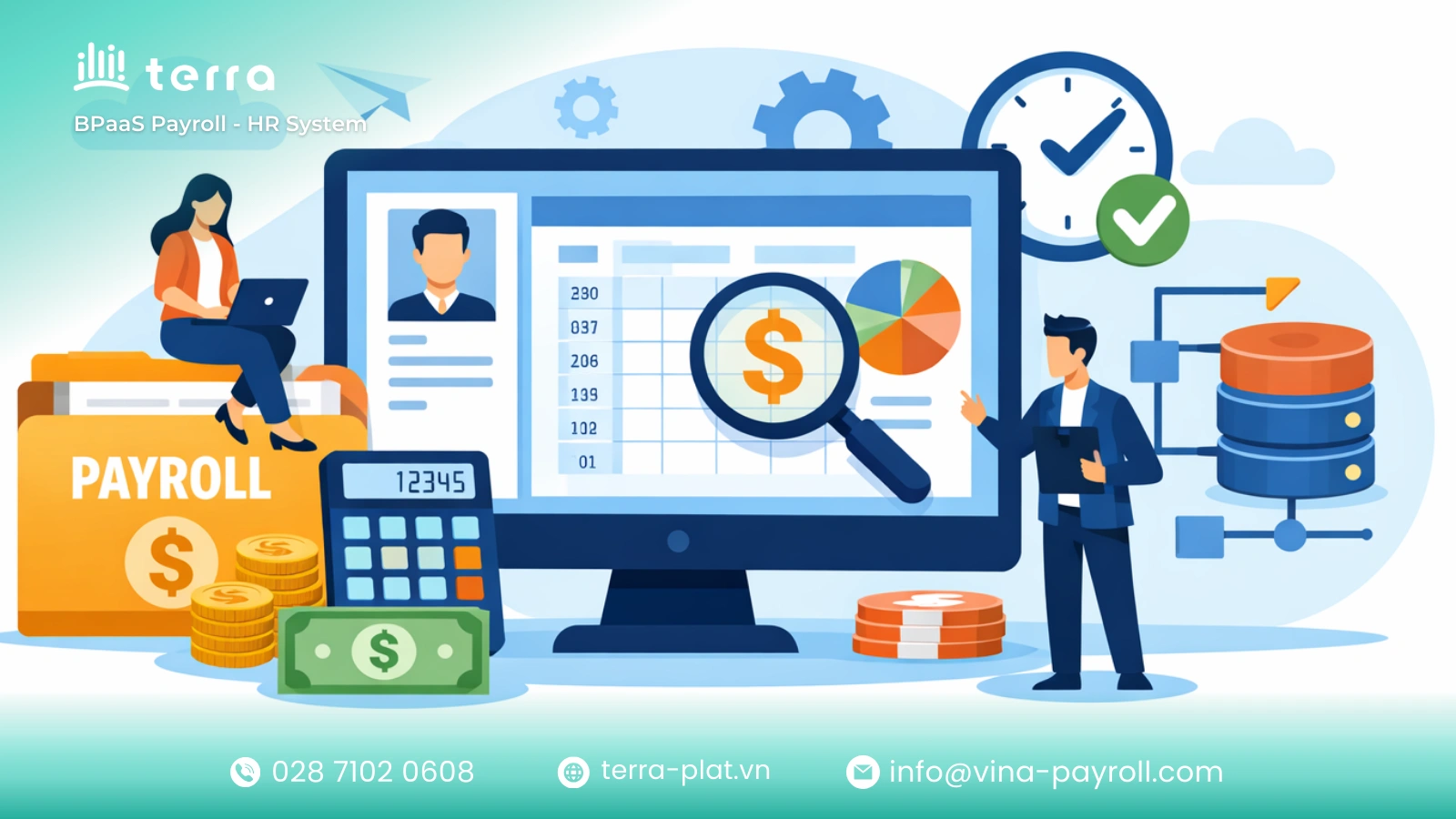
To understand the value of modern compensation management, one must first define the digital infrastructure that ensures every employee is paid accurately and on time. A database payroll is a centralized, secure digital repository designed to store, manage, and automate the processing of complex employee compensation data.
By utilizing a professional payroll data storage system, organizations eliminate data silos between HR and Finance, ensuring that every calculation, from a CEO’s bonus to a technician’s overtime, is pulled from a unified source.
In the context of Vietnam’s 2026 compliance requirements, a centralized database payroll typically tracks the following critical data points:
- Employee identity & regulatory profiles: Includes full names, addresses, personal tax codes (MST), and Social Insurance book numbers to ensure legal reporting accuracy.
- Comprehensive salary structures: Data on gross base pay, whether for executive high paying jobs or hourly rates for blue collar jobs, including specific regional minimum wage tiers under Decree 293/2025/NĐ-CP.
- Integrated attendance & time tracking: Precise records of hours worked, overtime (OT), night shift differentials, and paid leave (sick, maternity, or annual) to calculate fluctuating monthly earnings.
- Statutory deductions & tax withholding: Automated calculations for Personal Income Tax (applying the 2026 family deduction of 15.5 million VND) and Social Insurance contributions (10.5% for employees) as per the Law on Social Insurance 2024.
- Benefits & variable pay: Centralized tracking of mandatory insurance, seniority bonuses, and non-taxable allowances like meal or telephone stipends.
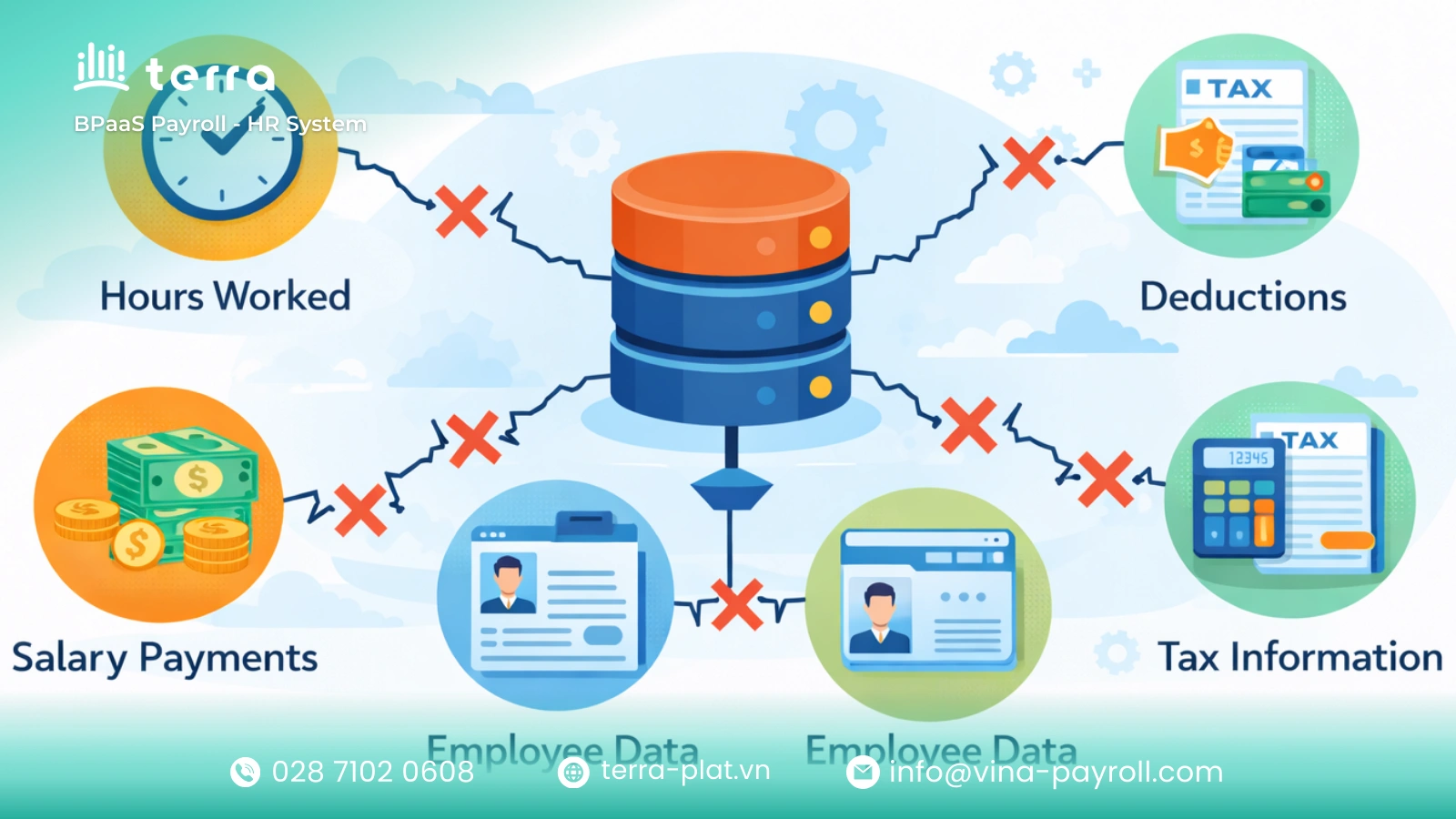
5 payroll data points that often break without a centralized payroll database
Implementing effective payroll database management is the only way to prevent the following common technical failures:
Inconsistent overtime calculation across departments
When OT rules are stored in separate departmental spreadsheets, discrepancies in “Night Shift” or “Holiday” premiums are inevitable. Under Vietnam’s Labor Code, miscalculating overtime can lead to costly labor disputes. A centralized employee payroll database system ensures that every department applies the same automated logic to both high paying jobs and blue collar jobs.
Tax deduction mismatches between HR and Accounting
Personal Income Tax (PIT) requires absolute synchronization. With the 2026 family deduction adjustments (15.5 million VND for taxpayers), any lag between HR’s dependent records and Accounting’s ledger results in incorrect filings. This mismatch is a leading cause of tax audit penalties for FDI firms.
Outdated employee benefit records
Static files often fail to track real-time changes in insurance or retirement contributions. In the context of the Law on Social Insurance 2024, failure to update a benefit record instantly can leave an employee uncovered, shifting the legal and financial liability directly onto the employer.
Attendance-to-payroll sync failures
Manual data entry is the “silent killer” of accuracy. Without a direct link between the time-tracking hardware and the payroll data storage system, “ghost hours” or missed shifts go unnoticed. Studies show that manual sync failures can lead to an error rate of up to 8% in total payroll costs.
Payroll reporting discrepancies
Inconsistent data makes it impossible to generate a “Single Source of Truth.” When HR and Finance report different figures for the average salary in Vietnam, leadership cannot perform accurate labor cost audits or financial forecasting, leading to flawed business decisions.
Comparison: Manual vs. Centralized database payroll
The table below illustrates the typical impact of moving from fragmented data to an integrated payroll data storage system:
| Data point | Decentralized (high risk) | Centralized (optimized) | Business impact |
| Overtime | Manual tracking; prone to rule misinterpretation | Automated rules based on local labor laws | Reduces labor cost leakages by 5-10% |
| Tax/SI | Monthly manual updates; high risk of “back-pay” penalties | Real-time sync with latest 2026 legal decrees | Eliminates compliance fines |
| Data Integrity | Multiple versions of the same file (Data Silos) | Single source of truth for all departments | Saves 20-40 hours of HR admin time/month |
| Security | Password-protected excels; high leak risk | Role-based access (RBAC) & encrypted storage | ISO-standard data protection |
How a database payroll system works
A modern database payroll functions through four critical stages that transform raw data into secure, compliant paychecks.
Data input and seamless integration
The process begins by gathering raw information from multiple departments into a centralized payroll data storage system. In a digital-first environment, this involves syncing data from time-tracking software (to capture hours worked), benefit providers (for insurance premiums), and HRIS systems (for new hire details). This stage eliminates the need for manual entry, which is the primary cause of errors in both high paying jobs and labor-intensive blue collar jobs.
Employee record aggregation
Once the data is ingested, the system aggregates all relevant variables into a “Single Source of Truth” for each individual. This includes consolidating fixed base pay, variable bonuses, and specific deductions.
Whether managing the average salary in Vietnam for a local team or a diverse global workforce, aggregation ensures that no component, from a senior manager’s performance incentive to a factory worker’s night shift differential, is overlooked.
Automated validation and calculation
This is the “engine” of the database payroll, where automated rules verify the aggregated data against current labor laws and tax codes.
For companies in Vietnam, this stage is where the system applies the 2026 Personal Income Tax (PIT) thresholds and the updated Social Insurance contribution rates mandated by the Law on Social Insurance 2024. By automating these calculations, businesses reduce the risks often associated with manual outsourced payroll services.
Analytics, reporting, and audit access
The final stage provides stakeholders with real-time visibility into labor costs and financial transparency. Modern systems offer secure, role-based access to audit logs and analytics dashboards, allowing CFOs to monitor budget vs. actual spend. This high level of oversight is vital for maintaining compliance and preparing for statutory audits without the stress of fragmented data.
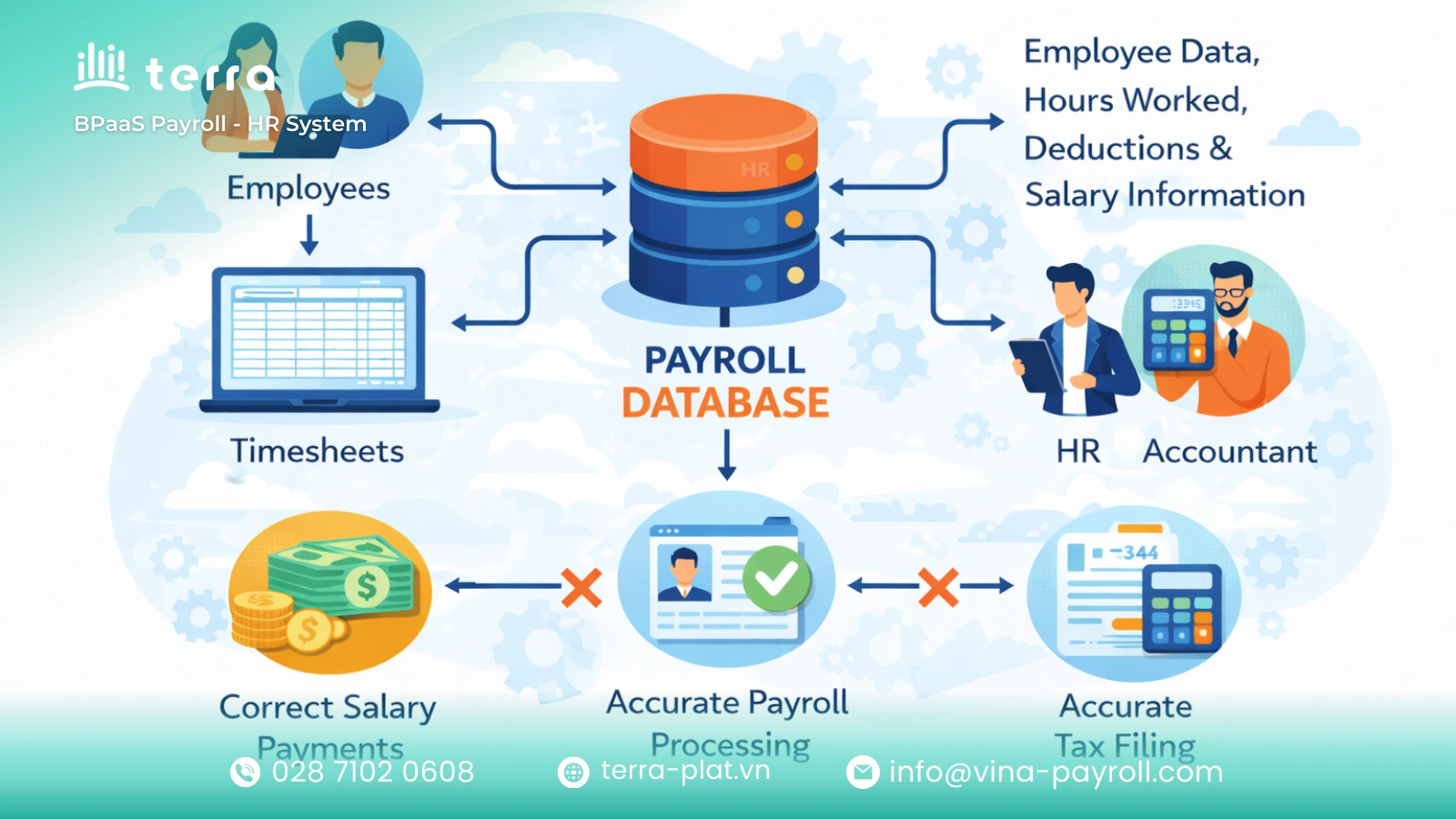
Data transformation: From input to net pay
| Payroll stage | Data processed | Compliance factor (Vietnam 2026) |
| Input | Attendance logs, OT requests, shift data | Adherence to Article 107 of the Labor Code on OT hours |
| Aggregation | Base salary + Allowances + Bonuses | Tracking against Region I-IV minimum wage tiers |
| Calculation | Gross-to-Net conversions | Applying 15.5M VND personal tax deduction |
| Reporting | Pay slips, bank transfer files, tax reports | Automated submission of Form 05/KK-TNCN |
Payroll database management best practices
Maintaining a high-performing payroll system requires strict adherence to data governance and security protocols to ensure that sensitive information remains accurate, secure, and ready for statutory scrutiny. Effective management of your employee payroll database system is the foundation of corporate transparency and employee trust.
Managing payroll data integrity
To prevent the “garbage in, garbage out” syndrome, organizations must implement regular data cleansing and automated validation routines. This involves verifying that inputs, such as the average salary in Vietnam for new hires or updated family deductions, are accurate before the pay run. Data integrity ensures that your payroll data storage system reflects the true financial obligations of the company at any given second.
Role-based access control in payroll database
Security is paramount when handling sensitive financial records. Implementing Role-Based Access Control (RBAC) ensures that only authorized personnel have access to specific data tiers. For instance, an HR assistant might only view attendance logs for blue collar jobs, while a Payroll Manager accesses sensitive tax withholding details for executive high paying jobs, effectively preventing internal fraud and data leaks.
Payroll database maintenance and audit logs
Keeping granular, time-stamped records of every data modification is a non-negotiable best practice for regulatory compliance. Detailed audit logs track “who, what, and when” for every change made within the database payroll. These logs serve as your primary defense during external tax audits or social insurance inspections, proving the transparency of your financial processes.
Integration with HRIS and attendance systems
The most effective way to eliminate manual entry errors is through seamless integration. By linking your database payroll directly with HRIS and time-tracking hardware, you ensure a “touchless” data flow. This integration is critical for accurately calculating night shift differentials or performance bonuses without the lag associated with traditional outsourced payroll services.
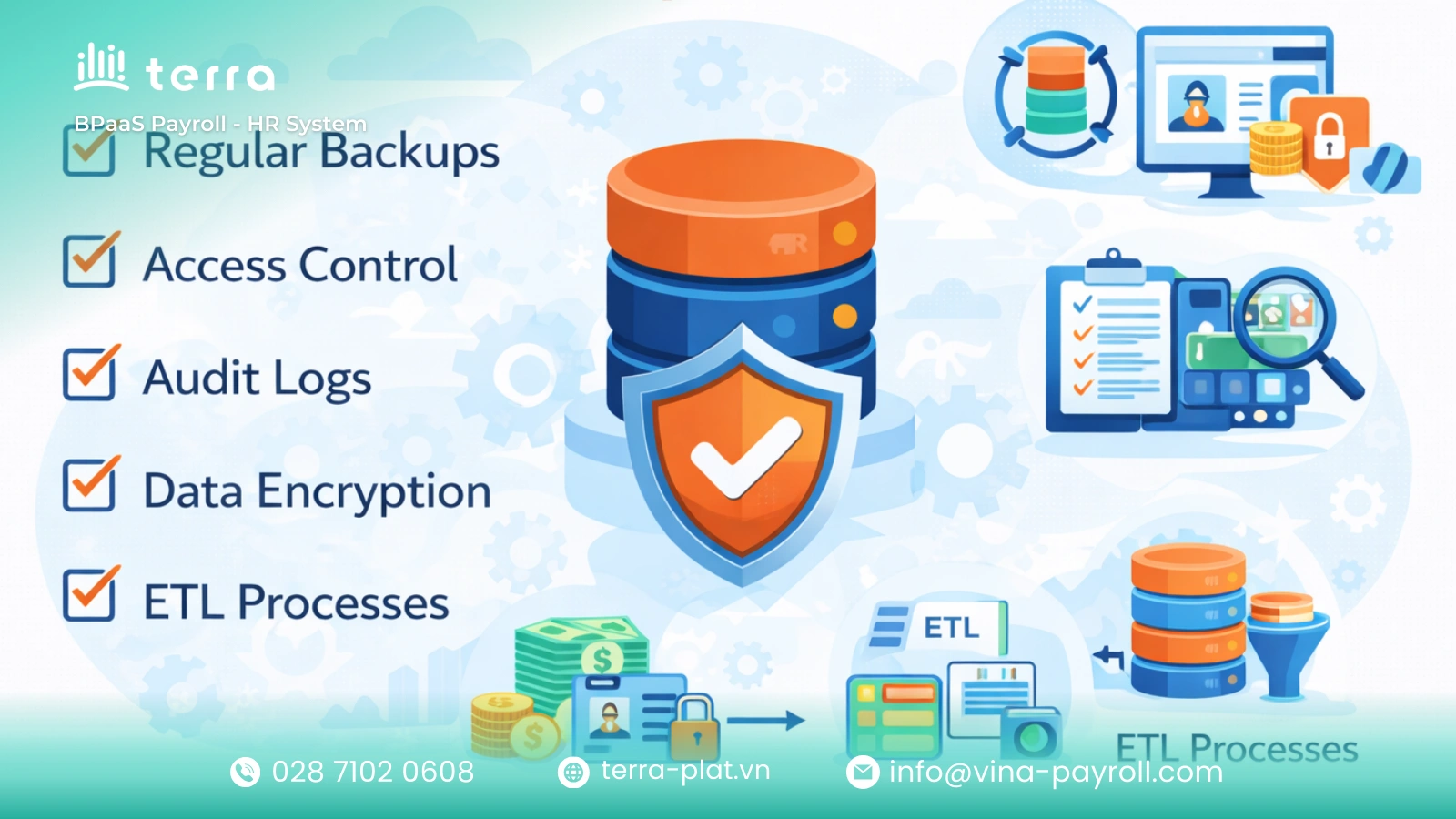
Comparison: Standard vs. Advanced payroll database governance
| Governance area | Standard practice (high risk) | Advanced best practice (low risk) |
| Data Security | Shared passwords or open spreadsheets | Multi-factor authentication and RBAC |
| Verification | Manual spot-checks before pay run | Automated validation and “Payroll Health Checks” |
| Compliance | Periodic updates based on news | Direct integration with 2026 legal engines (PIT/SI) |
| Reporting | Static monthly PDF reports | Real-time analytics and dynamic dashboards |
Centralized vs decentralized payroll database architecture
Choosing the right architecture is a foundational decision that directly impacts how a company scales its global or regional operations. For HR leaders, the choice between a centralized or decentralized database payroll determines the balance between local autonomy and global visibility.
Decentralized architecture
In this model, individual branches or regional offices manage their own independent data systems. While this allows for local flexibility, it frequently results in data fragmentation, creating disconnected “islands” of information. This makes it difficult for headquarters to audit records, increases the risk of “broken” information, and often leads to inconsistent pay practices across different regions.
Centralized architecture
Conversely, a centralized employee payroll database system consolidates all information into a single, secure repository. This “Single Source of Truth” ensures that corporate policies are applied consistently across all jurisdictions.
Centralization is particularly critical for managing high paying jobs, as it provides headquarters with a unified view of labor costs and enables high-level analytics for strategic decision-making.
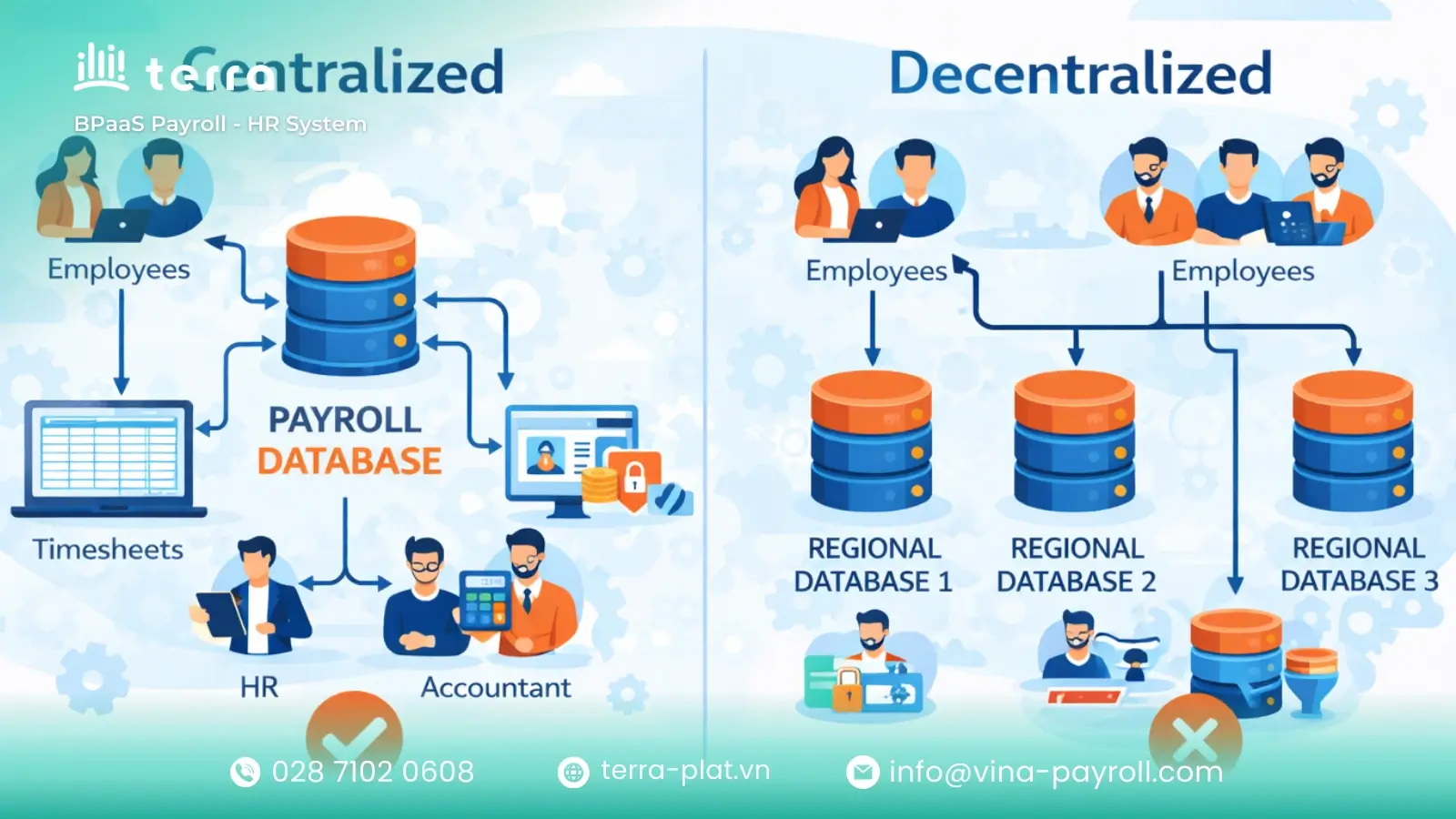
Comparison: Centralized vs. Decentralized payroll architecture
| Feature | Decentralized (high risk) | Centralized (optimized) |
| Data Visibility | Fragmented; requires manual consolidation | Real-time, global visibility |
| Security | Varied standards across local offices | Uniform, high-level security with RBAC |
| Compliance | Prone to local interpretation errors | Automated, consistent legal updates |
| Audit Readiness | Difficult; data silos hide discrepancies | High centralized logs for easy access |
| Efficiency | High administrative overhead per branch | Streamlined via seamless system integration |
Challenges in managing payroll databases at scale
Scalability brings a unique set of hurdles that can quickly overwhelm basic outsourced payroll services or manual internal processes if they lack a sophisticated employee payroll database system.
Data fragmentation
Managing multiple versions of the same employee record across disconnected software platforms (HRIS, CRM, and Accounting) creates dangerous “Data Silos.” For example, an employee’s average salary in Vietnam might be updated in HR records but not instantly reflected in the payroll data storage system, leading to massive manual recalculation errors and delayed payments that damage employee morale.
Compliance across jurisdictions
Staying ahead of shifting local regulations is the greatest challenge for expanding firms. In a scaling environment, a stagnant database payroll cannot automatically handle the nuances of the 2026 PIT family deduction adjustments or the night shift premiums required for blue collar jobs across different regional minimum wage zones. Failure to sync with these laws leads to heavy non-compliance fines during state audits.
Payroll data security
As the volume of data grows, so does the target on your back. Protecting highly sensitive personal and financial information from increasingly sophisticated cyber threats requires more than just a firewall, it requires enterprise-grade encryption and ISO-standard security protocols. At scale, any leak in your payroll data storage system can lead to catastrophic legal liabilities and brand damage.
Reporting inefficiencies
Consolidating data from various sources to get a clear picture of the “Total Cost to Employer” becomes a monumental task at scale. Without a unified database, leadership cannot generate the real-time analytics needed to make data-driven decisions regarding global labor spend or budget forecasting, often resulting in “flying blind” during critical expansion phases.
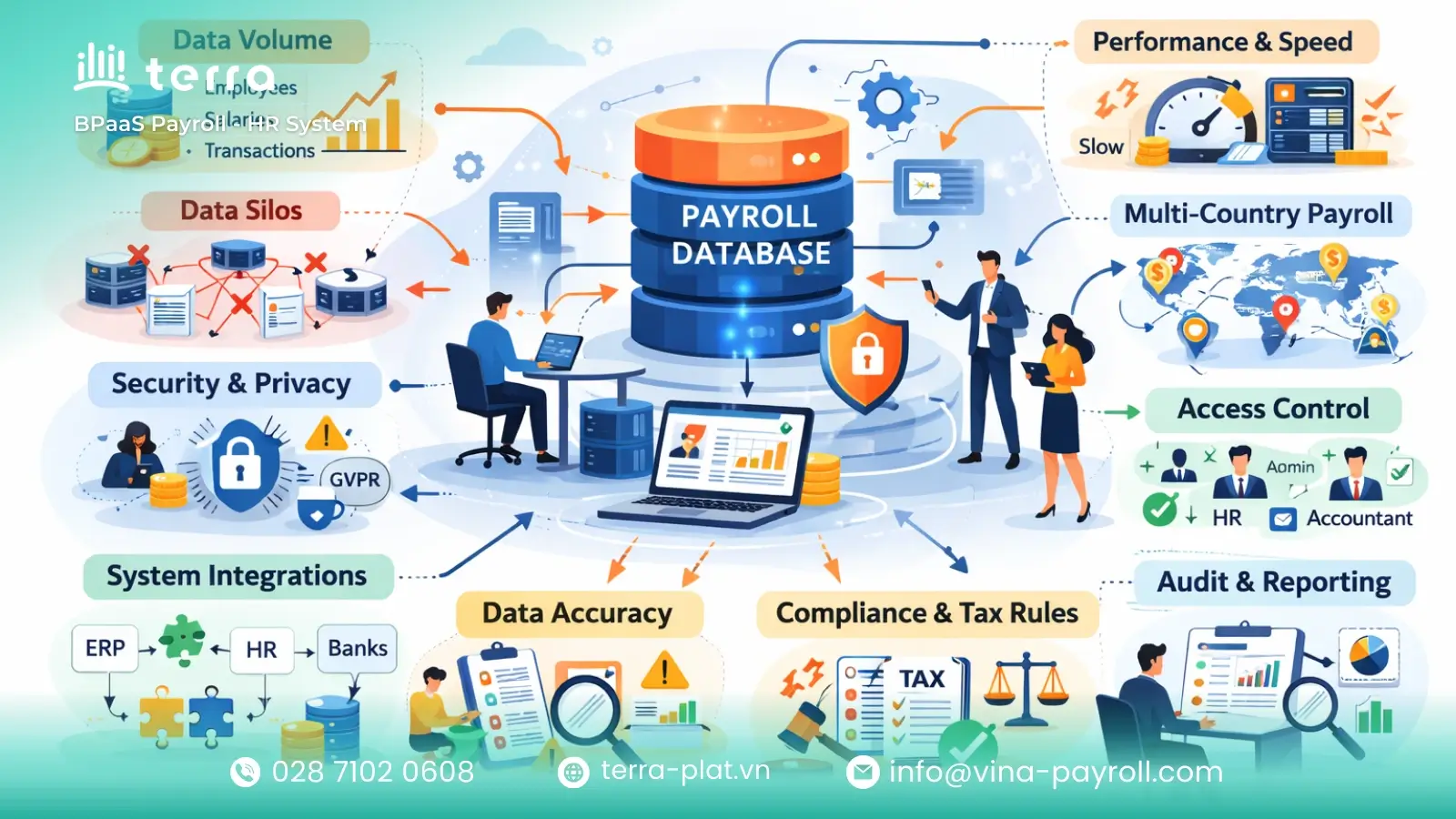
Comparison: Scaling impact on payroll Infrastructure
| Scale factor | Legacy/manual systems (high risk) | Scalable database payroll (low risk) |
| Data synchronization | Manual batch updates; high lag time | Real-time API integration across all platforms |
| Legal updates | Dependent on manual HR research/input | Automated compliance engines (PIT/SI 2026) |
| Data protection | Basic password security; localized storage | Multi-tier encryption & ISO 27001 compliance |
| Decision support | Delayed, fragmented reports (PDF/Excel) | Live dashboards & “Single Source of Truth” |
Why FDIs companies in Vietnam are moving to terra BPaaS Payroll Solutions

Foreign Direct Investment (FDI) companies in Vietnam face a unique set of challenges, from navigating the fluctuating average salary in Vietnam to complying with rapidly evolving labor codes. To solve these complexities, an increasing number of international firms are moving away from traditional models and adopting terra BPaaS Payroll Solutions.
By combining automated technology (SaaS) with expert human outsourcing (BPO), terra offers a “safe, accurate, and efficient” ecosystem that allows FDI firms to focus on their core business activities.
Robust regulatory compliance and risk mitigation
Vietnam’s tax and labor laws are subject to frequent updates. Terra provides automated, up-to-date compliance with the latest regulations concerning Personal Income Tax (PIT) and Social Insurance (SHUI).
This ensures 100% accuracy in calculating salaries for both executive high paying jobs and hourly blue collar jobs, significantly reducing the risk of legal penalties and ensuring the firm is always “audit-ready” according to the Law on Enterprises.
Operational efficiency and cost savings
By utilizing terra’s outsourced payroll services, clients have reported a 50% reduction in manual HR interventions and a 75% reduction in payroll audit preparation time.
This BPaaS model eliminates the need for maintaining an expensive in-house HR team, saving on recruitment and training costs while providing a scalable employee payroll database system that grows alongside the business.
Integrated technology and modern features
A standout advantage for FDI firms is the free access to the “terra HR System” included with payroll services. This all-in-one platform centralizes operations by covering:
- Centralized payroll data storage: Seamlessly manage attendance, leave, and personnel records in one place.
- Advanced tracking: Support for GPS-based attendance and facial recognition for high-precision timekeeping.
- Gold-standard security: The platform is ISO/IEC 27001:2022 certified, ensuring that your payroll data storage system meets international data protection requirements.
Specialized expertise for multinational teams
With a deep portfolio of FDI clients across multiple industries, terra understands the bureaucratic nuances of the Vietnamese market. The platform offers bilingual support (Vietnamese & English), making it the ideal partner for multinational management teams who require 24/7 dedicated support to handle complex, unexpected payroll issues promptly.
Conclusion
Investing in a modern database payroll system is no longer optional for companies that prioritize accuracy and compliance. By centralizing data, implementing best practices, and leveraging advanced solutions, businesses can ensure they remain competitive in a landscape where both high paying jobs and blue collar jobs demand precise, timely, and secure compensation management.









