
In the digital workplace, data protection is not merely an IT concern; it is a critical HR mandate. Payroll data contains an organization’s most sensitive financial and personal information. In this guide, terra explores common vulnerabilities and explains how robust payroll solutions prioritizing data protection safeguard your business against devastating data breaches.
Where payroll data is most vulnerable without proper data protection
When businesses rely on fragmented systems, sensitive data inevitably slips through the cracks. Without strict data leak protection protocols, human error becomes your greatest liability. Here are the most common vulnerability points, illustrated with specific, real-world examples:
Payroll spreadsheets shared internally
- The Vulnerability: Relying on Excel files for salary calculations.
- Specific Example: An HR executive accidentally attaches the master payroll spreadsheet to a company-wide email instead of the HR team thread, instantly exposing every employee’s salary and bank details, resulting in a critical data protection failure.
Email-based pay slip distribution
- The Vulnerability: Sending unencrypted pay slip PDFs via standard email servers.
- Specific Example: A cyber attacker intercepts unencrypted SMTP email traffic, gaining access to hundreds of detailed pay slips that contain tax codes, national IDs, and home addresses, which are then used for identity theft. Standard data protection policies demand secure portals instead of open email.
HRIS – Accounting integration gaps
- The Vulnerability: Manual data transfers between HR Information Systems and Accounting software.
- Specific Example: A payroll officer exports a raw CSV file from the HRIS and saves it to a shared local “Downloads” folder before importing it into the accounting tool. Anyone with network access to that folder can copy the raw data, bypassing all intended data protection barriers.
Unauthorized payroll database access
- The Vulnerability: Failing to revoke access credentials promptly.
- Specific Example: A terminated IT administrator still retains backend access to the legacy payroll server because their credentials were never disabled, allowing them to download the entire employee database maliciously.
In summary, fragmented systems and manual processes expose sensitive information to both internal errors and external cyber threats. Below is a quick-reference matrix highlighting these critical vulnerabilities:
| Vulnerability Area | The Core Vulnerability & Real-World Risk |
| Internal Spreadsheets | Relying on Excel files risks accidental mass exposure of employee salaries and bank details via company-wide emails. |
| Email Payslips | Sending unencrypted PDFs over standard email servers allows attackers to intercept data for identity theft. |
| Integration Gaps | Manual CSV transfers through shared local folders bypass security, allowing anyone on the network to copy raw data. |
| Unauthorized Access | Failing to promptly revoke credentials allows terminated employees to maliciously download entire employee databases. |
Payroll data protection failures that lead to compliance risks
In Vietnam, failing to secure payroll data can now lead to administrative fines of up to 5% of annual revenue or criminal prosecution under Decree 13.
Non-compliance with Vietnam’s Decree 13/2023/ND-CP
Under the new regulations, payroll data is classified as “Sensitive Personal Data” (Data regarding income, health insurance, and social status). Companies are now legally required to conduct a Personal Data Protection Impact Assessment (DPIA) and submit it to the Ministry of Public Security. Failure to implement mandatory encryption or having a leak without an immediate 72-hour notification can result in severe sanctions and the suspension of data processing activities, effectively paralyzing your payroll department.
Incorrect PIT & social insurance deductions
When master data files lack integrity protection, unauthorized users can accidentally or maliciously alter formulas. This leads to systemic underpayments or overpayments in PIT and social insurance. During a government tax audit, these “technical glitches” are viewed as tax evasion or non-compliance, resulting in hefty back-taxes, interest penalties, and “blacklisting” in future inspections.
Payroll reporting discrepancies and “Red flag” triggers
If your data is not protected from tampering, the figures reported to the authorities will not match your actual bank disbursements. These electronic discrepancies act as “red flags” in the state’s Big Data monitoring system, triggering immediate, invasive labor inspections that scrutinize every detail of your HR operations.
Outdated employee compensation records
Data mismanagement often means relying on obsolete files. For example, calculating a final severance payment using last year’s salary data, or failing to update the system to reflect the new Vietnam minimum wage, directly violates labor rights and invites employee lawsuits.
Payroll audit trail gaps
When a regulatory body investigates a complaint, they require an audit trail. If your system cannot definitively prove who changed a salary figure and when, your company assumes full legal liability for the error.

Payroll data access governance: who should see what and when
The cornerstone of data protection and privacy is the principle of least privilege. Employees should only access the data strictly necessary to perform their specific job functions.
Department-level payroll visibility
Department heads/payroll outsourcing need to manage their budgets, but they do not need to see individual tax deductions. Access should be restricted to aggregate departmental labor costs rather than line-by-line employee breakdowns. Only the C&B Director should have full visibility of the “Executive Compensation” layer.
This prevents “salary benchmarking” gossip, internal conflict, and aligns with best data protection practices.
Role-based access to salary records
Different HR roles require different views. For instance, a line manager might be granted access to view the performance bonus component of a 3P salary structure for their team, while only the core C&B specialist can view the fixed base salary and total compensation package.
Payroll data approval workflows
Implement strict, multi-tier approval chains. The person who inputs the overtime data should not be the same person who authorizes the final bank payout. Segregation of duties prevents internal fraud.
Logging payroll data access history
Every action whether viewing, editing, or exporting a report must be timestamped and linked to a specific user identity. This creates accountability and deters internal snooping.
How to audit payroll data protection before labor inspection
Proactive auditing allows you to identify and fix security gaps before an official inspector does. Regular internal audits are a mandatory defense mechanism.
Payroll reporting access logs
Review the system logs monthly to identify any anomalies. If a junior HR staff member is exporting full company payroll reports at 2:00 AM on a Sunday, it requires immediate investigation.
Payroll data traceability checklist
Ensure every change in the system has a documented source. If an employee cashes out unused annual leave, the system data must perfectly trace back to the signed approval form to ensure continuous data protection compliance.
Payroll database permission review
Conduct quarterly permission audits. Ensure that employees who have transferred departments or left the company have had their payroll access rights revoked immediately.
Payroll data encryption readiness
Verify with your IT department that all payroll databases are encrypted both at rest (stored on servers) and in transit (when being accessed via web browsers).

Practical data leak protection measures for payroll systems
To actively defend against modern cyber threats, businesses must move beyond policy documents and implement hard technical safeguards.
Payroll database monitoring
Deploy software that automatically monitors the database for unusual behavior, triggering instant alerts to administrators if a mass data export is attempted.
Secure payroll data storage system
Migrate away from local hard drives and vulnerable physical servers. Utilize enterprise-grade cloud environments that offer automated backups and disaster recovery protocols.
Employee payroll data masking
Implement data masking in your software UI. For example, when an HR assistant views a batch file, the system displays only the last four digits of bank accounts and masks personal ID numbers. This limits the “blast radius” of a physical screen-peek or an accidental screenshot leak.
MFA for payroll reporting access
Enforce Multi-Factor Authentication (MFA). Anyone attempting to access financial reports or payroll modules must verify their identity via a secondary device, rendering stolen passwords useless.

When manual payroll handling becomes a data protection risk
The human element is consistently the weakest link in information security. Relying on manual processes nullifies even the strictest IT policies, making professional payroll services a necessity rather than a luxury.
Spreadsheet-based payroll updates
Manual entry invites critical version control issues. Passing a “Payroll_Final_v3.xlsx” file back and forth lacks encryption and guarantees that multiple copies of highly sensitive data exist across various unsecured laptops.
Payroll cycle delays
When HR teams are overwhelmed and behind schedule, they take shortcuts. Rushing to meet a payout deadline often leads to sharing sensitive data over unencrypted consumer chat apps (like Zalo or WhatsApp) to get quick approvals.
Multi-country payroll inconsistencies
Managing cross-border teams manually means dealing with different local systems, diverse privacy laws, and varying security standards. This fragmentation is a massive liability that requires a unified payroll service built on strong data protection to resolve.

How terra BPaaS Payroll strengthens data protection for payroll operations
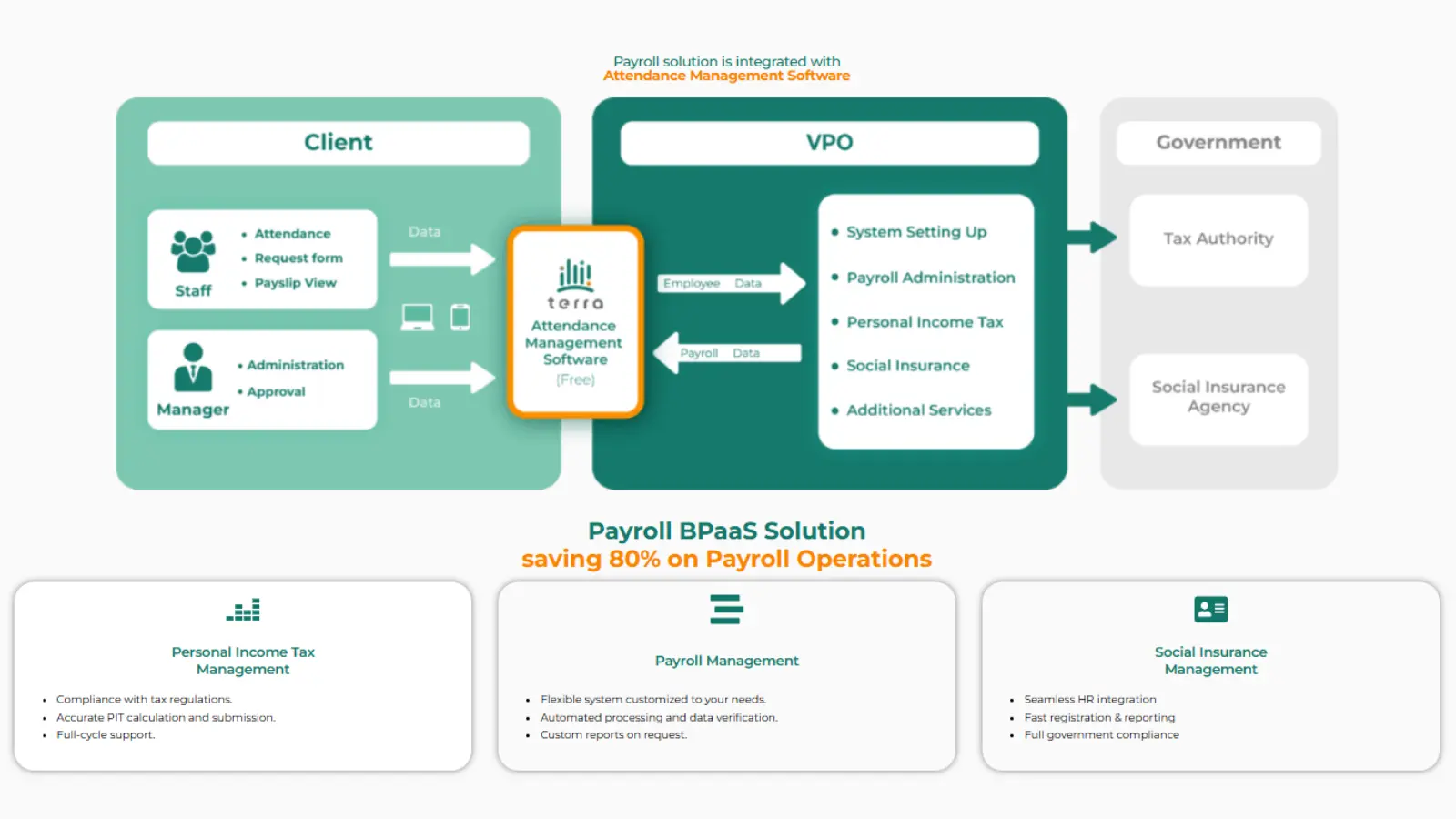
To effectively mitigate risk and maintain compliance, businesses are turning to professional payroll outsourcing. terra utilizes a BPaaS (Business Process as a Service) model, combining SaaS technology with expert outsourced payroll services to significantly enhance your data security.
Secure payroll data storage system
We minimize the vulnerabilities associated with local file sharing. Our platform centralizes your data within a secure, encrypted cloud infrastructure, providing strong protection against common external threats and internal mismanagement.
Role-based payroll data access
The terra system enforces strict, granular access controls. We ensure that your team only sees the data relevant to their specific clearance level, maintaining confidentiality across the organization.
Standardized payroll data protection processes
Security is a core component of our operations. Our payroll outsourcing services are governed by stringent data security protocols, ensuring your information is handled systematically and according to industry standards.
Compliance-ready payroll infrastructure
As a reliable payroll service in Vietnam, terra continuously updates its systems to reflect the latest local tax laws and data protection regulation requirements. By choosing terra for your payroll outsourcing, you ensure your payroll solutions are highly accurate and strictly aligned with current legal standards.
Contact terra HR Solution now for advice!
Conclusion
Effective data protection is the non-negotiable backbone of modern HR operations. By eliminating vulnerable manual processes and partnering with secure payroll services like terra, businesses can safeguard sensitive information, ensure strict compliance, and build lasting trust with their workforce.









