
Pay inversion is one of the fastest-growing compensation risks at FDI companies in Vietnam. It happens when newly hired employees earn more than experienced staff in the same role, not because of better performance, but because market wages have risen faster than internal salary adjustments.
In this guide, terra explains what pay inversion is, how to identify it early, and the exact steps HR teams can take to fix it before it impacts retention and compliance.
| Question | Quick Answer |
| What is pay inversion? | When a new hire earns more than existing staff in the same role due to rising market wages rather than greater experience or qualifications. |
| How is pay inversion different from pay compression? | Pay compression is a narrow gap between levels. Pay inversion is when the gap reverses and a junior earns more than a senior. |
| What causes pay inversion? | Fast-rising market wages, infrequent internal salary reviews, minimum wage increases, and competitive hiring pressure. |
| Is pay inversion illegal in Vietnam? | Not directly, but it can trigger labor disputes and turnover that create legal and financial exposure. |
| What is the fastest sign of pay inversion? | Experienced employees resigning shortly after new hire onboarding when they discover the salary difference. |
| How is it fixed? | Internal equity audit followed by targeted salary adjustments and a revised salary band structure. |
What is Pay Inversion?

Pay inversion is a compensation situation where employees with more experience or seniority earn less than newer colleagues in the same or comparable role, not because of skill differences but because market wages rose faster than internal salary adjustments. It is the extreme end of a progression that starts with pay compression and ends with a visible, morale-damaging reversal.
The progression from normal compensation to pay inversion:
| Stage | What it looks like | Employee reaction |
| Normal pay structure | Senior earns 25 to 35% more than junior in the same role | Motivated, committed to tenure |
| Pay compression | Senior earns only 5 to 8% more | Mild concern, beginning to compare externally |
| Salary inversion | Senior earns equal to or less than junior | Active anger, job searching, high resignation risk |
Pay inversion is specifically different from intentional pay equity. A company deliberately paying equivalent salaries to employees with equivalent performance regardless of tenure is a policy decision. Wage inversion is an unintended structural failure where timing, not performance, determines who earns more.
What Causes Pay Inversion in Vietnam?
Pay inversion in Vietnam is rarely caused by a single factor. Instead, it often results from a combination of regulatory changes and market dynamics that gradually distort internal salary structures over time.
Rising minimum wages and external market pressure
Vietnam’s regional minimum wage has increased 6% in 2024 and 7.2% effective January 2026 under Decree 293/2025/ND-CP. For companies offering starting salaries close to minimum wage, these increases require significant upward adjustments to new hire offers. Existing staff hired two or three years ago at then-market rates may now sit below these new entry-level offers even though their skills and knowledge have grown.
According to Vietnam Briefing (2025), wages at FDI companies in HCMC and Binh Duong have risen 9 to 10% annually over recent years. Companies that give existing staff annual increases of 4 to 6% fall behind this pace within two to three cycles. The math produces pay inversion automatically if nothing else changes. For full wage trend data, see average salary in the world for global context and benchmark.
Competitive hiring pressure in industrial zones
FDI companies in the same industrial park compete directly for the same workers. When a major electronics manufacturer raises entry salaries for technicians or machine operators, the pressure ripples across all supply chain manufacturers in the area. Companies that cannot match the market offer at the gate simply cannot fill vacant roles.
This creates a two-speed salary system inside a single company: new hires brought in at current market rates, existing staff paid at historical rates that have not kept pace. See high paying jobs in Vietnam for sector benchmarks showing where wage pressure is most acute.
Infrequent internal salary reviews
Companies that review salaries annually or less frequently accumulate lag over time. In a market rising 8 to 10% annually, a two-year gap between reviews creates a 16 to 20% deficit between internal rates and market rates. After three cycles without catching up, pay inversion vs pay compression has often already crossed the threshold from uncomfortable to actively damaging retention.
The Real Cost of Pay Inversion
Pay inversion in Vietnam is not just a morale issue. Each of the four cost categories below can be quantified for the purposes of a business case to fix it.

Direct turnover cost
When experienced staff leave because of pay inversion, replacement cost typically runs one to three months of the departing employee’s salary when recruitment, onboarding, and productivity loss during ramp-up are included. For a manufacturing team of 100 people experiencing 20% annual turnover partly driven by salary inversion, this translates to a consistent annual cost that likely exceeds the budget required to correct the inversion.
Training and institutional knowledge loss
Senior employees carry production knowledge, quality process understanding, and client or supplier relationships that cannot be immediately replicated. Pay inversion accelerates the departure of exactly the people who most justified the investment in their development. The new hire who earned more on day one cannot compensate for three years of accumulated capability that walked out the door.
Employer brand damage
In Vietnamese industrial zones, workers share salary information. It is common knowledge within a factory when new hires earn more than veteran staff. Once that reputation spreads externally, the company’s ability to attract qualified candidates at competitive offers weakens even before interviews begin. Fixing internal pay equity is also a recruiting investment, not just a retention action.
Legal exposure from pay disputes
While pay inversion is not directly prohibited, Labor Code 2019 requires that salary differences be based on objective factors including skill, seniority, job complexity, and working conditions. An employer who cannot justify a pay differential between two employees doing the same job faces legal risk during a DOLISA inspection or labor dispute resolution.
If pay inversion leads to collective resignations or mass terminations, severance payment obligations under Article 47 of the Labor Code 2019 may also be triggered. For severance calculation methodology, see the severance payment article. For a full picture of how total labor cost models should account for pay inversion risk, see the labor cost article.
How to Diagnose Pay Inversion: Internal Equity Audit
A structured internal equity audit is the only reliable way to know the extent of pay inversion before fixing it. Five steps:

Step 1: Pull salary data by job grade
Extract current gross salary for all employees, organized by job grade or role category. This data should come from the central payroll database, not individual department records. For companies managing data across multiple systems, this is often the first moment pay inversion becomes visible numerically. The pay slip in payroll article explains what data should be consistently recorded to support this analysis.
Step 2: Calculate the compa-ratio for each employee
| Compa-ratio = Employee actual salary / Salary band midpoint for the role |
A compa-ratio below 0.85 typically indicates compression. When a junior employee’s compa-ratio exceeds a senior employee’s ratio in the same role band, compensation equity has inverted. Run compa-ratios for every employee in each grade before drawing conclusions.
Step 3: Map salary against tenure
List all employees with three or more years of service and compare their salaries against employees hired in the past 12 months in equivalent roles. Any case where a newer hire earns more than a longer-tenured peer in the same grade, without an objective justification, is a documented instance of pay inversion in Vietnam.
Step 4: Quantify the affected population
Count how many employees are affected, calculate the aggregate salary gap, and model what it would cost to correct the inversion fully. A correction budget that covers 30 to 50% of the gap is often more achievable and still sufficient to retain the most at-risk employees.
Step 5: Prioritize by risk
Not all cases of pay inversion carry the same turnover risk. Prioritize roles with the highest replacement cost, the most critical institutional knowledge, and the most visible salary differential. Address the most damaging cases first even if the full correction takes more than one budget cycle.
Five Steps to Fix Pay Inversion at FDI Companies
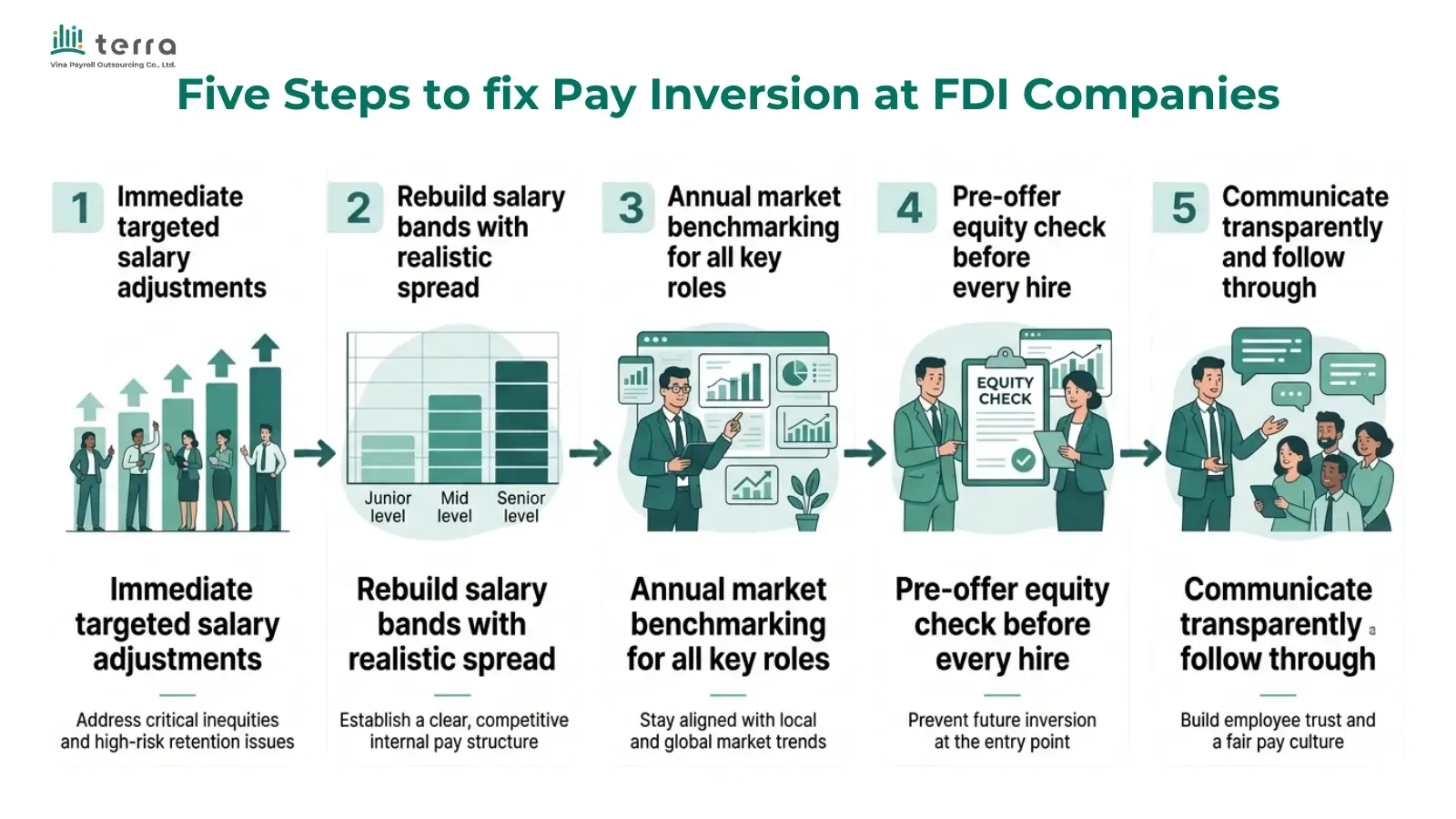
Step 1: Immediate targeted salary adjustments
Correct the most severe inversions first. Identify employees who are earning significantly below new hire rates for the same role and provide off-cycle increases. Announce these adjustments as a compensation equity correction, not as a favor or reward for complaining. Transparency reduces rumors and signals that the company manages pay fairly.
Step 2: Rebuild salary bands with realistic spread
Establish minimum, midpoint, and maximum for each job grade. The typical range spread is 50 to 80% from minimum to maximum. A band too narrow creates compression the moment market rates shift. A band too wide signals that the grading structure has broken down.
Step 3: Annual market benchmarking for all key roles
Set up an annual market review cycle comparing internal salary bands against external data for all job grades, not just high-turnover roles. In Vietnam’s rising wage market, a one-year lag between reviews is already enough for compression to emerge in fast-moving sectors. See average salary in the world for global benchmark context.
Step 4: Pre-offer equity check before every hire
Require hiring managers to compare any proposed offer against the current salaries of all employees in the same job grade before finalizing. This single step prevents wage inversion at the source. New hire offers that would create inversion should be escalated for an HR and finance review of whether a simultaneous adjustment for existing staff is feasible.
Step 5: Communicate transparently and follow through
Tell affected employees directly that the company recognizes the pay inversion problem, has a specific plan to address it, and will execute that plan on a stated timeline. Employees who receive a credible explanation and a realistic timeline are significantly more likely to stay through the correction period than those who receive evasive answers or discover the fix by accident.
Pay Inversion and Total Labor Cost Management
The most counterproductive aspect of pay inversion is that it typically emerges at companies trying to control labor costs by keeping existing salaries flat while offering competitive new hire rates. The result is that the apparent cost saving on existing staff is consumed multiple times over by turnover-related costs.
Modeling the true cost of pay inversion requires including: replacement and onboarding cost per departure, productivity loss during role vacancy and ramp-up, training investment lost when senior staff exit, and the downstream effect on production quality or output during high-turnover periods.
For a complete model of how labor cost compounds across turnover, corrections, and SHUI implications, see the labor cost article. For how a payroll audit surfaces hidden labor cost exposure, see the dedicated payroll audit article.
When pay inversion drives resignation waves, the company also faces potential severance payment obligations for employees who have worked more than 12 months. Budget the correction, including both salary adjustments and SHUI contribution increases at approximately 21.5% of each increment, before dismissing the cost of addressing pay inversion.
Source: Labor Code 2019 Articles 46, 47; Decree 12/2022/ND-CP
FAQ: Pay Inversion
Six questions on how pay inversion is identified, communicated, and resolved.
Is pay inversion the same as pay compression?
No. Pay compression is when salary gaps between job levels become too narrow to be meaningful. Salary inversion is the more severe outcome: the gap reverses, and a lower-level or less experienced employee earns more than a higher-level or longer-tenured peer. Compression often leads to inversion if left unaddressed over multiple salary review cycles.
How common is pay inversion at FDI companies in Vietnam?
Increasingly common. With Vietnam minimum wages rising 6 to 7% annually in recent years while many companies give internal increments of 3 to 5%, the math produces inversion over two to three cycles for employees hired at historical market rates. It is most acute in manufacturing, logistics, and electronics assembly, where external wage pressure is highest.
Does pay inversion violate Vietnam labor law?
Not directly. However, the Labor Code 2019 requires that salary differentials be justified by objective factors such as skill, seniority, and job complexity. If an employer cannot justify a pay differential during a labor inspection or dispute resolution process, it creates legal exposure. The risk increases significantly if affected employees file collective complaints.
How do I explain salary inversion to affected employees?
Directly and early. Acknowledge the situation, explain that it resulted from the pace of external market change rather than a judgment about the employee’s value, commit to a correction timeline with specific milestones, and follow through. Employees who receive an honest explanation with a credible plan are far more likely to remain through the correction than those who feel the company is being evasive.
Can pay inversion happen in one department but not others?
Yes, and this is the most common pattern. Pay inversion typically emerges first in roles facing the most external hiring pressure, such as technical operators, bilingual administrative staff, and logistics coordinators. Running a compa-ratio analysis by department, not just company-wide, reveals exactly where the problem is concentrated and allows prioritized correction.
How does fixing pay inversion affect SHUI contributions?
When salaries are adjusted upward to correct pay inversion, SHUI contribution bases increase accordingly. The employer should budget for both the salary increment and the resulting employer SHUI cost of approximately 21.5% of each increment. If corrections push any employee above the SHUI contribution cap of VND 46,800,000/month from July 2025, those amounts above the cap do not attract additional SHUI. See outsourced payroll services for how terra manages pay adjustment processing across the full workforce.
How terra supports FDI companies in maintaining payroll consistency and internal equity
Rather than positioning itself as a compensation design tool, terra supports HR teams by providing accurate payroll services, monitor and manage salary structures effectively:
- Reliable payroll data for internal analysis: terra’s structured payroll system ensures consistent gross-to-net calculations across all employees, enabling HR teams to extract clean data for compa-ratio and internal equity reviews.
- Pre-hire salary benchmarking support: On-demand payroll and salary reports by job grade help hiring managers validate new offers against existing structures, reducing the risk of internal misalignment.
- Seamless salary adjustment processing: terra supports off-cycle salary changes and ensures all related SHUI and PIT updates are reflected accurately within the same payroll cycle.
- Automated gross-to-net consistency: Correct SHUI rates, PIT calculations, and net pay are applied automatically for every employee, minimizing discrepancies caused by manual processing.
About terra
terra is managed by Vina Payroll Outsourcing Co., Ltd., part of Japan’s I-GLOCAL group. The service leverages more than 20 years of experience providing payroll services and advisory support to Japanese companies operating in Vietnam.
Rather than functioning as a standalone software solution, terra follows a BPaaS (Business Process as a Service) approach, combining payroll outsourcing with a robust digital platform. This model allows businesses to scale payroll operations effectively while maintaining full visibility and control, ensuring everything from time tracking to salary payments is streamlined, compliant, and easy to oversee.
Conclusion
Addressing pay inversion is not an additional labor cost but a reallocation of cost from high-turnover consequences to planned, sustainable salary investment.
For FDI companies that want to understand their current pay inversion exposure before it escalates, contact terra for a payroll data review. See also payroll audit and outsourced payroll services for the full range of terra’s payroll support services.









