
If you are about to move for work, or you already have and want to get the admin right, this guide covers what actually matters in 2026. Working in Vietnam as an expat means a work permit tied to your employer, payroll deductions that are smaller than most newcomers expect, a personal income tax regime that changed on 1 July 2026, and one refund most people forget on the way out. This is a practical walkthrough for foreign professionals, from the work permit and contract to pay, tax, cost of living, jobs, and reclaiming your social insurance when you leave.
Why Vietnam works for expats right now?
Vietnam pairs fast economic growth with a low cost of living, which is why foreign professionals keep arriving. In the InterNations Expat Insider 2024 survey it ranked 8th of 53 destinations and first for personal finance three years running. For most expats the appeal is a comfortable life on a salary that stretches much further than at home.
Demand for international talent sits in Ho Chi Minh City, Hanoi and Da Nang, driven by manufacturing, technology and foreign investment. The pull that keeps people here is financial. What draws most foreign professionals comes down to a few concrete things:
- A low cost base, so a mid level salary supports a comfortable life with real savings.
- Early responsibility, with leadership and specialist roles opening sooner than in mature markets.
- A regional hub position, with fast, cheap travel to Singapore, Bangkok and Hong Kong.
- Established expat districts that make settling in quicker for new arrivals.
The trade off of working in Vietnam as an expat is administration. The work permit, visa, contract, payroll and tax all follow specific rules, and two of those rules changed in 2025 and 2026. Getting the sequence right on the way in, and on the way out, is what separates a smooth stint from an expensive one.

How to work in Vietnam legally: Work permit and visa
Most foreign roles need a work permit before you start, and your employer applies for it, not you. The permit is tied to your job, and your visa or temporary residence card runs with it, under Decree 219/2025/NĐ-CP effective 7 August 2025. Lose the job and both close, so plan renewals and moves early.
Your employer submits the file, but you supply most of the documents, so start early because legalising foreign paperwork can take weeks. A work permit application for a foreigner in Vietnam usually needs:
- A legalised university degree or equivalent qualification.
- A criminal record check from your home country or latest country of residence.
- A health check at an approved Vietnamese hospital.
- Proof of professional experience, often three years or more.
- A passport valid for at least six more months.
A 2025 change matters here. Authority now sits with the provincial People’s Committee, which can delegate to the Department of Home Affairs, and by law the employer should start the application at least 15 working days before your start date. Once approved, the work visa and a temporary residence card follow, usually up to two years and linked to your contract.
Some employers cut corners, and the cost lands on you. Treat these as reasons to slow down and ask for written proof:
- You are asked to start work before the permit is issued.
- You are told your role does not need a permit, with no documentation to support it.
- A business visa is offered instead of a work permit.
- You are asked to pay for the permit, which is legally the employer’s cost.
Working on a tourist or business visa while the permit is pending is a real risk, not a shortcut. It exposes both sides to fines and can force a restart of the whole process.
Your labour contract and what must be in it
Once the permit is approved you sign a Vietnamese labour contract, and only what is written in it counts. Verbal promises about housing or bonuses carry no legal weight. Get a bilingual version, list every allowance, and do not start work before the contract is registered, or your permit can be at risk.
A proper contract under the Labour Code 2019 sets out the core terms clearly. Check that yours states:
- Job title and description, matching the work permit exactly.
- Salary, pay schedule, and whether figures are gross or net.
- Allowances in writing: housing, flights, health cover, bonuses.
- Annual leave, probation, and contract duration, usually one to two years.
The common failure mode is a housing allowance promised in conversation that never reaches the contract. Without the clause, the employer has no obligation to pay it. A job title that does not match the permit is the other frequent snag, and it surfaces at renewal rather than on day one.
Salary, deductions and take-home pay under the 2026 rules
Expat pay varies by sector, and the deductions are smaller than most newcomers expect. A foreign employee contributes about 9.5% for social and health insurance on a capped base, with no unemployment insurance. Personal income tax changed on 1 July 2026 under a new law, with a higher allowance and a simpler 5 band scale.
Pay for working in Vietnam as an expat depends on your profession, seniority and employer type. The ranges below are indicative monthly figures in US dollars and should be checked against current job postings, since a specialist expat salary in a multinational sits well above a language centre role.
What comes out of your pay: social and health insurance
Foreign employees on a labour contract of 12 months or more join compulsory insurance under the Social Insurance Law 2024 and Decree 158/2025/NĐ-CP, effective 1 July 2025. The employee share is about 9.5%, made up of 8% to the retirement and death fund and 1.5% to health insurance. There is no social insurance for foreigners covering unemployment, so the foreign rate sits below the local rate.
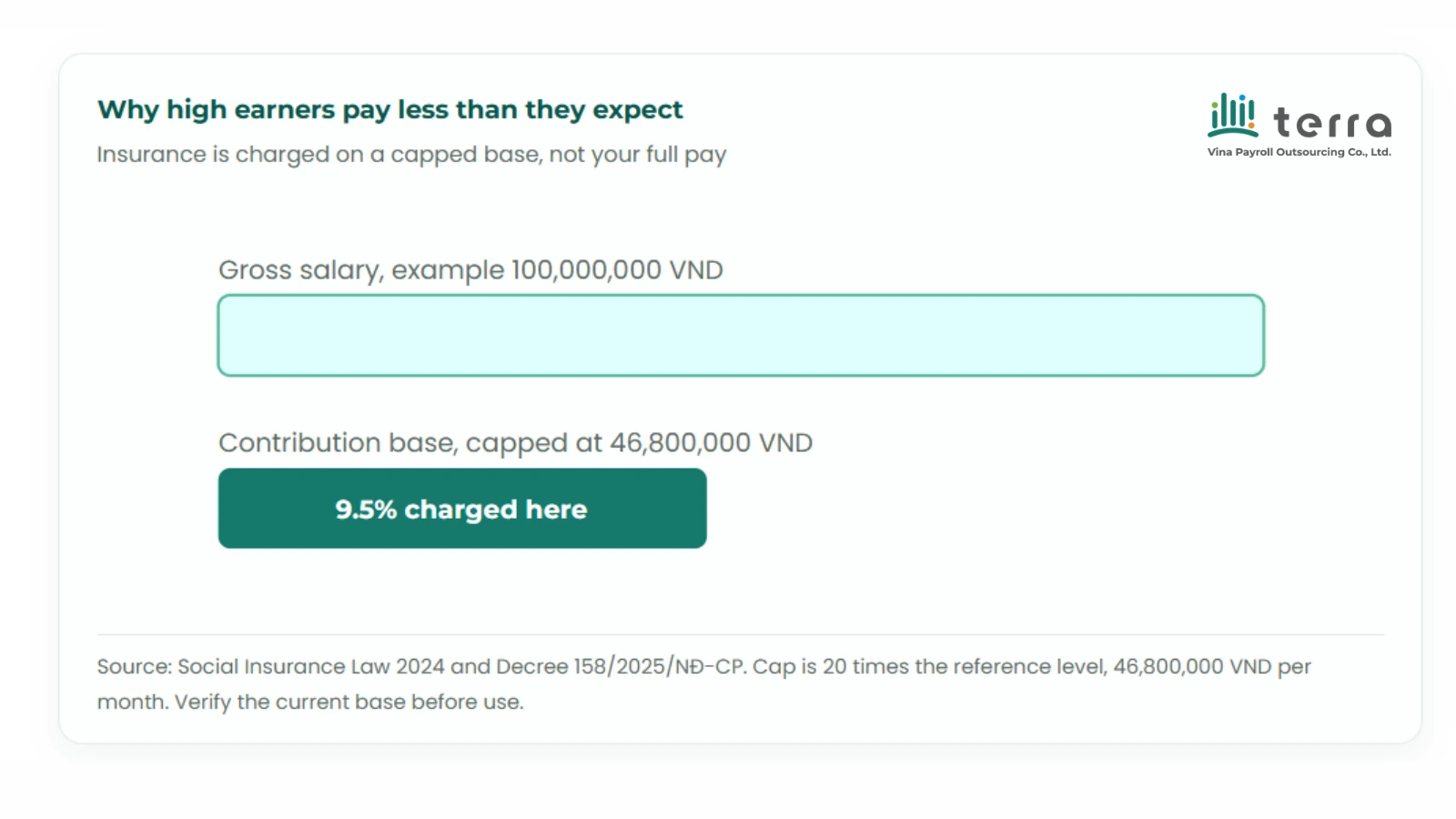
The detail that changes the maths is the cap. Contributions apply to a base capped at 20 times the reference level, currently 46,800,000 VND per month, not your full salary. A high earner therefore pays 9.5% on the capped base, so the effective deduction on a large package is much smaller than 9.5% of gross.
Read the full guide to social insurance rates for foreigners
Personal income tax from 1 July 2026: what changed
From the 2026 tax year, residents use a new 5 band progressive scale under the Personal Income Tax Law 2025 (Law No. 109/2025/QH15), effective 1 July 2026 with the salary provisions applied from 1 January 2026. Non residents still pay a flat 20% on Vietnam sourced income, with no allowance.
Two changes lower the bill for most people. The personal allowance rose to 15,500,000 VND per month, plus 6,200,000 VND per dependent, under Resolution 110/2025/UBTVQH15, up from 11,000,000 and 4,400,000. The scale dropped from 7 bands to 5, removing the old 15% and 25% steps. The bands below apply to monthly taxable income, which is your pay after compulsory insurance and allowances.
One point specific to foreigners: the allowance and bands apply once you are a tax resident, meaning 183 days or more in the tax year, or a permanent home in Vietnam. To claim the 6,200,000 VND dependent allowance you must register each dependent, and each dependent can be claimed by only one taxpayer.
A resident earning 60,000,000 VND per month with no dependents pays about 4,446,000 VND in insurance (9.5% on the capped base), then deducts the 15,500,000 VND personal allowance, leaving roughly 40,000,000 VND taxable. Progressive tax on that is about 4,500,000 VND, for take home pay near 51,000,000 VND. The higher allowance alone cuts the tax bill compared with the old rules.
Rates, bands and the reference level change, so confirm current figures on the Government portal or with a tax adviser before you rely on a number.
Cost of living and where expats settle
Your money goes far. Living costs run roughly 40% below the UK and around 60% below the US, so a mid level salary supports a comfortable life with room to save. Housing is the main variable, and the cost of living in Vietnam for an expat rises sharply in the prime districts of Ho Chi Minh City, Hanoi and Da Nang.
Most foreign professionals cluster in a handful of areas that trade a rent premium for international amenities and a ready made community:
- Ho Chi Minh City: Thao Dien and District 2 for families, District 1 for central living.
- Hanoi: Tay Ho, the lakeside district favoured by long term expats.
- Da Nang: beachfront districts popular with remote workers and smaller budgets.
A habit that protects the savings advantage: keep housing under about 30% of net income and track spending for the first few months. The trap that quietly erases the surplus is treating every weekend as a holiday, a pattern that is easy to slip into and hard to notice.

Banking, currency and health cover
Working in Vietnam as an expat means running two currencies and arranging health cover early. Keep daily money in Vietnamese dong and long term savings in a stable currency, use low fee transfer services, and confirm whether your package includes private health insurance on top of the compulsory scheme.
A simple money structure keeps currency loss down and gives you flexibility at home and abroad:
- A local dong account for salary and daily spending.
- A home country account for commitments such as loans or family transfers.
- A reputable transfer service, since fees on remittances vary widely.
On health, the compulsory 1.5% health insurance gives access to the public system, but most employers add private cover for English speaking clinics and shorter waits. Confirm this is written into your contract, because it is a benefit that is easy to assume and easy to leave unstated.
Where the jobs are for foreigners
The strongest demand for foreign professionals is in technology, finance, education and consultancy, concentrated in Ho Chi Minh City, Hanoi and Da Nang. Most expats arrive with a job already secured, because the work permit needs an employer sponsor. Three routes exist to hold that employment legally.
Technology and engineering carry the deepest demand, from software and data to cybersecurity and technical leadership. Finance and corporate roles sit closer to Western norms on process and English use. Teaching, at international schools or language centres, remains the most accessible entry point for newcomers. The route you use to work legally is a decision in itself:
- Local hire, where a Vietnam based company sponsors your permit and visa.
- Your own company, which gives control but is a heavier, costlier setup.
- An employer of record, best when a foreign company without a local entity hires you.
Working in Vietnam as an expat almost always begins with the offer, then the permit, then the move. Jobs in Vietnam for foreigners are usually found through Vietnam and Southeast Asia focused job boards and through referrals from other expats. Since the permit depends on a sponsor, securing the offer comes before the move, not after arrival on a tourist visa.
Your first 30 days: a practical checklist
Your first month has a fixed order, and the order protects your permit. Confirm the work permit is approved, sign and register the labour contract before you work, open a local bank account, register for your temporary residence card, then register any dependents for the tax allowance.
Working in Vietnam as an expat starts with these arrival steps, in this sequence, since several later steps depend on the earlier ones:
- Get written confirmation that your work permit has been approved.
- Sign the bilingual labour contract and confirm it is registered before you start work.
- Open a Vietnamese dong bank account for salary and daily spending.
- Apply for your temporary residence card through the employer sponsor.
- Register dependents so the 6,200,000 VND allowance applies from the right month.
- Keep digital copies of the permit, contract, visa and payslips.
The one step you cannot reorder is the contract. Starting work before it is registered can invalidate the permit, which is the single most expensive mistake a new arrival makes.
Reclaiming your social insurance when you leave
When you leave Vietnam for good you can make a one time social insurance claim on what you contributed, and the payout is exempt from personal income tax. You can sign an authorization before you fly out, so you never have to return. It is your own procedure, not the company’s, and it is the refund most people forget.
Eligibility for foreign workers follows Article 8 of Decree 143/2018/NĐ-CP. You can claim in these cases:
- Your labour contract ends and the work permit expires without renewal.
- You reach retirement age with under 20 years of contributions.
- You have a life threatening disease defined by the Ministry of Health.
- You qualify for a pension but no longer reside in Vietnam.
The payout equals your total months of contributions divided by 12, multiplied by 1.5, multiplied by your average monthly insured salary. The practical catch is timing: it cannot yet be done fully online, the follow up takes weeks, and claiming erases your prior contribution years, so you trade future pension related benefits for the lump sum.
Claim your social insurance one-time for foreigners
Sign an authorization before you leave and terra handles the one time social insurance claim end to end, fully remote, with bilingual support, so the refund reaches you after you have gone.
Leaving Vietnam cleanly: permits, visa and final pay
Because your permit, visa and residence are tied to your employer, leaving a job triggers several company filings and one refund that is yours. The company returns the work permit within 15 days and ends your residence sponsorship. You settle final pay and, if eligible, claim your social insurance.
On the company side, the obligations are specific and time bound:
- Return the work permit to the provincial People’s Committee within 15 days, under Decree 219/2025/NĐ-CP.
- End the visa or temporary residence card sponsorship, even if the card is still valid.
- Pay severance of half a month per year of service if you worked 12 months or more, under Article 46 of the Labour Code 2019, plus unused annual leave.
One boundary condition matters for you personally: an old residence card cannot be reused to work for a different company. The card is returned, you exit Vietnam, and you re enter on a visa sponsored by the new employer.
Read the full exit procedures guide for foreign employees
Is working in Vietnam as an expat right for you
Working in Vietnam as an expat suits people who are adaptable, skilled, and ready for some bureaucracy. The upside is real: strong demand, a low cost base, and a regional hub for your career. Treat it as a financial chapter, not just a job, and handle the admin early at both ends.
If the offer is solid and the employer is compliant, the numbers usually work in your favour, and the 2026 tax changes improve them further. The risk is rarely the day job. It is the paperwork at the edges: the permit that was rushed, the allowance left out of the contract, or the social insurance never claimed on the way out.
Conclusion
Working in Vietnam as an expat rewards people who plan the admin as carefully as the move itself. Get the work permit and contract right on the way in, use the 2026 tax rules that raised your allowance and simplified the bands, and remember the refund most people leave behind. Handle both ends well and Vietnam is one of the easier places to build a career and savings at once.









