
For both employees and HR managers, navigating the complexities of sick leave is essential for a healthy and compliant workplace. Unlike annual leave , which is for leisure, this leave type is a safety net for health recovery. This guide clarifies the legal definitions, calculation methods, and how the terra automates the entire management process.
What is sick leave?
Understanding what is sick leave requires looking beyond just time off. It is a statutory protection that ensures employees do not have to choose between their health and their livelihood.
Legal definition of sick leave
Legally, sick leave is a period of absence from work granted to employees who are temporarily unable to perform their duties due to illness or injury. In Vietnam, this is governed by the Law on Social Insurance, not just company policy. It is distinct from vacation time as it requires medical certification.
| Leave type | Paid by | Legal basis | Medical certificate required |
| Sick Leave | Social Insurance Agency | Law on Social Insurance | Yes |
| Annual Leave | Employer | Labor Code 2019 | No |
| Unpaid Leave | Employer (approval-based) | Company policy | No |
| Personal Leave | Employer | Labor Code | No |
Comparison: Sick Leave vs Other Common Leave Types in Vietnam
Unlike annual leave, sick leave requires valid medical documentation and is compensated by the Social Insurance fund, not directly by the employer.
Why sick leave matters for employees and employers
A robust and compliant sick leave policy is the cornerstone of a sustainable working environment, offering tangible benefits to both parties involved in the labor contract:
- For Employees: It provides financial security through sick pay and ensures adequate time for full recovery, preventing long-term health deterioration caused by returning to work too early.
- For Employers: It reduces presenteeism, the phenomenon where sick employees come to work but perform poorly and spread contagion. A clear policy also protects the company from legal penalties related to labor rights violations.
- For Public Health: It acts as a barrier against the spread of infectious diseases within the office, ensuring a safer workspace for the entire team.
Who is eligible for sick leave in Vietnam
Not every absence due to illness qualifies for statutory benefits. Eligibility is strictly tied to the employee’s participation in the national social security system and specific conditions of the illness.
Employees covered by social insurance
To be eligible for paid sick leave benefits from the Social Insurance Agency, an employee must:
- Be working under a labor contract with a term of at least 1 month.
- Be currently paying compulsory social insurance premiums.
- Provide valid medical certification from an authorized medical facility.
Special cases: Probation, suspension, and foreign employees
- Employees under probation: Employees working under probation contracts are not eligible for statutory sick leave benefits if they are not enrolled in compulsory social insurance.
- Employees under work suspension: If an employee is suspended from work and not paying social insurance during that period, sick leave benefits do not apply.
- Foreign employees working in Vietnam: Foreign employees holding a valid work permit and enrolled in mandatory social insurance are entitled to sick leave benefits under the same conditions as Vietnamese employees.
Cases where sick leave is not applicable
Even if an employee is sick, they are not entitled to sick pay benefits in the following specific scenarios outlined in Article 40 of the Law on Social Insurance:
- Sickness or accidents caused by self-inflicted injuries or deliberate harm to one’s own health.
- Sickness resulting from the abuse of substances, specifically drunkenness or the use of illegal drugs/narcotics.
- Illness or accidents occurring during the commission of a crime or legal violation.

Paid sick leave vs. unpaid sick leave
It is crucial for HR managers to distinguish between days covered by the social insurance fund and days that might be unpaid or covered by company goodwill.
What is paid sick leave?
Paid sick leave refers to the specific number of days per year an employee can take off due to illness while receiving a specific allowance from the Social Insurance Agency (not the employer). The maximum entitlement depends on the contribution period and working conditions:
- 30 days: For employees contributing for less than 15 years in normal conditions.
- 40 days: For employees contributing for 15-30 years.
- 60 days: For employees contributing for over 30 years.
When unpaid sick leave applies
Once an employee exhausts their statutory entitlement for the year (e.g., 30 or 40 days depending on conditions), any further absence due to illness is typically unpaid. However, companies with a generous sick leave policy may choose to offer unpaid leave to allow continued employment protection during recovery.

Sick pay in Vietnam: rules and calculation
Understanding the mechanics of sick pay is vital for payroll accuracy. Employees often mistakenly expect their full salary, so clarity on the 75% rule is essential for managing expectations.
Sick pay rate under Vietnamese law
According to Article 28 of the Law on Social Insurance 2014, employees are entitled to 75% of the salary on which their social insurance premiums are based for standard sick leave days. This rate applies regardless of whether the leave is for a few days or the full duration of entitlement.
Sick pay calculation formula
The benefit for a specific period is calculated using a standard formula that creates a daily rate based on a 24-day working month assumption:
| Sick Pay | = | Salary of preceding month _____________________ 24 | x | 75% | x | Number of sick days |
Note: The divisor is strictly fixed at 24 days by law, regardless of whether the company works 22 or 26 days a month.
Sick pay calculation example
To visualize this, let’s consider an employee with a monthly insurance salary of 10,000,000 VND who takes 5 days of sick leave.
| Component | Value | Notes |
| Monthly Insurance Salary | 10,000,000 VND | Salary used for social insurance contributions. |
| Daily Rate (Salary / 24) | 416,666 VND | 10,000,000 divided by 24 days. |
| Benefit Rate | 75% | Fixed statutory rate. |
| Daily Sick Pay | 312,500 VND | 416,666 x 75%. |
| Total Pay (5 days) | 1,562,500 VND | Paid by Social Insurance Agency. |
Application for sick leave: process and requirements
A smooth application for sick leave process ensures employees get paid on time and HR records remain accurate for future audits.
Required medical documents
To validate a claim and trigger payment, employees must submit specific forms authorized by the Ministry of Health:
- Certificate of Leave for Social Insurance: This form (C65-HD) is required for outpatient treatment and must bear the hospital’s official seal.
- Hospital Discharge Paper: This document is required if the employee was hospitalized (inpatient treatment).
Submission timeline and approval process
The process involves strict deadlines. Employees must submit their medical documents to the employer, typically within 45 days of returning to work. The employer then has 10 days to compile the dossier and submit it to the Social Insurance Agency. Finally, the agency processes the payment within 10 days of receiving the valid dossier.
Common mistakes in sick leave applications
To ensure successful claims with the Social Insurance Agency, HR and employees must avoid these frequent errors:
- Submitting Invalid Documentation
- Employees often submit a doctor’s prescription, a payment receipt, or a general health check note. The Social Insurance Agency rejects these. Only the official Form C65-HD (Certificate of Leave for Social Insurance) or a Hospital Discharge Paper is accepted.
- The Solution: Employees must explicitly ask the doctor for documents before leaving the clinic. HR should strictly refuse to process incomplete dossiers to save time.
- Claiming Benefits During Holidays or Paid Leave
- Applying for sick leave when the illness coincides with public holidays, weekends (if not a working day), or pre-approved Annual leave.
- The Solution: Sick pay is compensation for lost income. Benefits cannot be claimed for days where the employee is already receiving full salary (annual leave) or scheduled days off. HR must cross-check the calendar before submission.
- Discrepancies Between Medical Dates and Timesheet
- The dates on the medical certificate do not match the actual absent days recorded on the timesheet. For example, the doctor writes Rest for 2 days, but the employee takes 3 days off.
- The Solution: The From-To dates on the certificate must align exactly with the unpaid absence days on the system. If the employee takes extra days not covered by the doctor’s note, those days must be marked as annual leave or unpaid personal leave.
How to write a professional sick leave email
When illness strikes, communicating clearly and professionally with your manager is key to maintaining trust and demonstrating a responsible leadership style, even when absent.
Key information to include in a sick leave email
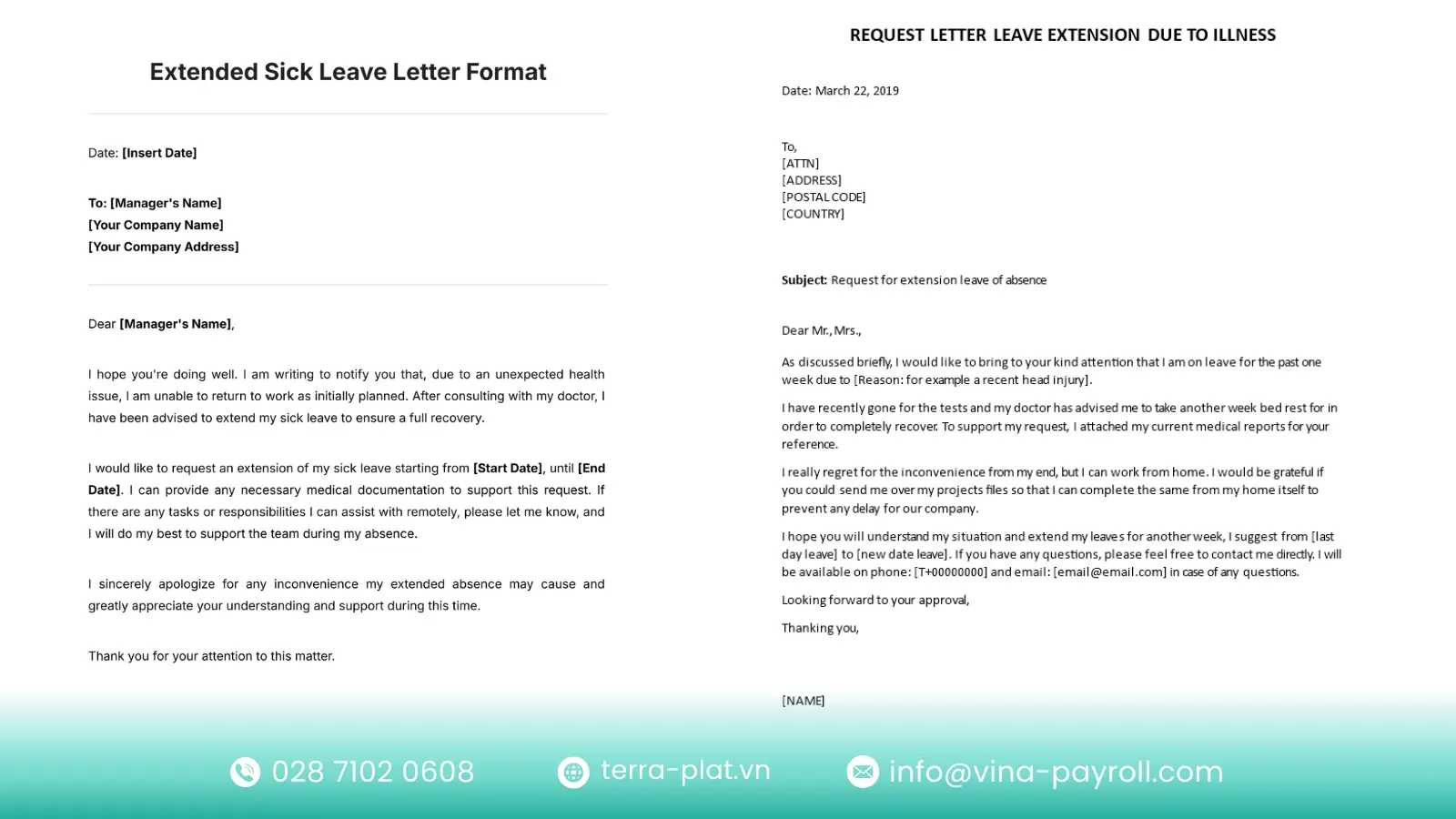
A professional sick leave email should be concise, factual, and helpful. It must include:
- Clear Subject Line: e.g., “Sick Leave Application – [Your Name] – [Date]”.
- Reason for Absence: A brief mention of illness is sufficient; there is no need to share graphic medical details.
- Expected Duration: State clearly when you plan to return to work so the team can plan.
- Availability: Clarify if you will be checking emails intermittently or if you are completely offline.
Sick leave email best practices
- Send it early: Notify your team before the workday starts, not hours later.
- Follow protocol: Ensure you follow the specific channel required by your company’s sick leave policy (e.g., sending an email vs. logging it in the HR portal).
- Attach evidence: If you have received a digital medical certificate, attach it immediately to speed up the HR processing time.
Managing sick leave effectively in the workplace
Balancing empathy for sick employees with the operational efficiency of the business is a constant challenge for every HR department.
Common sick leave management challenges
- Pattern Absenteeism: Some employees may abuse the system by consistently taking sick days on Mondays or Fridays to extend weekends.
- Documentation Lag: Delays in receiving physical medical certificates from employees complicate the monthly payroll closing process.
- Resource Planning: Sudden, unplanned absences disrupt workflows, requiring managers to quickly adjust the team’s workload and update the timesheet.
Risks of manual sick leave tracking
Relying on spreadsheets leads to significant errors. HR managers often struggle to distinguish between sick leave vs annual leave balances manually. This can result in overpaying salary (paying full wages when insurance should cover 75%) or rejecting valid claims due to poor record-keeping, leading to labor disputes.
Frequently asked questions about sick leave in Vietnam
Navigating specific scenarios can be confusing. Here are expert answers to the most common questions regarding sick leave regulations.
Can I receive sick leave benefits if I work remotely while on sick leave?
Answer: No.
Sick leave benefits are strictly designed for rest and recovery. If you are working remotely, you are effectively “working” and are entitled to your normal 100% salary from the employer. You cannot receive both the salary and the 75% social insurance allowance simultaneously.
I took three separate sick leaves totaling 45 days this year. Is that within the allowed limit?
Answer: It depends on your contribution period.
For normal working conditions with less than 15 years of social insurance contribution, the annual limit is 30 days. If you have contributed for 15-30 years, it is 40 days. Any days exceeding this statutory limit will be treated as unpaid leave or you must use your Annual leave.
I was sick for 5 days but forgot to obtain a medical certificate. Can I still receive the benefit?
Answer: No.
The Social Insurance Agency strictly requires a valid (Form C65-HD) to process sick pay. Without this official document, the days off cannot be claimed and will likely be deducted from your available Annual leave or treated as unpaid personal leave.
If a female employee falls ill after maternity leave, can she still receive sick leave benefits?
Answer: Yes.
Maternity leave and sick leave are separate regimes. If a female employee returns to work after maternity leave and subsequently falls ill, she is eligible for sick leave benefits as normal, provided she has valid medical documentation and has not exhausted her annual sick leave quota.
Are sick leave benefits subject to personal income tax (PIT)?
Answer: No.
According to the Law on Personal Income Tax, allowances paid by the Social Insurance fund including sick pay, maternity benefits, and occupational accident allowances are exempt from Personal Income Tax in Vietnam. Employees receive the full amount without tax deductions.
I took 7 days of sick leave, but the Social Insurance Agency only paid for 5 days. Why?
Answer: Benefits exclude holidays/weekends.
Sick leave benefits are only paid for working days. They do not cover weekly rest days (e.g., Saturday and Sunday) or public holidays. If your 7-day leave period included a weekend, the agency will only pay for the 5 working days, whereas the weekend is considered regular unpaid time off.

Automating sick leave with terra HR system
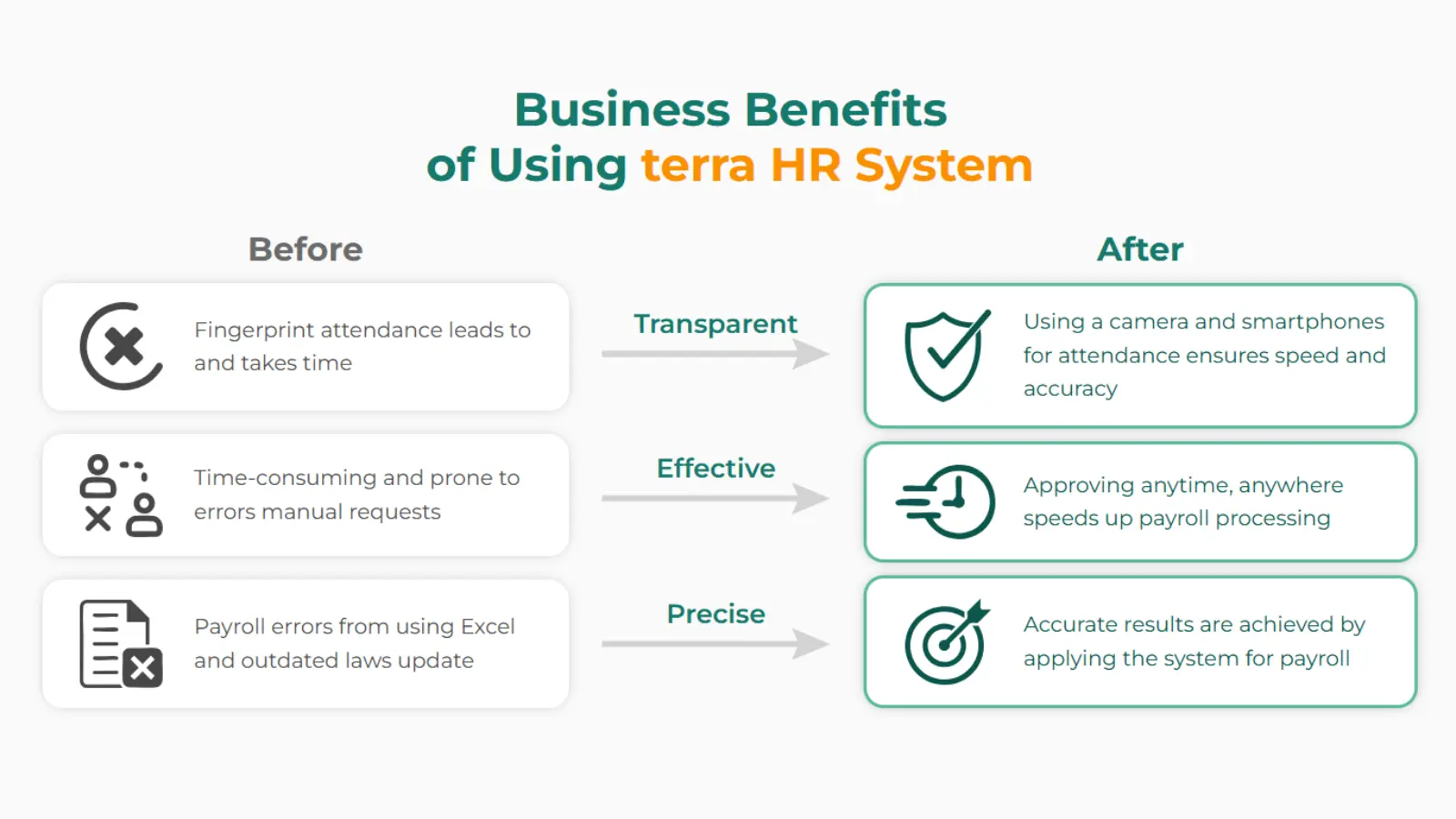
To mitigate compliance risks and reduce the heavy administrative burden of manual processing, modern enterprises are adopting the terra HR Management system to digitize their operations.
terra transforms how businesses handle health-related absences through advanced automation:
- Streamlined Requests: Employees can submit their application for sick leave and upload photos of their medical certificates directly via the terra HR Platform. This eliminates lost paperwork and ensures immediate notification to managers.
- Payroll Integration: The terra HR Software and terra Payroll calculate the correct deductions and allowances, ensuring the timesheet data flows correctly to payroll.
- Compliance Tracking: The terra HR Solution monitors the annual statutory limits (30/40/60 days) for employees.
By leveraging the power of terra HR software, companies can ensure 100% legal compliance while saving up to 80% of administrative time usually spent chasing documents and correcting formulas.
Contact terra HR Solution now for advice!
Summary
Understanding what is sick leave is critical for maintaining a compliant and supportive workforce. By clarifying the key differences in sick leave vs annual leave and mastering the sick pay calculation, businesses can protect both their financial budget and their employees’ well-being.









