For a company with only Vietnamese employees, payroll management for foreign employees in FDI companies is already a multi variable problem. The moment foreign workers appear on the payroll, the problem shifts to another level entirely. The process is no longer about getting one number right. It now has to handle several currencies at once, two separate personal income tax mechanisms for residents and non residents, compulsory social insurance for foreign employees, net salary commitments in expat contracts, and reporting obligations to a parent company abroad.
This is the story of a foreign invested trading company that worked through exactly these issues, and how it standardized its entire payroll process with terra. The client is anonymized under a confidentiality agreement and referred to as Company A.
About terra
terra is operated by Vina Payroll Outsourcing Co., Ltd., a member of the I-GLOCAL group (Japan) with more than 21 years of experience supporting foreign invested companies in Vietnam. terra is not just software. It is a BPaaS (Business Process as a Service) model that outsources the operational process on a technology platform, helping companies manage attendance, payroll, tax and insurance seamlessly, which is especially suited to companies with a foreign workforce.
The classic bottlenecks of running payroll for foreign workers
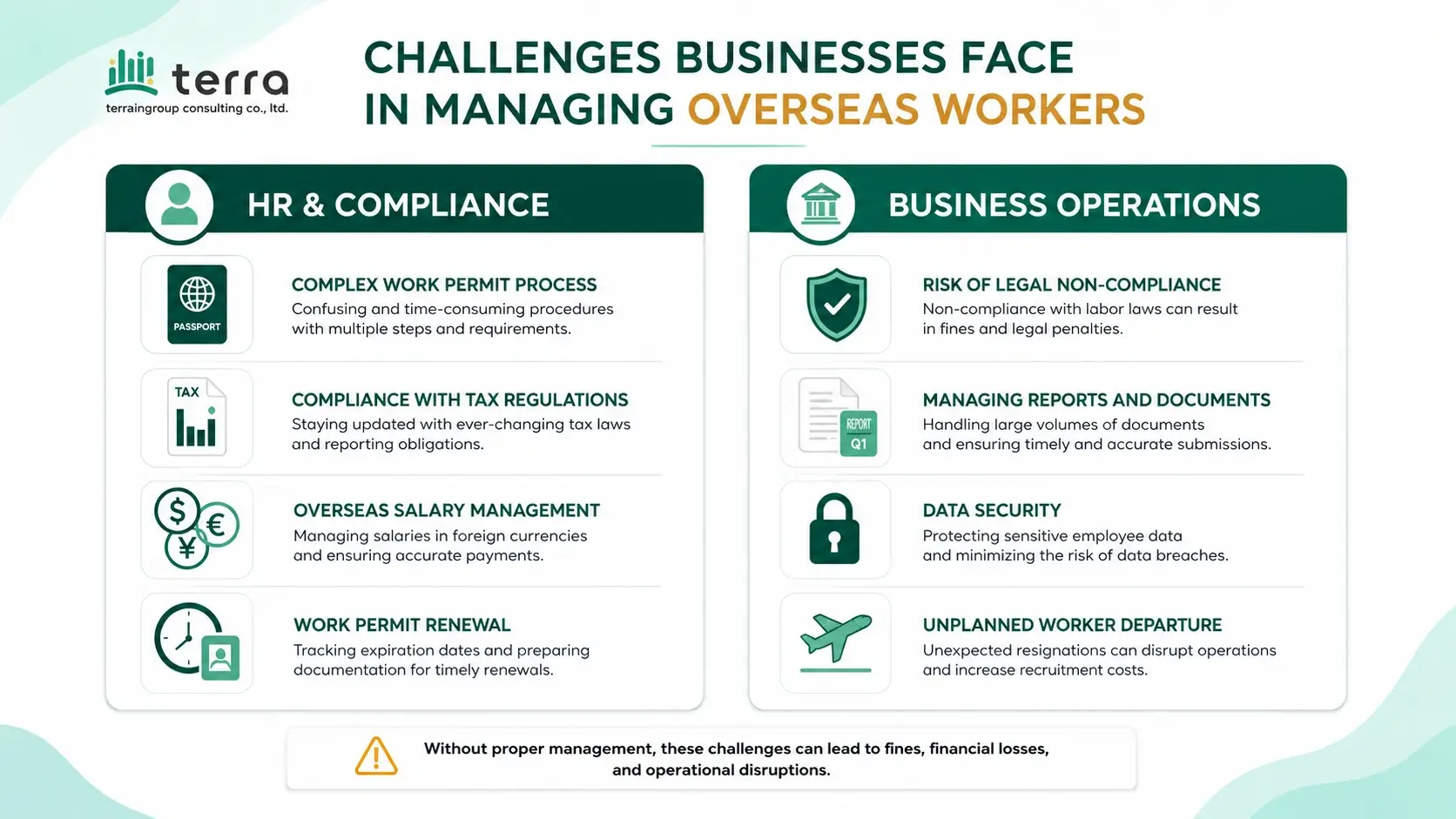
Unlike the shift attendance challenge of manufacturing, the bottleneck for companies with foreign workers sits in the compliance layer and the complexity of policy. We group it into two perspectives because HR and the BOD carry very different pressures.
OPERATIONAL VIEW
Pressure on HR and C&B
Classifying tax resident versus non resident individuals to apply the correct personal income tax mechanism, since the two groups are calculated in completely different ways.
Handling net salary commitments in expat contracts, which requires grossing up to reach the accurate taxable income.
Calculating and paying compulsory social insurance for eligible foreign workers, an obligation many companies still mistakenly assume does not apply.
Syncing work permit, visa and temporary residence card validity with the pay cycle to avoid paying against expired documents.
Running multi currency payroll and locking a consistent conversion rate across periods.
Keeping up with constant changes in tax and insurance regulations.
MANAGEMENT VIEW
Pressure on the BOD
Compliance risk and back collection during tax audits, especially on expat income.
Bilingual Vietnamese English reporting to the parent company or regional headquarters, in the right format and on time.
Absolute confidentiality of senior management and expat salary data.
The one time social insurance withdrawal when an expert finishes a term and leaves Vietnam, a complex procedure that, if handled wrong, costs the foreign employee their entitlement.
challenges businesses face in managing overseas workers
Why the traditional approach was no longer enough
Before partnering with terra, Company A ran payroll on Excel combined with one in house accountant doing double duty. This approach exposed three weaknesses as the foreign workforce grew.
1
A lack of deep expertise in tax and insurance for foreigners
The in house accountant was strong on general work, but tax residency and insurance for experts demand specialized, continuously updated knowledge.
2
Fragmented advisory
Each task went to a different vendor, one for work permits, one for tax advice, one for payroll, so the data did not line up and no one owned the whole picture.
3
A manual process prone to error at currency conversion and gross up
Where one small mistake can multiply into a large discrepancy in tax payable.
The result was that every pay cycle became a stress event, and every audit was a moment the leadership had to hold its breath.
Project overview
INDUSTRY
Trading and import export, foreign invested enterprise
HEADCOUNT
More than 120 employees, of which more than 15 are foreign managers and experts
NATIONALITIES
Multinational, including experts from Japan and several Asian markets
SPECIFICS
Multi currency payroll, net salary commitment for experts, reporting to regional HQ
SCOPE
Full payroll, PIT, social insurance and reporting for both Vietnamese and foreign workers
TIMELINE
About 6 to 8 weeks
The terra solution: technology and expertise unified on one platform
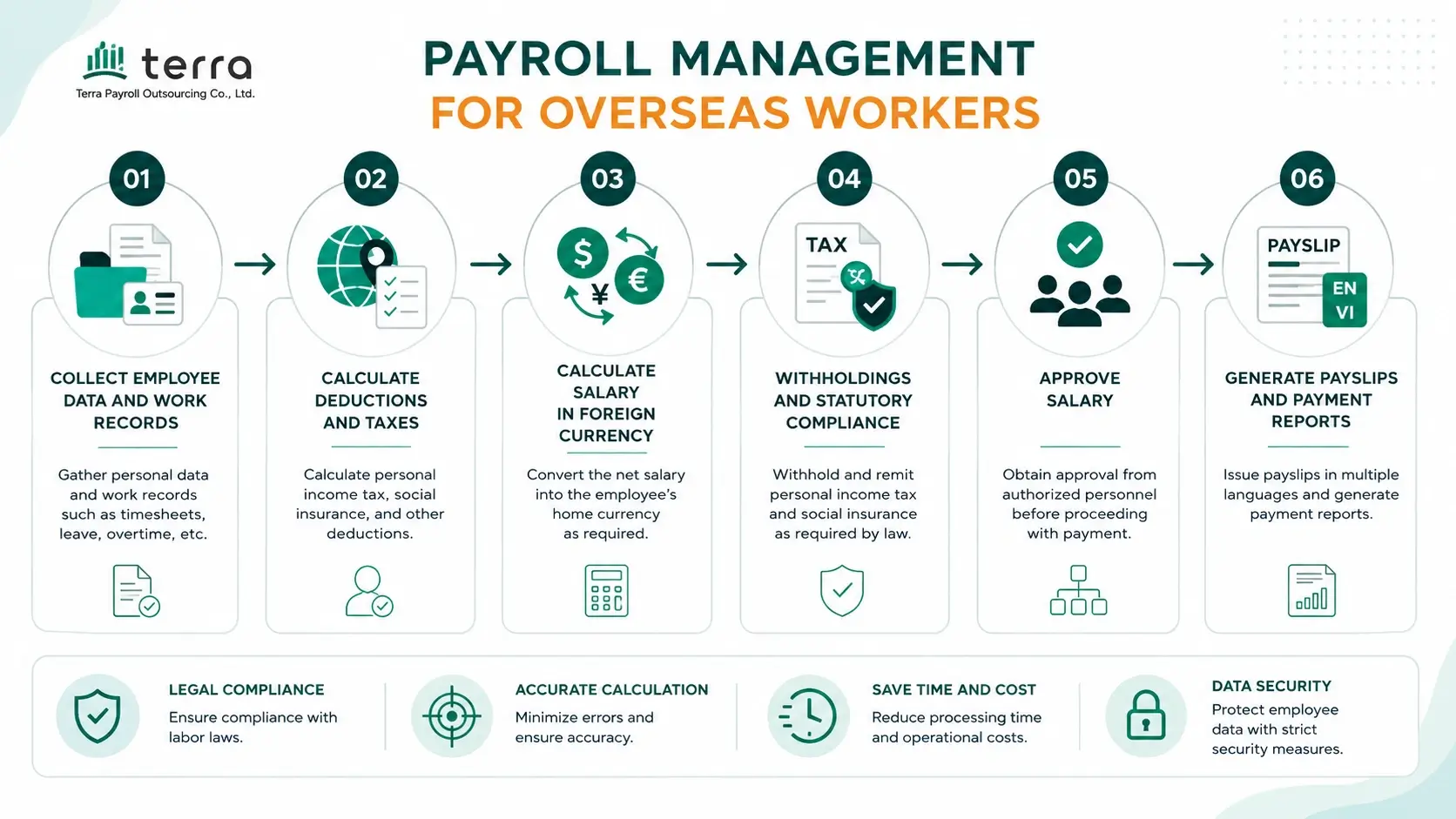
terra approached the problem by unifying three things that had been sitting apart: a payroll technology platform, a team with deep expertise in tax and insurance for foreigners, and a bilingual reporting process. Everything runs on a single data flow, connected directly to PIT finalization and insurance services when needed.
payroll management for overseas workers
One of the biggest values terra delivered was clarifying the difference in obligations between Vietnamese and foreign workers, so HR no longer had to dig through regulations every cycle. The table below summarizes the core differences Company A used to struggle with.
Obligation
Vietnamese worker
Foreign worker
Personal income tax
Progressive brackets for residents
Residents use progressive brackets, non residents apply a flat rate on Vietnam sourced income
Residency status
Resident by default
Must be determined by days present and place of stay, directly affecting the tax calculation
Social insurance
Full participation in compulsory schemes
Subject to compulsory participation if eligible, with some differences in entitlements
Year end finalization
Standard process
More complex due to multiple income sources and foreign factors
This comparison is general and only illustrates the complexity. The specific calculation is configured by terra for each case and updated to current regulations.
Implementation roadmap: standardized in 6 to 8 weeks
1
Policy review and data standardization (2 to 3 weeks)
The terra team reviewed all labor contracts, net salary commitments, allowance structures and the nationality of each foreign employee.
Re determined tax residency status for each expert, the foundation for calculating PIT correctly from the start.
Set up currency conversion rules and gross up formulas in the system.
2
Testing and handover (2 to 3 weeks)
Ran trial payroll on real data and reconciled against previous results to surface discrepancies.
Two terra teams supported in parallel: customer care for the system, and the payroll research team for tax and insurance.
Trained the client HR on reading reports and the approval flow.
3
Live operation and automation (2 to 3 weeks)
Ran the official pay cycle with multi level approval, payroll calculated by terra and confirmed finally by client HR.
Automatically issued payslips to each employee and produced bilingual reports for regional headquarters.
Pre configured the one time social insurance withdrawal for foreigners process, ready for when an expert finishes their term.
For a company with foreign workers, payroll is no longer a calculation but a compliance challenge. A mistake does not just upset employees, it can become a legal and financial risk for the whole business. Company A’s story shows that when the process is standardized on a platform that unifies technology and expertise, HR is freed from manual rule chasing, and leadership can rest easy on compliance and security.
Do you have foreign workers on your payroll?
Book a free consultation with a terra specialist to review your payroll, tax and insurance process for foreign employees.
Managing payroll for foreign employees in Vietnam requires handling multiple complexities including two separate personal income tax mechanisms for residents and non-residents, compulsory social insurance calculations, multi-currency conversions, and net salary commitments in expat contracts. Companies must also ensure compliance with visa, work permit, and temporary residence card validity requirements, and maintain accurate records for potential tax audits. Using specialized payroll outsourcing services like BPaaS (Business Process as a Service) platforms can help streamline these processes and reduce compliance risks.
Tax residents and non-residents in Vietnam are subject to completely different personal income tax mechanisms. The classification determines how much tax a foreign employee must pay, and misclassification can lead to serious compliance issues during tax audits. Proper classification requires understanding residency rules and continuously staying updated with tax regulation changes.
Yes, compulsory social insurance applies to eligible foreign workers in Vietnam, though many companies mistakenly assume it does not. Foreign employees must be properly enrolled and contributions calculated correctly to avoid compliance violations. Additionally, when a foreign expert finishes their term and leaves Vietnam, there is a one-time social insurance withdrawal procedure that must be handled correctly to preserve the employee's entitlements.
Gross-up is the process of calculating the base taxable income needed to ensure a foreign employee receives their committed net salary after all taxes and deductions are applied. Since foreign employees often have net salary commitments in their contracts, companies must work backwards from the desired net amount to determine the correct gross salary, accounting for all applicable taxes and insurance contributions.
Multi-currency payroll requires converting between currencies and maintaining consistent exchange rates across pay periods to avoid discrepancies in calculations. Companies must lock in conversion rates and ensure accurate tracking to prevent errors that can multiply into large tax liabilities. Using automated payroll systems helps standardize the conversion process and reduce manual calculation errors.
Foreign workers in Vietnam need valid work permits, visas, and temporary residence cards for payroll processing. Companies must sync the validity of these documents with the pay cycle to ensure they are paying against current, non-expired documentation, which is critical for compliance during tax audits.
Payroll outsourcing using specialized BPaaS platforms is important for FDI companies because it consolidates fragmented advisory services, provides deep expertise in foreign employee tax and insurance requirements, and reduces manual errors in complex calculations like currency conversion and gross-up. This approach helps companies maintain compliance, manage audit risks, ensure timely and accurate bilingual reporting to parent companies, and protect confidentiality of senior management salary data.