
Updated 15 September 2026. This article was first published in February 2026 as a summary of the July 2025 Social Insurance reform. It has been rewritten for foreign employees and the HR teams that offboard them, and now covers the Law on Social Insurance 2024, Decree 158/2025/ND-CP, Decree 219/2025/ND-CP on work permits and the salary-cap change of 1 July 2026 under Decree 161/2026/ND-CP.
Social insurance changes for foreign employees in Vietnam arrived in three waves: the Law on Social Insurance 2024 and Decree 158/2025/ND-CP from 1 July 2025, Decree 219/2025/ND-CP on work permits from 7 August 2025, and the higher contribution cap of VND 50.6 million from 1 July 2026 under Decree 161/2026/ND-CP. For an expat the headline is simple. The 30% contribution rate (20.5% employer, 9.5% employee) did not change, more expatriates now fall inside compulsory enrollment, the cap rose by 8%, and the right to withdraw the retirement contributions as a one-time payment when the contract ends is fully preserved, decided within 7 working days. This guide sets out what changed, what it costs in 2026, and what HR should do before a foreign employee leaves.
Social insurance for foreigners in Vietnam 2026: the three changes at a glance
| Change | In force | What it means for foreign employees and their employers |
|---|---|---|
| Law on Social Insurance No. 41/2024/QH15 and Decree 158/2025/ND-CP replace the 2014 Law and Decree 143/2018/ND-CP | 1 July 2025 | Minimum contribution period for a pension falls from 20 to 15 years. The one-time withdrawal for foreigners on contract end or permit expiry is kept (Article 70, Clause 2, point dd). The authority must decide a one-time claim within 7 working days (Article 79). Electronic Social Insurance books from 1 January 2026. |
| Decree 219/2025/ND-CP on foreign workers replaces Decree 152/2020 and Decree 70/2023 | 7 August 2025 | The intra-company transferee category is tightened: if the Vietnamese entity bears any part of the expat’s salary, the exemption from Social Insurance is at risk and enrollment is required. Work permit revocation within 15 days of termination. |
| Decree 161/2026/ND-CP raises the base salary to VND 2,530,000 | 1 July 2026 | The Social Insurance contribution cap (20 times the reference wage) moves from VND 46.8 million to VND 50.6 million per month. Contributions at the cap rise by about 8%, and so does the one-time payment calculated on capped salary. |

Who must enroll: the 2026 rules for foreign nationals
A foreign national is subject to compulsory Social Insurance when three conditions are met at the same time: a valid Vietnamese work permit, practising certificate or practising licence; a labour contract of 12 months or more with a Vietnamese legal entity; and not having reached Vietnamese retirement age at signing. Health insurance is compulsory alongside; unemployment insurance does not apply to foreign workers.
The group that changed most in 2025 is the intra-company transferee. Under Decree 219/2025/ND-CP the exemption only survives when the entire salary and allowances are paid by the foreign parent. Any salary paid by the Vietnamese subsidiary, including recharged cost, brings the expat into the scheme. Companies that still run pre-2025 structures face back-contribution exposure at the next inspection. For the full rate table and cost planning, see terra’s guide to the Vietnam Social Insurance contribution rate for foreigners.
Contribution rates and the new cap for foreign employees in 2026
The rates did not change in 2025 or 2026. The base they apply to did.
| Fund | Employer | Employee |
|---|---|---|
| Retirement and survivorship (the only refundable part) | 14% | 8% |
| Sickness and maternity | 3% | 0% |
| Occupational accident and disease | 0.5% | 0% |
| Health insurance | 3% | 1.5% |
| Total | 20.5% | 9.5% |
Contributions are calculated on salary capped at 20 times the reference wage: VND 46.8 million per month until 30 June 2026 and VND 50.6 million from 1 July 2026. For an expat at the cap, the monthly cost from July 2026 is about VND 10.37 million for the employer and VND 4.81 million for the employee, or roughly VND 182 million a year combined. Most of that is not lost: the 22% retirement component comes back to the employee as a one-time payment when the assignment ends.

The one-time withdrawal for foreigners is intact, and faster
The 2024 Law tightened the lump-sum rule for Vietnamese nationals who start contributing after 1 July 2025. It did not touch the right of foreign employees. Under Article 70, Clause 2, point dd, a foreign national claims the one-time payment as soon as the labour contract ends or the work permit expires without renewal, with no 12-month wait and without having to leave the country first.
- How much: 2 months of average insured salary for each year contributed from 1 January 2022, when foreigners started paying into the retirement fund. Odd months of 1 to 6 count as half a year, 7 to 11 as a full year.
- Example: March 2023 to May 2026 at VND 40 million declared salary is 3.5 years, so 2 x 40 million x 3.5 = VND 280 million, exempt from personal income tax.
- How fast: 7 working days from a complete file (Article 79, Clause 3), against 10 days under the old rules. In practice 4 to 6 weeks end to end, most of it spent closing the Social Insurance book with the former employer.
- What must happen in Vietnam: the notarised power of attorney, if a representative will file. Signed abroad it needs consular legalisation and adds two to four weeks.
Estimate a specific case in the one-time Social Insurance estimator, and see the full procedure in terra’s guide to the insurance claim for foreigners in Vietnam.
Changing employers, or a gap between jobs: what happens to your record
Nothing is lost. Your Social Insurance number stays with you for life, and periods from different employers are added together when the one-time payment is calculated. A three-month gap between two jobs does not reset anything; it simply is not a contributing period.
Three situations do need attention before you leave Vietnam for good:
- Each employer must close its own period. If you worked at three companies, all three have to have reported your departure and confirmed the contribution period. One unclosed book holds up the whole claim, not just its own months.
- Two Social Insurance numbers. It happens when a later employer registers a new number instead of reusing the old one, usually after a change of passport. The numbers have to be merged before a claim can be settled, and that is a separate procedure at the Social Insurance office.
- Overlapping months. If two employers both declared you for the same month, the office will ask which one to keep. Contributions are not counted twice.
For HR, the practical rule is to check the contribution history for gaps and duplicate numbers at offboarding rather than at claim time, when the employee has often already left the country. terra does this check as part of the one-time Social Insurance claim service.
Electronic Social Insurance books from 2026: what changes at offboarding
The Law on Social Insurance 2024 provides for electronic Social Insurance books from 1 January 2026, identified by the employee’s Social Insurance number rather than a paper booklet. For HR this removes the physical hand-over of the book but not the obligation behind it: the employer still has to report the departure and confirm the contribution period so the record is closed. For the departing employee, the closed record is the single document without which no one-time claim can be filed, so the request to HR should still be made in writing before the last working day.
What changed for Vietnamese employees, in brief
For completeness, the 2025 reform also brought three changes that affect the wider payroll: the minimum contribution period for a monthly pension fell from 20 to 15 years; compulsory coverage was extended to part-time, seasonal and managed “collaborator” arrangements that are employment in substance; and the one-time withdrawal for Vietnamese nationals who start contributing after 1 July 2025 is limited to special cases such as emigration, serious illness or reaching retirement age with fewer than 15 years. Employees who contributed before that date keep the old right after 12 months out of the scheme. These rules do not apply to foreign employees, whose one-time withdrawal is governed by the separate clause described above.
What HR should do before a foreign employee leaves
- Check the enrollment position of every expat against Decree 219/2025. An intra-company transferee whose salary is partly paid in Vietnam must be enrolled; fix it before an inspection does.
- Budget 2026 assignments on the VND 50.6 million cap from July, not the 46.8 million figure in last year’s model.
- Report the departure and close the Social Insurance record within the exit timeline, and hand the employee the contribution confirmation. The full sequence across labour, immigration, tax and Social Insurance is in terra’s exit procedures for foreign employees in Vietnam.
- Tell the employee about the one-time withdrawal at least 60 days before the flight, and point them to the 60-day plan for claiming Social Insurance before leaving Vietnam.
- Put any refund arrangement in writing. If the company covered the employee’s 9.5% share and expects the money back, that belongs in the contract or a side agreement signed at the start of the assignment.
Expats leaving before the end of the year? The 2026 rules give foreign employees a faster one-time withdrawal. terra runs it from the closed book to the payment. Eligibility check and estimate before anything is signed, book closure with your HR team, notarised authorisation while the employee is still in Vietnam, filing and follow-up until the money lands. Published fees: VND 10 million file fee plus 15% of the amount withdrawn, charged only after payment. Both before VAT.
|
Frequently asked questions about the 2026 Social Insurance changes for foreigners
Can foreign employees still withdraw Social Insurance one time after 1 July 2025?
Yes. The restriction in the 2024 Law applies to Vietnamese nationals who start contributing after that date. Foreign employees keep the right under Article 70, Clause 2, point dd, on contract end or non-renewed work permit, with no waiting period.
Did the Social Insurance contribution cap change in 2026?
Yes. The cap is 20 times the reference wage. Decree 161/2026/ND-CP raised the base salary to VND 2.53 million from 1 July 2026, so the cap moved from VND 46.8 million to VND 50.6 million per month.
Are intra-company transferees still exempt from Social Insurance?
Only when the entire salary and allowances are paid by the foreign parent company. Under Decree 219/2025/ND-CP any salary paid by the Vietnamese entity triggers enrollment.
How long does a one-time Social Insurance claim take in 2026?
7 working days from a complete file by law. Counting the time to close the book and notarise documents, plan for 4 to 6 weeks.
Do contributions before 2022 count towards a foreigner’s one-time payment?
No. Foreign employees only began contributing to the retirement and survivorship fund on 1 January 2022, and only that fund is refunded.
How terra supports HR and departing expats
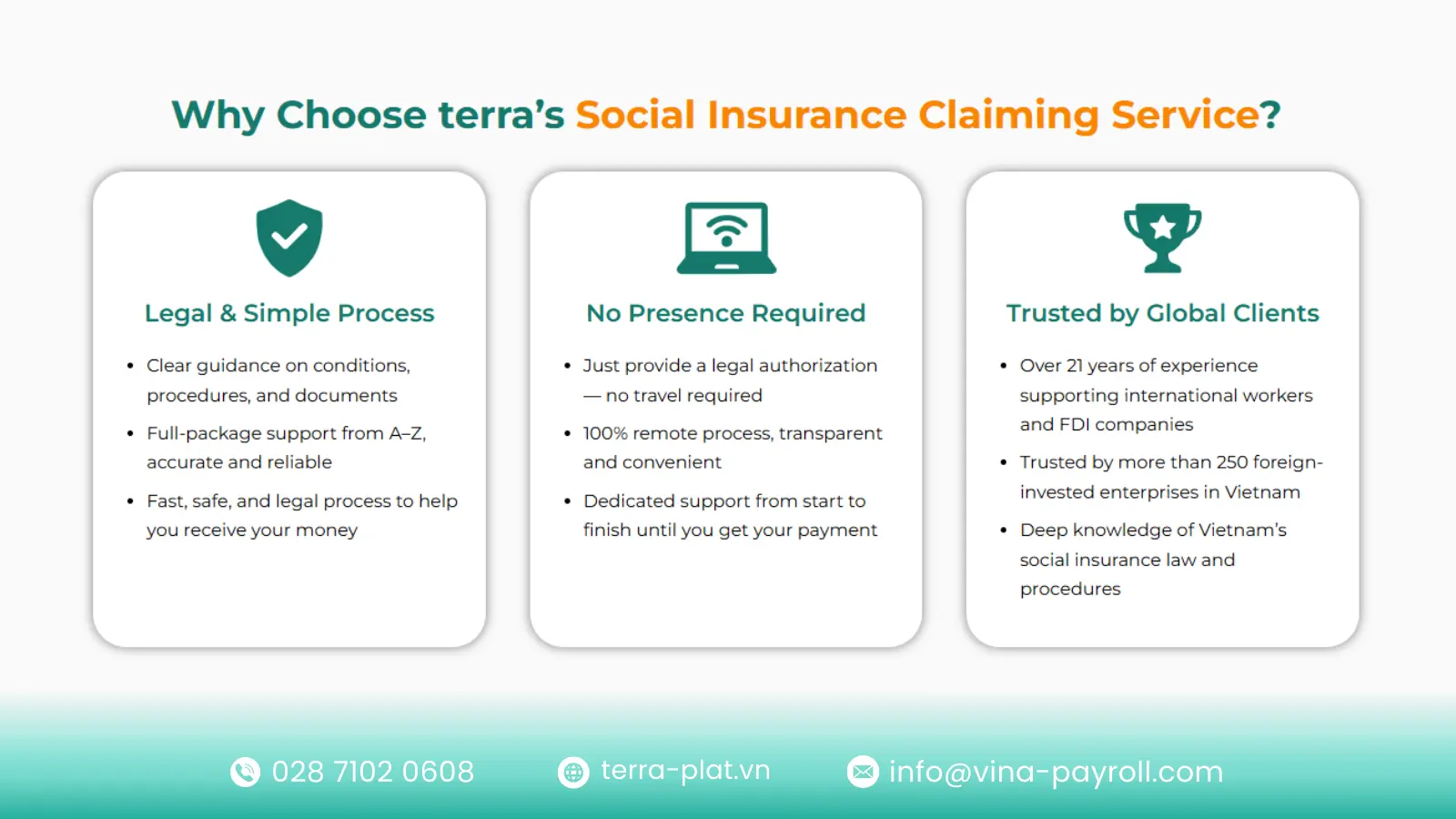
terra is a member of I-GLOCAL, a Japanese consulting group with more than 20 years of experience supporting foreign-invested companies in Vietnam. The team has completed more than 100 one-time Social Insurance files for foreign employees and runs payroll and compliance for FDI employers under the 2024 Law. For HR, that means enrollment reviews under Decree 219, 2026 cost modelling on the new cap, and a clean Social Insurance step in every expat exit. For the employee, it means a one-time Social Insurance claim service for foreigners with published fees, support in English, Vietnamese and Japanese, and updates until the money is in the account.
Conclusion
The 2025 to 2026 reform did not raise the rate foreign employees pay, but it widened who pays it, lifted the cap by 8% from July 2026 and kept the one-time withdrawal intact with a shorter 7-working-day decision. The practical consequence for HR is a cleaner offboarding: close the record, hand over the confirmation and give the employee 60 days to sign the authorisation before the flight. The practical consequence for the expat is that leaving Vietnam without claiming means leaving two months of insured salary per year on the table.
About the author terra Social Insurance team terra is the payroll and HR compliance service of Vina Payroll Outsourcing, a member of I-GLOCAL Group with more than 20 years advising foreign-invested companies in Vietnam. The team has completed more than 100 one-time Social Insurance files for foreign employees and updates this guide whenever the law or the Social Insurance authority’s practice changes. Last reviewed 15 September 2026. |









