
In modern performance management, relying solely on a manager’s view is outdated. 360 degree feedback offers a holistic view of employee performance by gathering insights from peers, subordinates, and supervisors. This guide explores the benefits, implementation steps, and how terra helps businesses apply this powerful tool effectively.
What is 360 degree feedback?
360 degree feedback is a performance appraisal method that gathers input about an employee’s behavior and skills from a variety of sources. Unlike traditional reviews where only the manager speaks, this method creates a complete circle of perspectives.
Also known as a 360 degree review, this approach focuses on professional development rather than just salary adjustments. It highlights blind spots in an employee’s soft skills and leadership style that a direct supervisor might miss during day-to-day operations.
Participants
A robust 360 degree feedback process relies on selecting a balanced group of raters who interact with the employee in different capacities. The goal is to capture a holistic view of performance from every angle.
- Self-Assessment (The Employee): The employee rates themselves on the same criteria as others. This is crucial for identifying blind spots areas where the employee believes they are performing well, but others disagree, or hidden strengths where they undervalue their own contributions.
- Direct Manager (The Supervisor): The manager provides a strategic view, focusing on goal achievement, KPI fulfillment, and alignment with company objectives. Their feedback usually carries significant weight regarding promotion and compensation.
- Peers and Colleagues: They offer unique insights into collaboration, reliability, conflict resolution, and soft skills that a manager might not witness directly. Peer feedback is vital for assessing teamwork.
- Direct Reports (Subordinates): For managers and leaders, feedback from their team is essential. It measures leadership effectiveness, delegation skills, empathy, and how well they motivate others. This upward feedback is often the most eye-opening part of the review.
- Internal/External Customers: In roles like Sales or Customer Support, including feedback from clients or vendors adds an external validation layer regarding professionalism, responsiveness, and service quality.
Participation Methods
The way organizations collect 360-degree feedback data directly impacts participation rates and the honesty of responses. The chosen method needs to be user-friendly and, crucially, guarantee confidentiality. Here are common implementation approaches.
- Digital Survey Platforms (Cloud-based Tools): Most modern organizations have replaced paper forms with specialized cloud-based software. Raters simply receive a secure email link to complete the assessment online whenever it’s convenient for them.
For example: a tech company using a digital platform gets real-time tracking and instant data compilation, saving HR significant administrative hours compared to manual methods.
- Anonymous Link Distribution & Data Aggregation: To encourage candid feedback, protecting the rater’s identity is essential. Systems anonymize data right at collection, showing aggregated group scores (like an average for “Peers”) rather than individual ratings.
For example: Consider a nurse manager receiving anonymous feedback about unclear communication. Because the comment isn’t tied to a specific team member, they feel safe sharing critical insights without fear, leading to genuine improvement.
- Mixed-Method Input (Quantitative & Qualitative): Effective feedback gathers both numerical scores (e.g., a 1-5 scale) for quick analysis and open text boxes for necessary context. Numbers alone rarely tell the whole story.
For example: a sales director might see a high score for client relationships, but a qualitative comment could clarify that they need to be faster at addressing new client complaints, making the feedback actionable.
Benefits and drawbacks of 360-degree feedback
Like any HR tool, the 360 appraisal system has its pros and cons. Understanding these helps organizations decide if this model fits their culture.
Benefits of 360-degree feedback
A well-implemented 360-degree feedback process provides comprehensive insights that drive growth and development across all levels of the organization.
For Individual Contributors
- Provides more balanced and comprehensive feedback than relying solely on a manager’s perspective.
- Uncovers blind spots in behavior or skills that the individual may not be aware of.
- Significantly boosts engagement; research shows that employees who receive regular feedback are 3x more likely to be engaged in their work.
For Teams
- Improves overall communication and collaboration within the group.
- Helps team members learn how to effectively give and receive constructive feedback.
- Builds trust among colleagues by fostering an environment of open development.
For Managers
- Gives managers a clearer picture of their leadership strengths and weaknesses through upward feedback.
- Identifying and developing strengths has a tangible business impact; managers who received feedback on their strengths showed 8.9% greater profitability compared to those who didn’t.
- Helps managers identify specific areas for leadership development to better support their teams.
The disadvantages of 360-degree feedback
However, without careful planning, the process can face challenges:
- Time and Cost:
- Problem: Collecting and analyzing data from multiple sources is resource-intensive.
- How to avoid: Utilize digital 360-degree feedback software to automate data collection, reminders, and report generation, significantly reducing manual effort and administrative time.
- Relevance:
- Problem: Raters may focus on irrelevant personal traits rather than professional competencies.
- How to avoid: Design a questionnaire with clear, behavior-based questions tied directly to job competencies. Provide training for raters on how to give constructive, professional feedback rooted in observed behaviors, not personality.
- Anonymity Issues:
- Problem: If confidentiality is breached, it can cause office politics and resentment.
- How to avoid: Choose a third-party platform that guarantees rater anonymity. Ensure that reports aggregate data for groups (e.g., “Peers”) and never reveal individual scores. Communicate this privacy policy clearly to all participants to build trust.
- Cultural Impacts:
- Problem: In high-power-distance cultures, subordinates may hesitate to criticize bosses.
- How to avoid: Foster a company culture of psychological safety where open feedback is encouraged and valued. Leaders must visibly welcome and act on upward feedback to demonstrate that it is safe for employees to be honest without fear of retribution.

Why is 360-degree feedback important?
360 degree feedback is important because it reduces bias. A single manager’s opinion can be subjective, but a collective view provides a more accurate picture of an employee’s impact.
Furthermore, 360 degree performance feedback promotes a culture of continuous improvement. It shifts the focus from judging to developing, encouraging employees to take ownership of their professional growth plans based on data rather than intuition.

Implementing a 360 feedback assessment procedure
Implementing a 360 degree feedback program is not a one-time event but a cyclical evaluation process that includes preparation, data collection, feedback interpretation, and employee development. A structured roadmap helps ensure the feedback is valid, actionable, and well-accepted by participants without creating anxiety.
Step 1: Create a 360 feedback framework.
Start by defining who will be evaluated and who will provide feedback. Typically, this includes managers, peers, direct reports, and sometimes clients.
At this stage, organizations should also identify the core competencies to be measured, such as leadership, communication, collaboration, or technical capability. A clear framework ensures consistency and fairness across the evaluation cycle.
Step 2: Develop a feedback module
Design the questionnaire carefully to ensure the questions are behavior-based and role-relevant. Use a consistent rating scale (for example, 1–5) to allow meaningful comparison across different rater groups.
To guarantee anonymity and reduce administrative errors, organizations should avoid manual spreadsheets. Using a specialized platform such as terra HR Software helps automate survey distribution, data collection, and instant report generation, ensuring accuracy and confidentiality.
Step 3: Set goals for the 360 assessment
Clarify the purpose of the 360 degree feedback initiative from the start. Is the assessment used strictly for employee development, or will it also influence promotion, compensation, or bonuses?
Clearly communicating the goal helps manage expectations, reduces participant anxiety, and improves engagement throughout the evaluation cycle.
Step 4: invite stakeholders to provide input
Rater selection is critical to ensuring a fair and statistically valid sample. Typically, the employee and manager agree on a list of raters (for example, 2 peers, 3 direct reports, and 1 client) who have worked closely with the employee for at least six months.
Once selected, survey links are distributed electronically. HR or the system administrator monitors response rates and sends reminders to ensure sufficient participation before the deadline.
Optional Step: Employees do self-evaluations
Including a self-evaluation enables gap analysis between self-perception and how others perceive the employee. This comparison often provides powerful insights, especially when employees discover where they rated themselves higher or lower than their peers, managers, or direct reports did.
Step 5: Collect Feedback
This is the main data collection phase and typically lasts one to two weeks. During this period, the system gathers responses while protecting the anonymity of raters.
Active monitoring and gentle nudges help maintain high response rates, ensuring the results are reliable and representative.
Step 6: Share feedback
Once data collection is complete, the system aggregates the results into a comprehensive report that highlights strengths, development areas, and gaps between self-ratings and rater feedback.
A trained manager, HR professional, or coach should lead the feedback session to help the employee interpret the results constructively. The goal is to identify 2–3 key strengths to leverage and 1–2 priority areas for improvement.
The process concludes with the creation of a Personal Development Plan (PDP), outlining concrete actions such as attending a delegation workshop or leading regular team briefings effectively closing the loop between feedback and continuous development.

Setting up a 360-degree feedback system: Best practices
Launching a 360 degree feedback system can backfire if not managed carefully. To avoid creating a culture of distrust or revenge rating, organizations should adhere to these industry-standard best practices.
- Define the Purpose Clearly: Decide if this is for Development (coaching only) or Appraisal (pay and promotion). Experts strongly recommend starting with Development. If feedback affects pay, raters tend to inflate scores to help their friends, rendering the data useless.
- Ensure Strict Anonymity: Except for the direct manager, all other feedback should be grouped. For example, report data as Peers (Average Score: 4.2) rather than listing individual names.
- Train the Raters: Do not assume people know how to give feedback. Provide a short guide on how to avoid bias and how to write constructive, behavior-based comments.
- Pilot with Leadership: Start the process with the executive team. This demonstrates that senior leaders are open to feedback, setting a powerful example for the rest of the organization.
- Focus on Strengths: A 360 report can be overwhelming. Encourage employees to focus on building their strengths rather than just obsessing over every negative comment.

360-degree feedback questionnaire
A well-designed 360 degree feedback questionnaire is the foundation of the entire process. It must be short enough to avoid survey fatigue but detailed enough to provide actionable data.
- Competency-Based Structure: Questions should be grouped by core competencies (e.g., Communication, Leadership, Adaptability) rather than a random list.
- Behavioral Statements: Questions should describe observable behaviors, not personality traits.
- Bad: Is she a good leader? (Subjective).
- Good: Does she provide clear direction during crisis situations? (Observable).
- Rating Scale: Use a consistent Likert scale, typically 1 to 5 (e.g., 1=Never, 5=Always). Some organizations use a frequency scale to measure how often a behavior is observed.
- Stop-Start-Continue: Include open-ended text sections. The Stop, Start, Continue framework is popular because it forces specific, actionable advice.

360-degree feedback sample questions
Here are examples of 360 degree feedback questions you can include in your survey, categorized by question type.
Closed Questions
These questions use a rating scale (e.g., 1 to 5) to measure specific behaviors and competencies quantitatively.
- Controls emotions effectively, even in high-pressure situations.
- Demonstrates an awareness of how their actions and decisions affect others.
- Treats mistakes and setbacks as learning opportunities.
- Actively seeks feedback from others on their performance.
- Sets challenging goals for themselves and helps others achieve their objectives.
- Prioritizes work based on the needs of the organization and its customers.
- Achieves objectives even when faced with obstacles and challenges.
- Encourages others to pursue growth and learning.
- Is resourceful in solving problems and deals with conflict appropriately.
- This employee meets their deadlines and works in an efficient manner.
- This employee brings a good attitude into their work and collaborates well with others.
- This employee communicates decisions transparently and clearly.
- This employee embodies your company culture or values.
- This employee always keeps the needs of the customer/target audience top of mind.
Opened Questions
These questions allow for detailed text responses, providing context and actionable advice.
- What suggestions do you have to help them improve their self-awareness?
- What suggestions do you have to help them improve their drive for results?
- What kind of role has this employee taken when working on projects together?
- What is one thing this employee should start doing to be more effective?
- What should this employee stop doing that isn’t working for them?
- What should this employee continue doing that works well?
- How has this employee lived your company’s culture or values?
- How does this employee handle taking feedback and putting it into practice?
- How has your communication been with this employee on projects?
- Where do you think this employee could improve in your working relationship?
- How could you see this employee taking the next step in their development?
360 feedback question examples by type
To build an effective 360-degree feedback survey, selecting questions tailored to the specific role and competencies being assessed is crucial. Below are examples of closed-ended questions categorized by skill type, which you can easily apply to your organization’s evaluation process.
For Managers
This group of questions focuses on assessing leadership abilities, decision-making, and the manager’s interaction with their team.
- Does the manager work in a respectful manner to others?
- Does the manager consider other team members’ opinions before making a decision?
- Does the manager effectively solve problems?
- Is the manager responsive to their team’s needs and questions?
- Can the manager work under pressure to meet deadlines?
- Does the manager provide a clear vision that aligns with the organization’s objectives?
Leadership Skills
These questions help evaluate the leadership potential and capabilities of employees, even if they are not in formal management positions.
- Does the employee provide solutions to difficult customer problems?
- Is the employee demonstrating leadership on a daily basis?
- Does the employee take accountability for the work and carry it out to the deadline?
- Do other team members look to the employee to help them with their work?
- Does the employee carry out duties without issue?
- Does the employee bring ideas to the table when problem-solving?
- Does the employee supervise work to an effective level?
Communication Skills
Assesses the employee’s ability to convey information and listen within the work environment.
- Does this employee listen well to others’ suggestions?
- Does the employee communicate effectively with customers/managers/peers?
- Does the employee ask for more information if they do not understand something?
- Does the employee communicate well in writing with good grammar and spelling?
- Does the employee speak in a clear and concise way?
- Does the employee effectively communicate their ideas to others?
- Does the employee create opportunities for discussion and dialogue?
Interpersonal Skills
This set of questions measures the ability to build and maintain positive relationships within the organization.
- Does this employee work well with others on tasks?
- Does this employee show respect to others in their team?
- Does the employee manage their emotions and keep them in check?
- Does the employee effectively manage their stress levels?
- Does the employee regularly have conflict with others?
- Does the employee exhibit the core people values of the organization?
- Does the employee collaborate with others effectively in a team?
- Is this employee someone that other staff will turn to for advice?
Problem Solving Skills
Evaluates the capability to analyze situations and provide feasible solutions.
- Is the employee effective at evaluating a problem?
- Does the employee suggest useful solutions to a problem?
- Does the employee recognize when there is a problem?
- Does the employee effectively communicate the problem to others and bring them on board?
- Is the employee able to work independently to fix a problem?
- Does the employee feel confident in exploring problems without assistance?
- Does the employee provide creative solutions to problems?
- Does the employee understand the impacts and dependencies of a problem?
Organizational Alignment
Assesses the employee’s understanding of and commitment to the company’s goals and values.
- Does the employee know about the organization goals?
- Does the employee know about the organization’s strategic vision?
- Does the employee live the company values daily?
- Does the employee discuss the company in meetings?
- Does the employee recommend the company to customers?
- Is the employee showing engagement with the organization goals?
- Does the employee actively feedback about organization ideas or activities?
Employee’s Motivation
Explores the employee’s level of interest and commitment to their work and role.
- Does the employee appear to be motivated by their job?
- Does the employee communicate that they are motivated with their job?
- Is the employee difficult to motivate to do a task?
- What is the level of motivation that the employee shows?
- Is the employee motivated to independently share their work with others?
- Does the employee motivate others in a group task?
Efficiency
Evaluates quality, timeliness, and overall effectiveness in task execution.
- Does the employee complete their tasks effectively?
- Does the employee create a sense of collaboration when working with others?
- Does the employee deal with daily work tasks effectively?
- Is the employee’s work finished to the right level every time?
- Does the employee complete their work on time?
- Does the employee provide high standards in their work?
- Does the employee exceed expectations with their work?
- Does the employee improve processes to make them more effective?
terra HR System
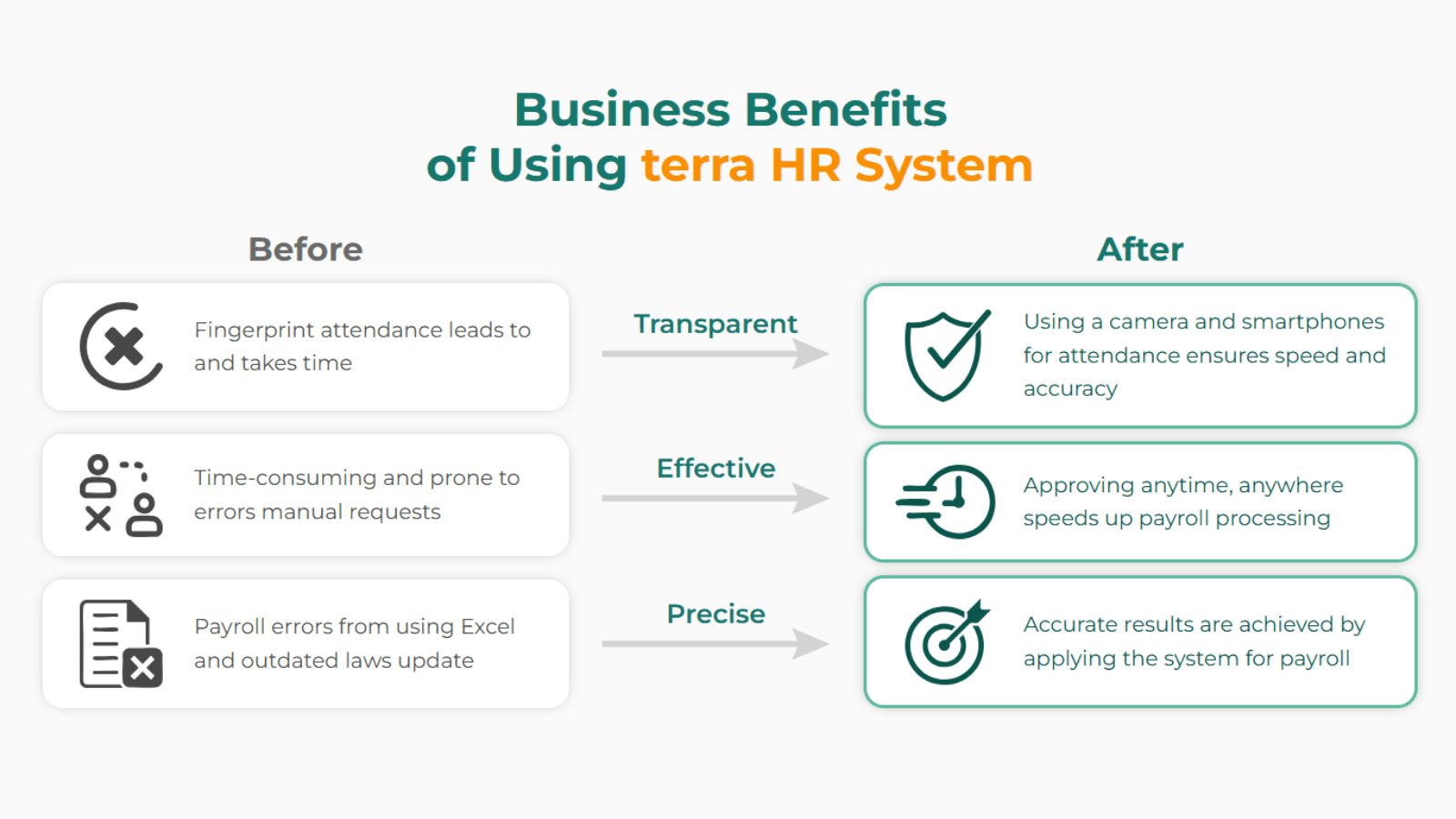
Implementing a performance evaluation cycle requires a stable and accessible platform. The terra HR Management system offers a comprehensive terra HR Solution that digitizes your entire HR workflow without the need for complex software installation on computers.
Operating seamlessly on both web platforms and mobile applications, terra HR Software allows businesses to automate HR processes and optimize internal communication effectively.
Key features that support comprehensive workforce management include:
- Performance Evaluation Management: Streamline your employee review processes directly on the system as part of a unified ecosystem.
- Training Management: Easily link evaluation results to training programs to foster employee development.
- All-in-One Functionality: From Recruitment and Labor Contracts to Payroll and Social Insurance, all 9 core HR functions are fully integrated.
- Cost Efficiency: Businesses pay a single fee for full access to all features, including future updates, ensuring budget predictability.
With the terra HR Platform, companies can save significant time and effort, allowing HR departments to focus on people strategy rather than administrative paperwork.
Contact terra HR Solution now for advice!
Conclusion
360 degree feedback is a transformative tool that drives self-awareness and organizational growth. By gathering diverse perspectives, companies can build stronger teams and better leaders. However, success requires a structured approach and the right technology. Utilizing a robust tool like the terra system ensures that the process is smooth, secure, and beneficial for everyone involved.









