
More than just a formality, an employment contract is the legal cornerstone of the employer – employee relationship, defining rights, responsibilities, and expectations. With the rise of flexible work models, the variety of contracts has expanded beyond traditional permanent roles. In this post, terra explains 12 different types of employment agreements to help you choose the right arrangement for every role.
What Is an Employment Contract?
Before diving into the specific types, it’s crucial to establish a clear foundation of what an employment contract is and why it matters.
Definition of an employment contract
An employment contract is a legally binding agreement between an employer and an employee that outlines the terms and conditions of employment. It details the obligations of both parties, including job duties, compensation, working hours, and termination procedures, creating a framework for a transparent and professional relationship.
Difference between “employment contract” and “contract of employment”
While these terms are often used interchangeably, there is a subtle distinction.
- Employment contract: is the more common and widely used term in business and HR contexts.
- Contract of employment: is a slightly more formal, legalistic phrase, often found in statutes and legal documents, particularly in jurisdictions like the United Kingdom. Functionally, they refer to the same agreement.
Why employment contracts are essential for both parties
A well-drafted contract provides critical protection and clarity for everyone involved.
- For employers: it ensures consistency and protects confidential information.
- For employees: it guarantees their rights regarding pay, benefits, and working conditions, reducing the risk of exploitation or disputes.

Non-legal or informal employment contracts
These are agreements that may exist in practice but are not typically legally enforceable in a labor court. Relying on them poses significant risks to both employers and employees due to their lack of provable terms.
1. Verbal employment agreement (spoken commitment)
This agreement is based solely on a spoken conversation and mutual understanding. While it may feel sufficient at the moment, its terms are incredibly difficult to prove or enforce if a dispute arises, as there is no written record to reference.
2. Implied employment agreement (by behavior or routine)
An implied contract is created through the consistent actions, behaviors, and routines of the employer and employee, even without explicit verbal or written consent. For instance, if an employee consistently receives a bonus every year, an implied agreement to continue this practice might be argued, though it often lacks strong legal standing.
3. Gentleman’s agreement or handshake deal
This is an informal promise based entirely on trust and honor between two parties. It holds no legal weight and is not recognized by labor authorities. A handshake deal is unenforceable if one party decides not to uphold their end of the bargain.
4. Probationary understanding without written terms
A common mistake made by small businesses is assuming a “trial period” is legally sound without documentation. Without a written clause in a formal contract, the terms of the probation including performance expectations and termination rights – are undefined and legally weak.

Legally recognized types of employment contract
These are formal, written agreements that are legally enforceable and provide clear frameworks for different working relationships.
5. Permanent employment contract (full-time)
This is the most common type of contract for an indefinite duration. It establishes a long-term relationship and includes statutory benefits like social insurance, paid leave, and clear notice obligations for termination.
6. Part-time employment contract
This contract specifies reduced working hours compared to a full-time role. Entitlements such as annual leave and benefits are typically prorated based on the number of hours worked.
7. Fixed-term employment contract
A fixed-term contract has clear start and end dates. It is commonly used for roles tied to a specific project, seasonal work, or to cover for an employee on leave (e.g., maternity leave).
8. Temporary employment contract
Designed for short-term hires, an employment contract for temporary staff details a specific, often brief, duration of employment. It may include options for renewal or conversion to a permanent role but offers less job security than a fixed-term contract.
9. Casual or zero-hour contract
Under this agreement, the employer does not guarantee a minimum number of working hours, and the employee is not obligated to accept any work offered. It is popular in flexible industries like hospitality, retail, and logistics.
10. Freelance or independent contractor agreement
This type of contract employment is for engaging external service providers who work independently. These individuals are not legally considered employees and are responsible for their own taxes and insurance. The agreement focuses on the deliverables and project scope rather than controlling how the work is done.
11. Executive or management contract
Tailored to senior-level roles, this contract is more complex and often includes performance-based bonus schemes, equity options, extensive confidentiality clauses, and specific provisions on how commission works.
12. Collective or union employment contract
This contract is not negotiated with an individual but between an employer and a trade union or employee representative body. It governs the shared working conditions, wages, and benefits for a group or all employees within the company.
Learn more: How does commission work? Commission pay meaning, formulas and examples
Special employment arrangements and related clauses
These are not standalone contract types but are important clauses or concepts that significantly impact the employment relationship.
At-will employment
Primarily used in the United States, this doctrine allows either the employer or the employee to terminate the relationship at any time, for any reason (as long as it’s not illegal), without requiring notice. This arrangement is rare outside the U.S. due to its limited protection for employees.
Non-compete, NDA, and confidentiality clauses
These are protective clauses that prevent employees from disclosing confidential company information or working for a direct competitor for a certain period after leaving. They can be integrated into the main contract or exist as separate, standalone agreements.
Probationary period clauses (within full-time or fixed-term contracts)
This clause defines a trial period at the start of employment, during which the employer assesses the new hire’s suitability for the role. It specifies evaluation criteria and often allows for termination with shorter notice if performance is unsatisfactory. This is a critical part of the onboarding process.

Essential components of a compliant employer contract
A truly effective employer contract moves beyond a generic template. It is a detailed, customized document that forms the legal backbone of the employment relationship. To be compliant and protective for both parties, every contract, regardless of type, must clearly articulate the following essential components:
Job title and duties
This section sets clear expectations from day one. It should precisely define the employee’s official title and provide a detailed breakdown of their key responsibilities.
A well-defined scope prevents mission creep and creates a clear benchmark for performance evaluation. It is also best practice to specify who the employee reports to, establishing a clear line of command.
Compensation and benefits
Clarity on remuneration is non-negotiable. This component must detail every aspect of the employee’s financial package.
- Base Salary: State the gross salary (annual or monthly) and the currency.
- Payment Schedule: Specify the payment frequency (e.g., monthly) and the exact day.
- Bonuses and Commissions: Describe the structure of any performance bonuses or sales commissions. Clarify if they are discretionary and reference a separate appendix for complex schemes, explaining how commission works.
- Benefits: Detail statutory benefits like social insurance, alongside voluntary perks such as private health insurance or wellness programs.
Working hours, overtime, and leave
This section defines the work-life framework. It must specify the standard working days and hours (e.g., 9:00 AM to 6:00 PM, Monday to Friday).
Crucially, it should outline the company’s policy on overtime. This includes how it will be compensated in accordance with local labor laws.
Finally, it must list all leave entitlements, including annual paid leave, public holidays, sick leave, and other relevant leave policies.
Termination notice and severance
This component defines the contract’s lifecycle. For fixed-term contracts, it must state the exact start and end dates. For permanent roles, it should specify the notice period required from both the employer and employee to terminate the agreement.
The section should also detail conditions for dismissal without notice (gross misconduct) and outline any applicable severance pay policies.
Confidentiality and dispute resolution
These clauses are critical for protecting the business and ensuring legal clarity.
- Confidentiality: This clause legally obligates the employee not to disclose company trade secrets or sensitive data, both during and after employment.
- Intellectual Property (IP): This clarifies that any work or inventions created by the employee in the course of their duties belong to the company.
- Dispute Resolution: This defines the governing law and jurisdiction, and outlines the process for resolving disagreements, such as mediation or arbitration.

How to make an employment contract
Creating a legally sound contract is a methodical process. Following these structured steps will help ensure you produce a compliant and professional document.
Step 1: Define the employment type
This is the foundational step. Before writing, you must determine the nature of the business need. Ask yourself: Is this a core, long-term function needing a permanent contract? Is it for a specific project suited for a fixed-term contract? This decision dictates the entire document’s structure.
Step 2: Outline key employment terms
With the contract type defined, you can now populate the “commercial” details of the agreement. Document the specifics for job title, duties, salary, benefits, working hours, and leave. The goal here is to be as precise as possible to prevent future misunderstandings.
Step 3: Add legal and compliance clauses
This step adds the protective legal layer. Incorporate clauses that ensure legal compliance and mitigate risk. These include standard clauses like confidentiality, intellectual property rights, and data protection (e.g., GDPR). You must also add any specific clauses mandated by local labor laws.
Step 4: Attach relevant appendices
Use appendices for detailed supplementary information to keep the main contract body clean and focused.
Common appendices include a detailed job description, the employee handbook, or a commission scheme breakdown. The main contract should simply reference these attachments.
Step 5: Review and finalize the document
Never finalize a contract without a thorough review. It’s highly recommended to have the draft checked by an HR legal expert or a qualified employment lawyer.
This review ensures the contract is fully compliant with the latest labor laws and contains no unenforceable clauses. Also, read it from the employee’s perspective to ensure it is fair and clear.
Step 6: Keep a verified record
Once finalized, the contract must be signed by both parties. Digital signatures are a legally valid and efficient method for this.
After signing, provide a copy to the employee. The original must be stored securely in the employee’s file for the legally required duration for compliance and record-keeping.

Employment contract sample and template guide
While using an employment contract sample can streamline the drafting process, it should never be a simple copy-paste exercise. This guide breaks down a standard contract structure, essential adaptations for different roles, and common drafting mistakes to help you create a compliant and effective agreement.
H3: Example structure of a standard written contract
Part 1. Parties to the Agreement
- Full legal name and address of the Employer (the Company).
- Full name, date of birth, and permanent address of the Employee.
Part 2. Position and Duties
- Job Title: The official title for the role.
- Reporting Line: Specifies the title of the manager the employee reports to.
- Key Responsibilities: A summary of the main duties and responsibilities. It often references a more detailed job description in an appendix.
- Work Location: The primary physical address where the employee will work.
Part 3. Term of Employment
- Commencement Date: The official start date of employment.
- Probationary Period: The duration of the trial period (e.g., 3 months) and the conditions for confirmation.
- Contract Duration: Clearly states if the contract is permanent (indefinite) or fixed-term (with a specified end date).
Part 4. Compensation and Benefits
- Base Salary: The gross monthly or annual salary amount.
- Payment Details: The frequency and method of payment.
- Bonuses/Commissions: Outlines the structure of any performance-related pay.
- Benefits: Details on statutory insurance, paid leave, and any additional company perks.
Part 5. Working Hours and Leave
- Standard Hours: Specifies the normal working hours and days per week.
- Overtime Policy: Explains the rules and compensation for any work done outside standard hours.
- Leave Entitlements: Details the policy for annual, sick, and other types of leave.
Part 6. Confidentiality and Intellectual Property
- Confidentiality Clause: Obligates the employee not to disclose company trade secrets.
- Intellectual Property Clause: States that any work created by the employee during employment belongs to the company.
Part 7. Termination of Employment
- Notice Period: The length of notice required from either party to terminate the contract.
- Grounds for Summary Dismissal: Lists severe offenses (gross misconduct) that allow for termination without notice.
- Severance Pay: Details any severance entitlements upon termination.
Part 8. Governing Law and Dispute Resolution
- Specifies which country’s or state’s laws will govern the contract.
- Outlines the process for resolving any potential disputes.
Part 9. Signatures
- Dated signatures from both an authorized company representative and the employee.
Adaptations for temporary, part-time, or fixed-term staff
A standard contract template must be carefully modified to reflect the unique nature of non-permanent or reduced-hour roles. Failing to make these specific adaptations can lead to legal disputes and non-compliance.
For Fixed-Term and Temporary Staff:
The most critical adaptation involves the Term of Employment clause.
- Clear Duration: The contract must state a precise start date and a specific end date. This removes any ambiguity about the employment’s limited duration.
- Termination Conditions: It should clarify what happens upon the end date whether the contract terminates automatically or if there are conditions for renewal.
- Purpose of the Term: For legal clarity, it is often best practice to specify the reason for the fixed term (e.g., to complete Project X, or to provide maternity cover for [Employee Name]”).
For Part-Time Staff:
Adaptations for part-time roles primarily focus on ensuring compensation and benefits are calculated fairly and transparently.
- Specific Working Hours: The Working Hours clause must explicitly define the reduced schedule (e.g., “… hours per week, from … AM to … PM, Monday to Friday”).
- Pro-Rata Entitlements: This is the most important concept. All benefits, including salary, paid leave, and holiday pay, must be calculated on a pro-rata basis. This means they receive a fraction of the full-time equivalent. For example, if a full-time employee gets 20 days of annual leave, a part-time employee working 50% of the hours would be entitled to 10 days.
Common drafting mistakes and how to fix them
Many legal disputes arise from simple, avoidable errors in the contract drafting stage. Here are some of the most common mistakes and how to proactively fix them:
Mistake 1: Overly Vague Job Descriptions
Using generic phrases like “and other duties as assigned” without a core list of responsibilities gives managers unchecked power to change an employee’s role fundamentally. This ambiguity can lead to performance disputes and claims of constructive dismissal if the job changes too drastically.
Solution: Always include a bulleted list of the top 3-5 core responsibilities. Reference a detailed, separate job description document as an appendix for comprehensive clarity.
Mistake 2: “One-Size-Fits-All” Template Abuse
Applying the same standard contract template to every employee, from a junior part-time staffer to a senior executive, is a significant risk. A senior role needs stronger confidentiality and non-compete clauses, while a part-time contract requires specific pro-rated benefit clauses.
Solution: Develop a master template, but create specific, pre-approved variations for different employment types (permanent, fixed-term, part-time, executive).
Mistake 3: Forgetting to Define Probationary Terms Clearly
Simply stating “a 3-month probationary period applies” is not enough. It leaves key questions unanswered. What are the success criteria? What is the notice period during probation? Can it be extended? Lack of detail makes it hard to justify a termination based on performance.
Solution: The probationary clause must specify the notice period during this time (which is often shorter), the review process, and the company’s right to terminate if performance standards are not met.
Mistake 4: Outdated Legal Clauses
Labor laws change frequently. Using a contract template from a few years ago might mean your clauses on termination notice, data protection, or statutory leave are no longer compliant. This exposes the company to legal challenges and fines from regulatory bodies.
Solution: Schedule an annual review of all contract templates with an HR legal expert. This ensures your documents always reflect the most current legislation.

Employment contract advice for HR professionals
Providing sound employment contract advice is a cornerstone of strategic HR management. It involves balancing business needs with legal compliance and employee fairness. Here are key considerations for HR professionals when handling employment agreements.
Choosing the right contract type per role
The first strategic decision is selecting the appropriate contract type. This choice should be driven by the nature and longevity of the role.
Ask yourself: Is this a core, permanent function? A project with a defined timeline? Or a role with fluctuating demand? Answering this determines whether a permanent, fixed-term, or casual contract is most suitable.
Avoiding ambiguous or missing clauses
Ambiguity is the enemy of a good contract. Vague terms related to job responsibilities, bonus eligibility, or grounds for termination are common sources of conflict. HR professionals should ensure every key term is explicitly defined, leaving no room for misinterpretation. Always double-check that all legally mandated clauses are included.
Aligning contracts with business policy and law
An employment contract does not exist in a vacuum. It must be perfectly aligned with both internal company policies (like the employee handbook) and external labor laws. Effective Employee training is also essential to ensure line managers understand and apply the contract terms consistently in their daily management.
When to seek HR legal consultancy
While HR can handle most standard contracts, it’s wise to seek specialized legal consultancy in certain situations. These include drafting contracts for senior executive roles, hiring international staff with complex visa requirements, or when facing a potential employee dispute related to contract terms.

FAQs about employment contracts
Even with a solid understanding of contract principles, specific scenarios and practical questions often arise. To provide further clarity, this section addresses some of the most frequently asked questions that HR employees encounter regarding employment contracts.
Is a verbal employment contract enforceable?
Answer: Rarely enforceable and highly risky.
While some legal systems may recognize verbal agreements, their terms are nearly impossible to prove in a dispute. Without a written record, disagreements over salary, duties, or termination conditions become one person’s word against another’s, creating significant legal uncertainty.
Is a written contract mandatory for all employees?
Answer: Yes, in most jurisdictions, it is a legal requirement.
Most labor laws mandate that employers must provide employees with a written statement of their core employment terms within a specific timeframe after they start work. This practice ensures clarity, protects both parties, and is a key compliance requirement.
Can employment contracts be signed digitally?
Answer: Yes, digital signatures are legally valid and widely accepted.
Modern electronic signature laws in most countries recognize digital signatures as legally binding, provided they meet specific security and authentication standards. This makes the hiring process faster, more efficient, and just as secure as a physical signature.
What is the difference between a fixed-term and a temporary contract?
Answer: A fixed-term contract has a specific end date for a defined project or role, while a temporary contract is typically shorter and used to cover immediate, non-permanent needs.
For example, a one-year contract for a specific project is ‘fixed-term.’ A three-month contract to cover an employee on maternity leave is ‘temporary.’ The key distinction is often the duration and strategic purpose of the hire.
Can an employment contract be changed after signing?
Answer: Yes, but only if both the employer and the employee agree to the changes.
An employer cannot unilaterally alter the terms of a signed contract. Any modifications, such as a change in duties or salary, must be mutually agreed upon and documented in a written addendum or a new, superseding contract that both parties sign.
What happens if an employee works without signing a contract?
Answer: An implied contract is typically formed based on the actions of both parties.
If an individual performs work and the employer pays them for it, a legal relationship is created even without a signed document. However, the lack of written terms creates significant risk, as the specific conditions of employment are undefined and open to dispute.
How long should companies keep signed contracts?
Answer: For the duration of employment and for a specific period after termination, as required by law.
Local labor, tax, and data protection laws mandate a minimum retention period for employee records, which often ranges from three to seven years after the employee leaves. It is crucial to comply with these local statutes.
What is the typical probation period in an employment contract?
Answer: It generally ranges from three to six months, depending on the country and role complexity.
The probation period must be a reasonable length of time to assess an employee’s suitability. It should be clearly defined in the contract, including any different notice periods that apply during this time.
Can employees refuse to sign a new contract version?
Answer: Yes, an employee has the right to refuse to sign a new contract or an amendment.
An employment contract is a mutual agreement. If an employee rejects new terms, the employer cannot force them to sign. The company must then decide whether to continue under the existing contract terms, negotiate a compromise, or, in some cases, follow a formal termination process if the changes are critical.
What should HR check before offering a contract to foreign staff?
Answer: HR must verify the candidate’s legal right to work and ensure the contract complies with both labor and immigration laws.
This includes checking for valid visas and work permits. The contract must not contain terms that contradict immigration regulations. It is often advisable to seek legal counsel to navigate the complexities of hiring foreign nationals.
Are freelancers protected by employment law?
Answer: Generally, no, as they are considered independent contractors, not employees.
Employment laws concerning minimum wage, paid leave, overtime, and termination notice do not typically apply to freelancers. Their relationship is governed by the terms of their specific service agreement or freelance contract.
Can an employee be dismissed without notice?
Answer: Only in cases of gross misconduct.
Summary dismissal (termination without notice) is reserved for the most serious breaches of contract, such as theft, fraud, violence, or severe insubordination. In all other situations, the employer must provide the notice period specified in the contract or by law.

Smart HR management with terra HR System
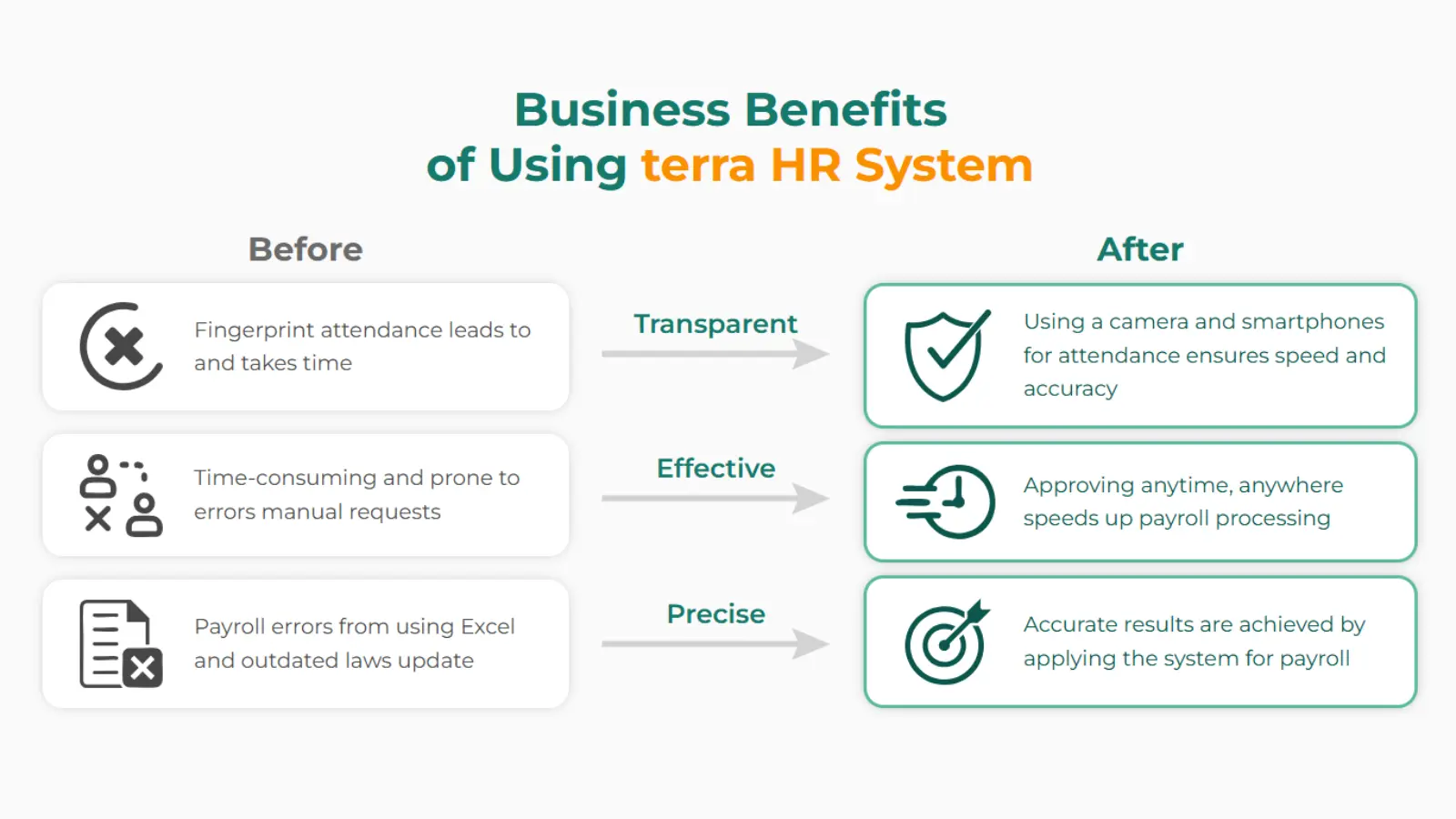
Managing the complexities of different employment contracts is a significant administrative challenge where a manual approach often leads to errors and legal risks. This is where a comprehensive terra hr Management System becomes essential, transforming manual tasks into automated workflows.
Trusted by over 100 businesses, this all-in-one terra HR solution acts as a central hub for all your HR needs, ensuring accuracy and efficiency from recruitment to offboarding.
- Core HR Management: Securely store and manage all employee data in one place from personal details, salary history, and tax information to signed employment contracts. This terra HR platform eliminates paperwork and provides instant, centralized access to all critical records.
- Automated Payroll: Automate complex calculations for salary, personal income tax (PIT), and social insurance contributions, ensuring every employee is paid accurately and on time while guaranteeing compliance.
- Time and Attendance Tracking: Effortlessly track working hours, overtime, and leave requests. Data syncs directly with the payroll module, simplifying calculations and ensuring transparent records.
- Streamlined Recruitment Management: Manage your entire hiring pipeline, from posting jobs and tracking candidates to generating offer letters and employment contracts.
- Performance & Goal Management: Set, track, and evaluate employee performance against clear objectives to make informed decisions. By integrating these functions, the terra hr software empowers businesses to manage their workforce strategically.
Liên hệ ngay với terra để nhận tư vấn chi tiết!
Conclusion
Ultimately, a well-crafted employment contract is the foundation of a fair and legally compliant work environment. By understanding the different types, businesses can manage their workforce strategically while employees can secure their professional rights.









