A probation period is a crucial stage in every employment relationship, allowing both the employer and the employee to assess suitability before a long-term commitment. In this post, terra will help you understand its meaning, rules, and best practices helps organizations maintain compliance and build a transparent, fair workplace.
What is a probation period?
Before officially joining a company, new hires often go through a probation period – a trial phase designed for both employer and employee to evaluate mutual compatibility. Understanding the probation meaning is essential for both HR managers and employees to ensure fair and compliant practices.
Understanding the probation meaning is essential for HR professionals to design fair and compliant hiring practices, ensuring every new team member is set up for success.
Probation period meaning
The probation period is a specific timeframe at the start of an employment relationship during which both employer and employee evaluate their compatibility. This period serves as a testing phase to assess job performance, work attitude, and cultural fit before signing a permanent labor contract.
In HR terms, the probationary period is designed to minimize hiring risks and ensure that the employee meets the company’s expectations. It is not merely a trial job – it’s a formal part of the recruitment process, governed by labor law and company policy.
The purpose of the probationary period
The probationary period benefits both parties.
- For employers: It allows time to assess whether a candidate possesses the right skills, mindset, and cultural adaptability.
- For employees: It’s an opportunity to understand job expectations, work environment, and internal processes like onboarding process or employee training.
Essentially, the probation period ensures that employment decisions are made on evidence, not assumptions that create mutual confidence and long-term alignment.
How long should the probation period last?
According to Article 25 of the Vietnam Labor Code 2019, the probation period must be based on the nature and complexity of the job, and both parties may agree on its duration. However, each position can only have one probationary period, and its length must comply with legal limits as follows:
- Up to 180 days for enterprise managerial positions (e.g., directors, general managers).
- Up to 60 days for roles requiring college-level qualifications or higher (such as engineers, accountants, or specialists).
- Up to 30 days for positions requiring vocational or intermediate qualifications (such as technicians or office clerks).
- Up to 6 working days for simple or unskilled jobs.
These limits ensure fairness and protect employees from excessively long probation periods. Employers and HR professionals should clearly state the agreed duration in the employment offer or probation agreement to avoid disputes and ensure full compliance with Vietnamese labor law.

Employee rights during the probation period
A probationary stage is not a time for employers to test limits. It’s a lawful employment phase where both sides share mutual rights and obligations. Understanding these rights helps employees protect themselves and ensures compliance for HR managers.
Salary and benefits entitlement
Even during the probation period, employees have the right to fair pay and equal treatment.
- Minimum wage: Vietnam’s Labor Code requires employers to pay at least 85% of the official salary for the same position, ensuring workers are not underpaid while demonstrating their ability.
Minimum wage and equal pay regulations still apply during the probation period, meaning no employer can pay below the statutory floor. Violations can result in back-pay claims or penalties.
- Supplementary benefits: Depending on company policy, probationary employees may receive supplementary benefits such as meal allowances, travel support, or productivity bonuses.
Social insurance and other contributions
- Insurance: A frequent question during this stage is whether employees are covered by insurance. Generally, during the probationary period, the employment relationship has not yet been formalized under a full labor contract, meaning compulsory social insurance may not apply.
- After probation: Once the employee passes probation and signs the official contract, insurance contributions start immediately.
- Forward-thinking organizations often provide voluntary insurance or wellness programs during the probation period to strengthen their employer brand and attract talent.
Notice requirements for termination
Ending employment during the probation period also requires attention to legal detail. According to Vietnam’s Labor Code:
- Both the employer and the employee can terminate the agreement at any time without cause – provided they give proper notice.
- The date of termination: A probation period notice is typically a written document stating the date of termination, evaluation summary, and any outstanding payments. While the law allows either party to end the trial, professional HR practice recommends at least three (03) days’ notice to maintain fairness and minimize disputes.

Legal framework for probation in Vietnam
Vietnam’s Labor Code 2019 provides a clear legal foundation governing how employers and employees should conduct the probation period. Understanding these regulations helps businesses comply with the law and protects employees from unfair treatment.
Labor Code regulations on probation
The labor law in Vietnam sets specific limits on probation duration, depending on the employee’s position and job complexity.
- For managerial or specialized roles: Requiring professional qualifications, the probation period can last up to 60 days.
- For technical or skilled workers: The probation time must not exceed 30 days.
- For simple or unskilled jobs: The limit is 6 working days.
Employers exceeding these limits may be deemed in violation of Vietnam’s Labor Code, leading to administrative sanctions.
Probation length by job level
The maximum probation time must correspond to the employee’s qualification and job classification:
- Workers and unskilled employees: up to 6 working days.
Technical, vocational, or skilled workers: up to 30 days. - Specialists and managerial positions: up to 60–180 days, depending on the nature of the role.
The probation period cannot be extended or repeated for the same job title. If an employee continues to work after the probation ends without any formal notice, the employment relationship is automatically recognized as a valid labor contract under the law.
Employment contract and documentation
The probation contract is a legal document that defines the rights and responsibilities of both parties. It must be made in writing, separate from or included in the main labor contract, and specify:
- Job title and duties: clearly describe the role, responsibilities, and reporting line.
- Duration of the probation period: must comply with Article 25 of the Labor Code.
- Salary and payment method: probation salary must be at least 85% of the official wage for the same position, and payment timelines must follow legal payroll standards.
- Working conditions and evaluation criteria: outline the workplace, tools, working hours, and performance metrics used for assessment.
Transparency is essential. If the employee passes the probation, the employer must immediately sign an official labor contract. If the probation is unsuccessful, payment for actual working days remains mandatory.
Legal consequences of non-compliance
During the probation period, employers must still uphold core labor rights, such as providing a safe workplace, paying salaries on time, and ensuring non-discrimination. Failure to follow these obligations may lead to penalties under Decree 12/2022/NĐ-CP, which governs administrative violations in the labor field.
- Violation: Exceeding permitted probation period or multiple probation attempts
If an employer requires an employee to undergo probation longer than the legally allowed duration, or forces repeated probation for the same position, they may be fined from VND 2,000,000 to 5,000,000.
- Violation: Unreasonably imposing probation for short-term contracts or failing to notify results
Employers who ask employees to undergo probation when the labor contract is shorter than one month, or who fail to inform employees about probation outcomes, can be fined between VND 500,000 and 1,000,000 (for individuals). For organizations, the fine may be doubled.
In addition to monetary fines, employers may be ordered to pay back differences in salary, or be required to formalize the employment contract if the probationary employee has met requirements but hasn’t been officially engaged.
What happens after a period of probation
Once the probation period ends, both the employer and employee must make an official decision to continue the employment relationship or to part ways. This stage is critical because it determines whether the individual becomes a permanent member of the team or leaves the company.
Successful completion of probation
When an employee successfully completes the probation period, the employer is required by law to sign a formal labor contract immediately. A clear and prompt transition after a period of probation not only enhances compliance but also reinforces employee trust and motivation.
Typical post-probation actions include:
- Issuing an official confirmation letter.
- Converting the probation agreement into a full labor contract.
- Adjusting salary and benefits according to company policy.
- Updating the employee record in the HR system.
Probationary period extension
Extending a probationary period is rarely allowed under Vietnamese law.
Employers must either:
- Confirm the employee as official staff if they meet the performance criteria, or
- Terminate the relationship with proper notice if they do not.
An extension is only valid in exceptional cases for example, when both parties explicitly agree in writing and the total probation time does not exceed the legal limit set for the role.
Ending a probation period
If the employee fails to meet job expectations, the employer may end the probation period.
To stay compliant:
- Provide written probation period notice at least 3 days before termination.
- Pay for all days worked during the probation.
- Document the reasons for termination, especially in cases of performance or behavior issues.
Proper documentation protects both parties and minimizes the risk of disputes or claims.
After a period of probation, decisive and transparent actions are essential. Whether confirming, extending, or ending employment, HR teams must follow clear legal and procedural steps.
Termination during the probation period
This part addresses how to legally and fairly terminate an employee during the probation period, including notice requirements, valid reasons, and compliance procedures. HR managers must ensure every step is documented to prevent disputes and penalties.
Terminating an employee on probation
An employer may terminate a worker during the probation period if performance, attitude, or job fit is unsatisfactory. However, this must be handled carefully to respect both labor laws and company policies. The probation period notice should include:
- Full name and position of the employee
- Start and end date of the probationary period
- Summary of performance evaluation results
- Termination decision and final working day
Employers must give the employee at least 3 days’ written notice before the termination date, unless the contract specifies otherwise.
Grounds for termination during probation
Valid grounds for ending a probation period include:
- Failure to meet the job’s performance standards
- Misconduct or violation of internal regulations
- Incompatibility with the company’s working environment or culture
It’s crucial that termination decisions are supported by written performance reviews, attendance logs, or manager feedback.
Procedures for termination
When ending employment during the probation period, employers in Vietnam must strictly follow the steps outlined under the 2024 Labor Code to avoid potential disputes or legal penalties.
- Step 1: Provide written notice. Either the employer or employee may terminate the probation without cause, but a written probation period notice is required to document the decision: name, probation start and end dates, performance assessment, and final working date.
- Step 2: Ensure timely payment. Employers must pay wages for all days worked, including any overtime, by the next payroll cycle. Deductions (such as PIT) must comply with Vietnamese tax laws.
- Step 3: Record and archive termination documents. HR should retain signed copies of the termination notice and evaluation results for at least three years, as required for potential audits or inspections by the Department of Labor, Invalids and Social Affairs (DOLISA).
- Step 4: Conduct a clear handover. Employees should complete a formal handover checklist for company property, documents, and digital access before leaving.
Following these steps ensures compliance and helps employers avoid misunderstandings that could escalate into disputes or claims.
Legal consequences of unjustified termination
Under Vietnamese Labor Code 2019, both the employer and the employee have the right to end the probation at any time, without prior notice and without compensation. There are no legal penalties for terminating during probation, as long as it complies with the agreed probation terms. However, the employer may face compliance risks if they:
- Fail to pay agreed probation wages;
- Do not inform the employee of the probation result; or
- Continue to employ the worker without signing an official labor contract afterward.
While not “termination penalties,” these acts may result in administrative fines for non-compliance with labor regulations under Labor Code 2019.
Benefits and drawbacks of probation periods
A probation period offers both employers and employees a chance to evaluate each other before committing to a long-term employment relationship. When managed correctly, this period can minimize hiring risks and ensure a better organizational fit. However, it also presents certain challenges that businesses should prepare for to stay compliant and maintain employee trust.
Benefits for employers
For employers, the probationary period serves as a low-risk evaluation phase before signing a long-term labor contract. Key advantages include:
- Assessing employment fit: Employers can evaluate an employee’s skills, work ethics, and cultural fit in real conditions that provide a more accurate picture than interviews and supporting data-driven hiring decisions.
- Reducing long-term employment costs: Probation helps identify unsuitable hires early, preventing costly terminations, retraining, or replacement expenses that come with long-term contracts.
- Evaluating employees’ skills before full hire: With measurable goals set during probation, employers can assess performance and decide on promotions, salary adjustments, or permanent employment confidently.
Benefits for employees
The probationary period also benefits employees, giving them time to explore whether the company is the right fit for their career goals.
- Opportunity to prove capabilities: Probation gives employees the platform to demonstrate their professional skills and commitment in a real work environment. Strong performance during this phase often leads to better contract terms or faster advancement opportunities.
- Time to evaluate company culture: Employees can experience the organization’s management style, team dynamics, and internal processes firsthand. This helps them decide whether they feel aligned with the company’s values, leadership, and workplace culture before officially committing.
Drawbacks of probation periods: What could go wrong
Despite its advantages, probation is not without challenges. Improper handling can create legal or human resource risks for both parties.
- Employees may feel insecure or undervalued: The temporary nature of probation can cause uncertainty or stress, lowering motivation and engagement if expectations are not clearly set.
- Compliance complexity increases when operating across borders: Labor laws differ by country, and misunderstanding probation rules like duration or notice requirements can result in legal risks. In Vietnam, probation time must not exceed 60 days for most roles.
- Great candidates might walk away early: Overly long or poorly managed probation may push skilled professionals to leave, especially when feedback and recognition are lacking.

HR best practices for managing probationary periods
A well-managed probation period not only ensures fair evaluation but also builds trust between employers and new hires. HR teams should combine clarity, communication, and compliance to make the process smooth and legally sound.
Clear onboarding and written probation terms
Every probationary period should start with a formal onboarding process and a written agreement outlining duration, goals, and evaluation methods. This prevents misunderstandings and protects both sides legally.
Regular performance feedback sessions
Continuous communication during the probation time helps employees adjust and perform better. Short feedback meetings every few weeks allow managers to identify issues early and provide support where needed.
Accurate payroll management from day one
HR must ensure salaries and deductions are correctly handled even during probation. Using digital tools like the terra HR software or terra HR platform helps automate payroll calculations and stay compliant with tax and statutory contribution rules.

Frequently asked questions about the probation period
Many employers and employees have similar concerns about the probation period: its length, pay, and legal obligations. Below are some of the most common questions answered according to Vietnam’s Labor Code.
How long can a probation period last in Vietnam?
Answer: The probation period typically ranges from 6 to 60 days, depending on the job’s complexity and skill level.
- Unskilled or manual jobs: up to 6 days.
- Technical or specialized positions: up to 30 days.
- Managerial or high-level expert roles: up to 60 days.
Some industries may apply up to 180 days for senior management if both parties agree in writing, but this must comply with labor law provisions.
Can a probation period be extended?
Answer: No.
Under Vietnam’s Labor Code, an employee can only be placed on probation once per position. If the employer is still uncertain after probation, they must either sign an official labor contract or end the employment. Any probation extension is considered a breach of law.
Is it mandatory to pay employees during probation?
Answer: Yes.
Employers must pay at least 85% of the official salary for the same role, as stated in the employment offer or labor contract. Payment must also follow standard payroll timelines and be subject to deductions where required (e.g., personal income tax).
Are probationary employees entitled to social insurance?
Answer: No.
In most cases, probationary employees are not yet covered by compulsory social insurance because no formal labor contract has been signed. However, once the official contract is issued, coverage begins from that date. Many employers still opt to offer voluntary insurance or benefits to attract and retain talent.
Can an employee resign during the probation period?
Answer: Yes.
Employees have the right to resign without cause during probation but must provide a minimum of 3 days’ notice (or as stated in the agreement). No compensation is required if the resignation follows this notice rule.
Can an employer terminate a probationary employee?
Answer: Yes.
Employers may end the employment at any point during the probation period if the employee fails to meet performance standards. However, termination must include:
- Written notice (usually 3 days in advance).
- Payment for all days worked.
- Clear documentation explaining performance issues if requested.
Companies that do not comply with these requirements may face legal consequences.
What happens after a probation period ends?
Answer: After the probation period:
- If the employee passes, the employer must sign an official labor contract immediately.
- If the employee does not meet requirements, the employer must notify termination before or on the last day of probation.
- If no action is taken and the employee continues working, the relationship automatically becomes a formal employment contract by law.
What is a probation period notice?
Answer: A probation period notice is the written communication used when either side decides to end or confirm employment during or after probation. It outlines the employee’s performance result, decision on continuation, and the final working date.
For compliance, the notice should include:
- Dates of probation and decision.
- Evaluation results.
- Signature of both parties (optional but advisable).
Can employees take leave during the probation period?
Answer: Yes, but the type of leave matters. Probationary employees can take unpaid leave or personal leave if the employer agrees. However, paid annual leave is usually not applicable until the employee becomes official.
Is it legal to end probation without explanation?
Answer: Yes. Either the employer or the employee may end the probation period without providing a reason.
Under Vietnam’s Labor Code, both parties have the right to terminate probation at any time without cause, as long as prior notice (usually three days) is given if specified in the probation agreement. No compensation or severance is required for lawful termination during probation.
What if an employee performs exceptionally well before the probation ends?
Answer: The employer may confirm the employee as official before the probation period expires.
Vietnamese law allows flexibility in ending probation early if both sides agree. In this case, the employer should issue an official labor contract effective from the confirmation date, and the employee becomes entitled to full salary, benefits, and insurance coverage as stated in the contract.
How are taxes handled during the probation period?
Answer: Personal income tax (PIT) still applies to salaries paid during probation.
Employers must deduct PIT at a flat rate of 10% from the probationary salary if no tax code or dependent declaration is provided. Once the employee becomes official, PIT is recalculated monthly under the progressive tax schedule. If total income during the year is below the taxable threshold, the employee may claim a refund during annual tax finalization.
What are common mistakes companies make during probation?
Answer: Some typical compliance errors include:
- Having probation longer than legally allowed.
- Extending probation multiple times.
- Paying below the minimum wage or missing pay deadlines.
- Ending employment without written notice.
- Failing to issue an official contract after probation.
What should HR managers include in a probation policy?
Answer: A clear probation policy should define:
- Duration and evaluation criteria.
- Pay and benefits during probation.
- Termination and notice procedures.
- Assessment templates and decision timeline.

Smart HR management with terra HR System
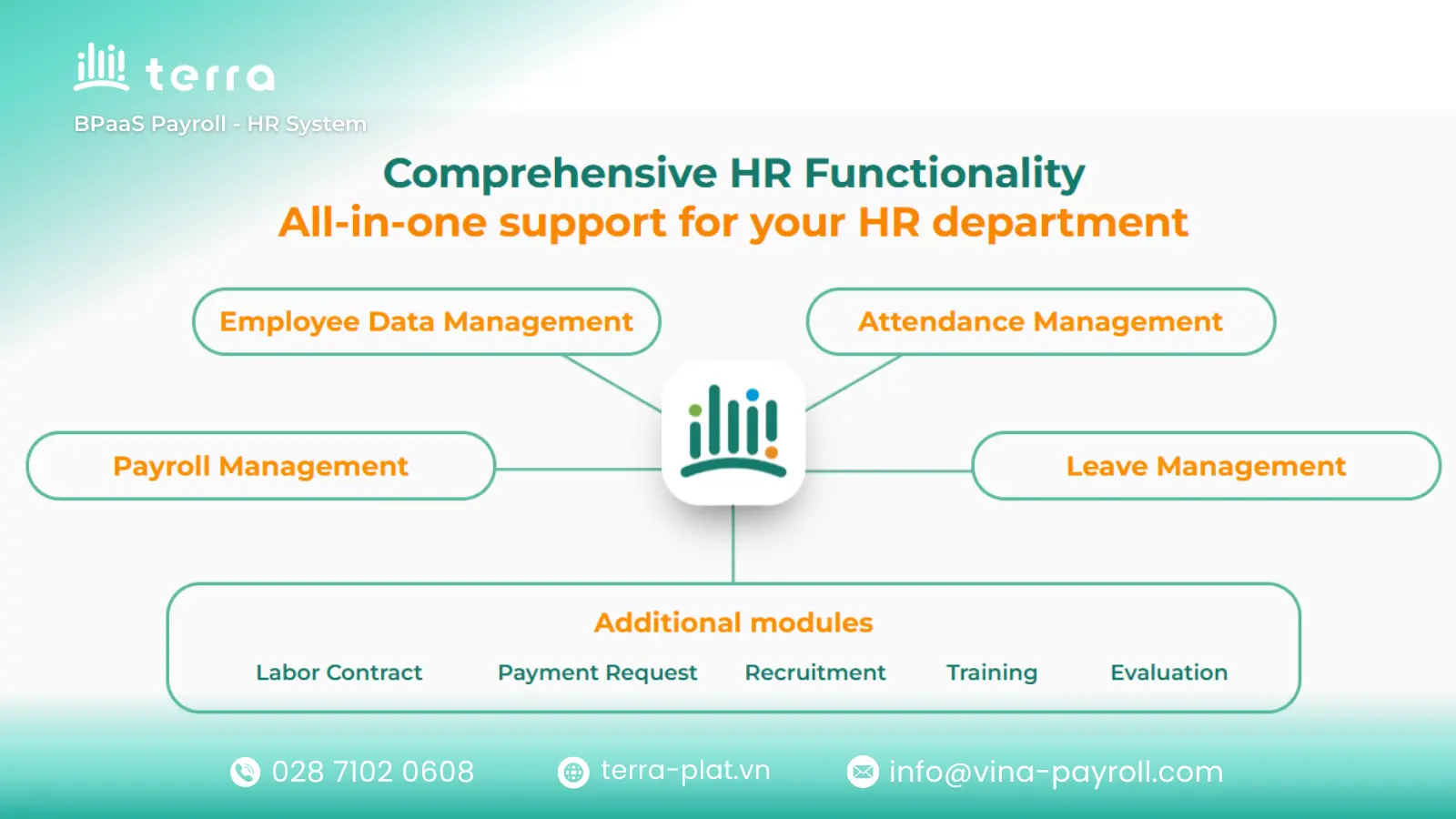
In today’s fast-paced workplace, managing people efficiently requires more than spreadsheets or isolated tools. terra HR System is a comprehensive HR software that simplifies every aspect of workforce management.
Developed by VINA PAYROLL OUTSOURCING Co., Ltd., a member of the I-GLOCAL Group with over 21 years of experience in tax and HR consulting, terra HR management system provides organizations with the tools they need to simplify HR operations, save time, and improve employee experience.
Key advantages of terra HR solution:
- Centralized employee database: Store and manage all HR records securely in one place.
- Smart attendance tracking: Choose from GPS-based, camera FaceID, or traditional timekeeping methods for accurate attendance data.
- Leave and overtime management: Approve requests instantly and maintain transparency across teams.
- Automated payroll integration: Seamlessly connected with terra Payroll for accurate, compliant salary computation.
- Social insurance management: Full legal compliance with automated data processing.
- Recruitment and onboarding: Manage candidate pipelines and onboarding documents efficiently.
- Performance and training modules: Track progress, evaluate results, and manage learning resources.
Each feature of terra HR platform is designed to help HR professionals reduce manual work and make faster, data-driven decisions. With terra HR platform, companies can modernize their HR operations, improve accuracy, and build a smarter digital workplace.
Liên hệ ngay với terra để nhận tư vấn chi tiết!
Conclusion
The probation period is a vital stage in every employment relationship, allowing both employers and employees to evaluate fit before committing long-term. Understanding its definition, duration, and best practices ensures compliance with Vietnamese labor laws while fostering transparency and trust.