
In this comprehensive guide, terra breaks down everything you need to know about employee benefits in Vietnam. Whether you are an SME or a global corporation, this article will show you how to build a compliant, tax-efficient, and irresistible benefits program.
What are employee benefits in Vietnam?
Employee benefits in Vietnam are forms of indirect remuneration provided to workers beyond their base salary. These can include mandatory insurance, health screenings, allowances, and flexible work arrangements. Essentially, if the salary is the “main course,” benefits are the “essential sides” that make the meal complete and satisfying.
Employee benefits vs. salary under the Labor Code 2019
Under the Labor Code 2019, salary is defined as the amount paid for work performed. Benefits, however, often fall under “allowances” or “other regimes.” While the salary is the fixed contractual amount, benefits are the supplementary rights designed to improve an employee’s quality of life and provide social protection.
The difference between employee benefits and compensation
In the modern HR landscape of Vietnam, “Salary” and “Benefits” are often lumped together.
However, to build a world-class Total Rewards strategy, employers must distinguish between the two. Think of an employee’s total package as an iceberg: Compensation is the visible tip, the immediate financial reward while Benefits represent the substantial foundation below the surface that ensures long-term stability and engagement.
Understanding this distinction is vital for compliance with the Labor Code 2019 and for effectively communicating value to potential hires during the recruitment process.
Compensation vs. Employee Benefits
| Feature | Compensation (Direct Remuneration) | Employee Benefits (Indirect Remuneration) |
| Core Definition | The direct monetary payment for work performed or results achieved. | The non-wage value provided to support health, security, and work-life balance. |
| Primary Goal | Attraction: To secure talent by offering competitive market rates. | Retention: To build loyalty and reduce long-term turnover. |
| Payment Format | Liquid cash (Monthly salary, commissions, bonuses). | Services, insurance premiums, or “in-kind” perks (Gym, training). |
| Legal Basis | Strictly governed by the Labor Code 2019 and individual contracts. | A mix of statutory requirements (SI/HI/UI) and voluntary corporate policies. |
| Tax Impact (PIT) | Generally 100% taxable as part of gross income. | Often Tax-efficient; many benefits are exempt or capped (e.g., mid-shift meals). |
| Frequency | Fixed cycles (Monthly, quarterly, or annually). | Continuous (Insurance coverage) or event-based (Birthdays, Tet). |
| Visibility | High; usually the first line on a job offer. | Moderate; requires a “Total Rewards Statement” to be fully appreciated. |
| Examples | Base salary, OT pay, Sales commissions, 13th-month bonus. | Private healthcare, WFH flexibility, ESOPs, Mental health apps. |
Base salary, allowances, and other types of employee benefits
Compensation refers to the direct monetary value an employer provides in exchange for the employee’s time, skills, and labor. In Vietnam, these figures are typically the “hard numbers” negotiated in the labor contract and are the primary drivers of an employee’s immediate purchasing power.
- Base Salary: The fixed monthly amount that serves as the basis for calculating social insurance (SI) and health insurance (HI) contributions.
- Overtime Pay (OT): Mandatory additional payments for work performed beyond standard hours, ranging from 150% to 300% of the hourly rate depending on when the work occurs.
- Commissions & Performance Bonuses: Variable pay linked directly to sales targets or KPI achievements.
- Taxable Allowances: Payments like seniority allowances or responsibility stipends that are generally added to the gross income for Personal Income Tax (PIT) calculations.
Taxable vs. non-taxable employee benefits
Unlike compensation, benefits are non-wage values provided to enhance the employee’s quality of life, health, and future security. While compensation attracts talent, a robust benefits package is what retains them.
- Supplemental Health Insurance: Private schemes (e.g., PVI, Bao Viet) that offer faster access and better facilities than the mandatory public health insurance.
- Time-Off Programs: Annual leave exceeding the statutory 12 days, “recharge” days, or paid leave for birthdays and family events.
- Wellness & Lifestyle Perks: Gym memberships, mental health counseling, or mid-shift meal vouchers (which, within certain limits, are non-taxable in Vietnam).
- Learning & Development (L&D): Company-funded certifications, language courses, or professional workshops that increase the employee’s market value.
Why employee benefits are important in Vietnam
In 2026, Vietnam’s labor market has shifted from a “surplus of labor” to a “war for talent,” particularly in high-growth sectors like ICT, Fintech, and Manufacturing. In this environment, employee benefits are no longer a “nice-to-have” addition, they are the backbone of a sustainable business strategy.
Importance of employee benefits for employers
For organizations operating in Hanoi, Ho Chi Minh City, or Da Nang, a well-structured benefits program serves three critical business functions:
Legal compliance with the Labor Code 2019
The Labor Code 2019 serves as the primary legal framework in Vietnam, and its enforcement is rigorous. Failing to provide mandatory statutory benefits, specifically Social Insurance (SI), Health Insurance (HI), and Unemployment Insurance (UI), is more than an administrative oversight; it is a legal liability.
- The risk: Non-compliance can result in heavy administrative fines (under Decree 12/2022/ND-CP), forced business suspensions, and severe damage to a company’s reputation during labor inspections.
- The benefit: Full compliance ensures a smooth operational path and builds trust with local authorities.
Learn more: Organizational Structure: Types, Key Elements & How to Design Effectively.
Talent attraction and retention in Vietnam’s labor market
In the 2026 landscape, top-tier Vietnamese candidates, especially Gen Z and Millennials, are increasingly “benefit-conscious.” While a high base salary gets a candidate to the interview, a robust benefits stack closes the deal.
- Competitive edge: When two companies offer similar salaries, the one providing supplemental private health insurance or hybrid work flexibility invariably wins the candidate.
- Reducing churn: High turnover is costly. Benefits like long-term retention bonuses and professional development programs create “golden handcuffs,” making it harder for competitors to poach your best people.
Employer branding and workforce stability
Your benefits package is a direct reflection of your corporate culture. Companies that prioritize mental health support, wellness employee benefit programs, and parental leave are perceived as “people-first” organizations.
- Preferred employer status: A strong employer brand reduces recruitment costs by attracting organic applications.
- Stability: Employees who feel cared for are more productive, have lower absenteeism rates, and contribute to a stable, harmonious working environment.
Importance of employee benefits for employees
From the perspective of a Vietnamese professional, benefits represent a holistic commitment to their well-being and future.
Income security and social protection
In a developing economy, mandatory insurance acts as a vital financial cushion. Statutory benefits provide a safety net for life’s unpredictable moments:
- Sickness and maternity: Ensuring employees receive up to 75-100% of their salary during medically approved leave or childbirth.
- Unemployment: Providing a bridge of 60% of the average salary during career transitions.
Health care access and work-life balance
Vietnam’s fast-paced work culture often leads to high stress. Benefits that focus on work-life balance, such as remote work options and additional paid leave, are essential for burnout prevention.
While public healthcare is available, employer-provided private insurance allows employees to access international-standard hospitals, ensuring they return to work faster and healthier.
Long-term career and retirement security
The Vietnamese workforce highly values stability. A comprehensive benefits plan addresses the entire lifecycle of an employee’s career:
- Professional growth: Access to certifications and training ensures the employee remains competitive in the global market.
- Retirement: Consistent Social Insurance contributions guarantee a monthly pension, providing peace of mind for the employee’s “golden years.”
Categories of employee benefits in Vietnam
In the modern Vietnamese workplace, a “one-size-fits-all” approach no longer works. Companies now categorize benefits into four strategic pillars to address the diverse needs of a multi-generational workforce, from Gen Z digital natives to seasoned Gen X leaders.
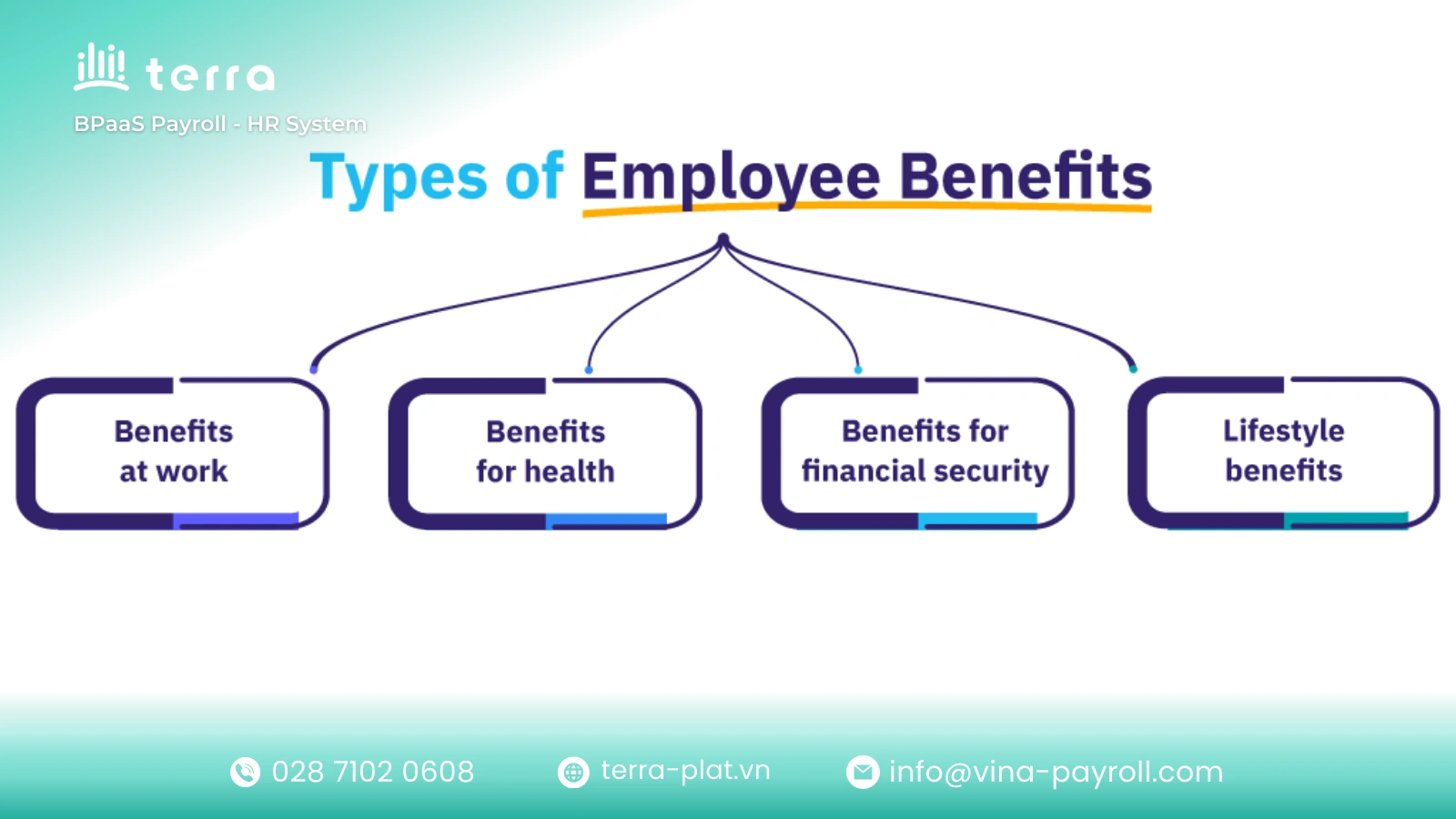
Health and well-being benefits
Physical and mental health have become the cornerstone of productivity. In 2026, leading firms in Vietnam are moving beyond “bare minimum” insurance to offer holistic wellness ecosystems.
Periodic health check-ups
While annual health screenings are a legal requirement under the Labor Code, top employers differentiate themselves by offering comprehensive diagnostic packages. These often include specialized screenings (cancer markers, cardiovascular health) and are conducted at top-tier international hospitals.
Mental health support and counseling
The “hustle culture” in cities like HCMC has led to increased burnout. Progressive companies now provide Employee Assistance Programs (EAPs), offering confidential access to psychologists, stress management workshops, and 24/7 mental health hotlines.
Wellness and work-life balance programs
This category includes gym memberships, yoga classes, and “Wellness Fridays.” By encouraging physical activity and mindfulness, employers see a direct correlation in reduced absenteeism and higher energy levels.
Training and professional development benefits
The Vietnamese workforce is known for its “growth mindset.” Providing pathways for self-improvement is one of the most effective ways to foster long-term loyalty.
Paid training and upskilling programs
With the rapid integration of AI and automation in 2026, upskilling is essential. Employers fund internal workshops or subscriptions to platforms like Coursera and LinkedIn Learning to keep their teams competitive.
Professional certifications and short courses
For technical roles, covering the cost of global certifications (e.g., PMP, ACCA, AWS, or Google Cloud) is a major draw. These “micro-credentials” add immediate value to both the employee and the firm.
Career development and promotion pathways
Transparency is key. Benefits here include mentorship programs and clearly defined “Internal Mobility” policies that allow employees to see a future for themselves within the company, rather than looking for a promotion elsewhere.
Work arrangement and commuting benefits
Urban congestion in Vietnam’s “Mega-Cities” makes the daily commute a significant pain point. Solving this through benefits is a massive competitive advantage.
Transportation and parking allowances
Covering the cost of fuel, Grab credits, or monthly parking fees in Grade A office buildings is a standard but highly appreciated perk that eases the financial burden on daily commuters.
Company shuttle services
For businesses located in high-tech parks (like SHTP in District 9) or industrial zones, providing private shuttle buses with Wi-Fi allows employees to commute safely and even start their workday comfortably.
Remote and hybrid working models
In 2026, Hybrid Work is non-negotiable for office roles. Offering the flexibility to work from home 2-3 days a week is often valued as much as a 10% salary increase, as it directly impacts an employee’s “Time Wealth”.
Financial and incentive-based benefits
While “soft benefits” are rising, financial security remains the primary motivator for the majority of the Vietnamese labor force.
Performance bonuses and annual bonuses
These are structured rewards tied to individual or company-wide KPIs. They create a “pay-for-performance” culture where high achievers are directly rewarded for their impact.
Tet bonus and special occasion allowances
The 13th-month salary (Tet Bonus) is a cultural pillar in Vietnam. Beyond Tet, companies often provide smaller allowances for the Mid-Autumn Festival, International Women’s Day (March 8th), and birthdays.
Long-term incentives and retention bonuses
To combat “job-hopping,” companies are increasingly using ESOPs (Employee Stock Ownership Plans) or “Stay Bonuses” that vest after 3 or 5 years of service, aligning the employee’s success with the company’s long-term growth.
28 Employee benefits commonly applied in Vietnam
Navigating the Vietnamese labor market requires a blend of legal adherence and cultural intuition. Below is a comprehensive breakdown of 28 benefits, categorized from legal “must-haves” to competitive “differentiators.”
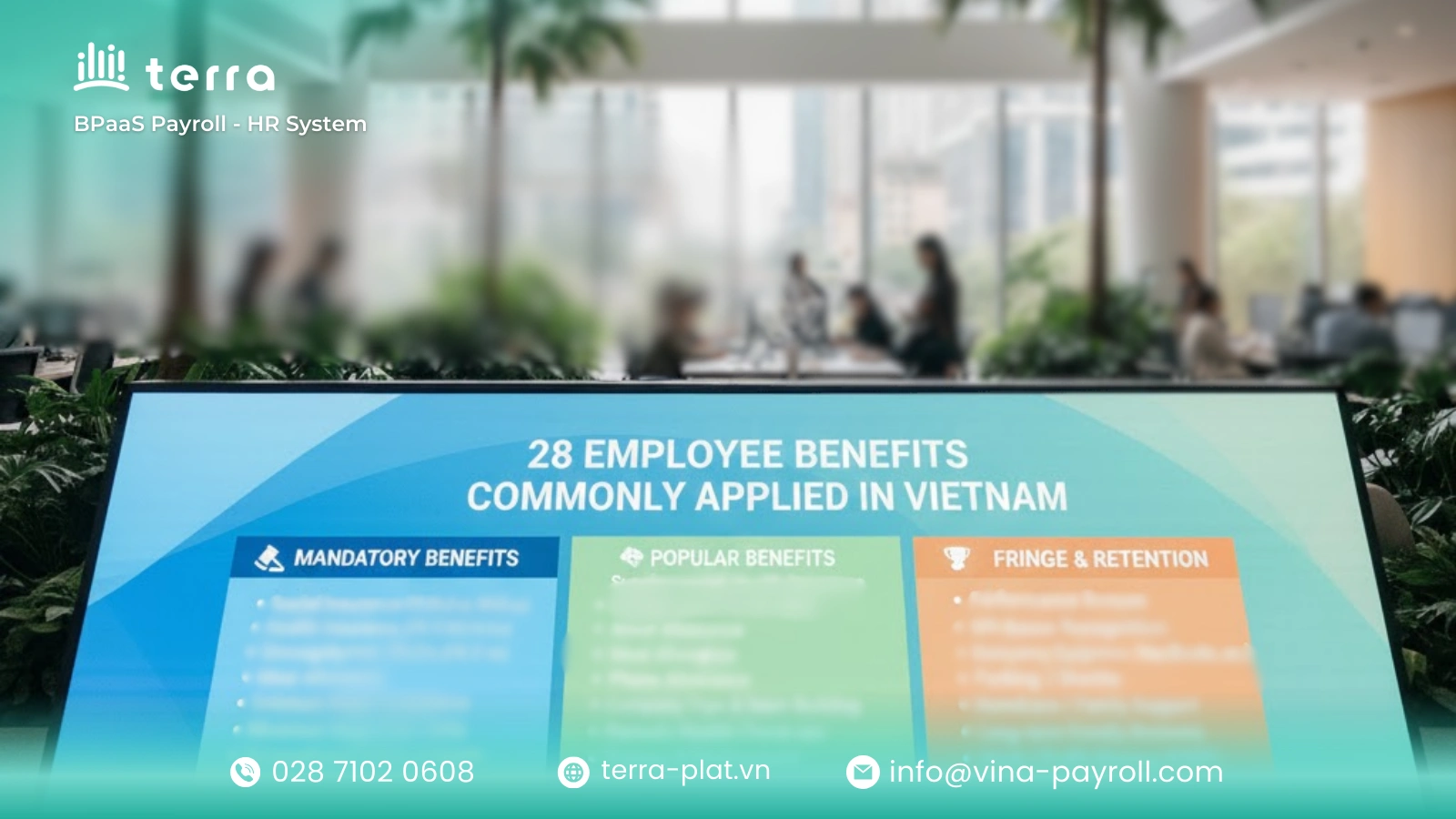
Mandatory employee benefits under Vietnamese law
These are non-negotiable entitlements governed by the Labor Code 2019 and the Social Insurance Law. Failure to provide these can result in legal action.
- Social Insurance (SI): Covering pension, sickness, and maternity. In 2026, the employer contribution is 17.5% and the employee pays 8%.
- Health Insurance (HI): Ensuring access to the national healthcare system. Rates are 3% (Employer) and 1.5% (Employee).
- Unemployment Insurance (UI): A safety net providing 60% of the average salary during job transitions. Both parties contribute 1%.
- Minimum Wage Compliance: Salaries must meet or exceed the regional minimums (Region I to IV) as set by the government.
- Overtime Pay: Legally mandated premiums: 150% for weekdays, 200% for weekends, and 300% for public holidays.
- Occupational Safety and Health (OSH): Providing a safe work environment and necessary protective gear, especially in manufacturing or hazardous roles.
Popular employee benefits in Vietnamese companies
These are not required by law but are expected by 90% of office-based professionals in Vietnam. Skipping these will make recruitment significantly harder.
7. Supplemental Health Insurance: Private plans that cover high-end clinics and international hospitals.
8. Annual Leave & Paid Leave: While the law mandates 12 days, many competitive firms offer 15–20 days plus extra leave for “Service Years.”
9. Meal Allowance: Monthly cash stipends or vouchers to cover lunch costs.
10. Transportation Allowance: Stipends for fuel, parking, or ride-sharing (Grab) to assist with the daily commute.
11. Phone Allowance: Covering mobile bills for employees who use their personal devices for work.
12. Company Trips & Team Building: An annual “Offsite” or beach trip – a vital cultural ritual for building “Engagement” in Vietnam.
13. Periodic Health Check-ups: Enhanced annual screenings that go beyond the basic legal requirements.
14. Training & Development Programs: Subsidized English courses, technical workshops, or leadership retreats.
Fringe and retention-focused employee benefits
In 2026, these “luxury” or “modern” perks are what top candidates in the ICT and creative sectors use to choose between multiple job offers.
15. Flexible Working Hours: Allowing employees to start and end their day outside of the traditional 8:00-17:00 window.
16. Remote Work Options: The freedom to work from home (WFH) or a cafe for a portion of the week.
17. Performance Bonuses: Cash rewards for exceeding quarterly or bi-annual objectives.
18. Tet Bonus (13th Month Salary): While not legally mandatory, it is a cultural obligation. Almost all Vietnamese employees expect a full month’s salary before the Lunar New Year.
19. KPI-Based Incentives: Transparent, data-driven bonuses for hitting specific production or sales targets.
20. Employee Recognition Programs: “Employee of the Month” awards or peer-to-peer recognition platforms.
21. Company Equipment: High-end tech (MacBooks, dual monitors) or ergonomic office furniture for home setups.
22. Parking & Commuting Support: Guaranteed parking spots in congested city centers or company-run shuttle buses.
23. Housing or Relocation Support: Particularly vital for attracting expats or moving talent between Hanoi and HCMC.
24. Extended Unpaid Leave: Sabbatical options for personal growth or long-term travel without losing job security.
25. Childcare or Family Support: Stipends for school fees or “Family Days” where children can visit the office.
26. Mental Health Programs: Access to therapy, meditation app subscriptions, or “Mental Health Days” off.
27. Long-term Retention Bonuses: Significant cash payouts for employees who reach the 3, 5, or 10-year milestones.
28. Stock or Profit-Sharing Schemes: ESOPs (Employee Stock Option Plans) are becoming highly popular in the burgeoning Vietnamese startup scene.
How to build a compliant employee benefits program in Vietnam
Designing a benefits package in Vietnam is a balancing act. You must satisfy the strict requirements of the Labor Code 2019 while optimizing your budget for Personal Income Tax (PIT) and corporate employee benefit expenses. Follow this three-step strategic framework to build a program that is both legal and competitive.
Ensuring compliance with the Labor Code 2019
The foundation of any benefits program must be legally watertight. In Vietnam, labor inspectors are meticulous, and social insurance audits are common.
- Audit Your Contracts: Ensure that every benefit, whether mandatory or voluntary, is clearly documented in the Labor Contract, Collective Labor Agreement (CLA), or the Company’s Internal Regulations.
- Social Insurance (SI) Thresholds: Remember that SI contributions are calculated based on salary plus certain allowances. However, as of 2026, there is a cap on the salary used for SI calculation (20 times the statutory base salary). Ensure your payroll system reflects these caps to avoid overpaying.
- Mandatory Leave Tracking: Beyond the 12 basic days of annual leave, ensure you are compliant with specific leave types like Maternity (6 months), Paternity (5-14 days), and Convalescence leave after illness.
Structuring employee benefits for tax efficiency
A “smart” benefits program maximizes the take-home pay for the employee without increasing the tax burden on the employer. This is achieved by utilizing non-taxable benefits recognized by the Vietnamese Tax Authorities.
The 15% Housing Cap: If you provide a housing allowance, only the amount up to 15% of the employee’s total taxable gross income is subject to PIT. Anything above this is tax-free for the employee but remains a deductible expense for the company.
Maximize Non-Taxable Allowances: Focus on providing benefits that are exempt from PIT (within specific regulated limits):
- Mid-shift meals: Up to the monthly limit set by the Ministry of Labour, Invalids and Social Affairs.
- Funeral and Wedding allowances: Within the company’s general policy.
- Uniform allowances: Cash payments up to 5,000,000 VND/year (or unlimited if provided in kind).
Documenting Deductibility: To ensure these benefits are treated as “deductible expenses” for Corporate Income Tax (CIT), ensure you have valid invoices (VAT invoices) and that the benefits are clearly stated in the company’s financial policy.
Aligning benefits with company size and industry
A “one-size-fits-all” strategy is the quickest way to waste your HR budget. Your benefits should reflect your industry’s specific pressures and your company’s growth stage.
| Company Stage / Industry | Recommended Focus | Strategic Benefit |
| Startups & Tech | Agility and Ownership | ESOPs, Remote work, and Unlimited Learning budgets. |
| Manufacturing | Safety and Logistics | Shuttle buses, high-quality meals, and OSH certifications. |
| Large Corporates | Stability and Prestige | Supplemental Insurance, Seniority bonuses, and Pension schemes. |
| SMEs | Personal Touch & Flexibility | Flexible hours, family-day events, and personalized wellness perks. |
terra Payroll’s professional employee benefits management services

While specialized recruitment software is excellent for talent acquisition, many businesses find greater value in a unified system. terra HR Management System is a comprehensive solution that integrates recruitment directly into the core HR workflow.
This all-in-one terra HR Solution provides a single hub for all employee data, so when you hire a candidate, their profile automatically transfers to payroll and management, eliminating errors and creating a seamless onboarding process.
- Core HR management: This is the central heart of the terra HR Platform. It securely stores and manages all employee profiles, contracts, and insurance details, eliminating paperwork and providing instant, centralized access to all critical records.
- Automated payroll management: This module automates complex calculations for salary, Personal Income Tax (PIT), and social insurance, ensuring 100% compliance with Vietnamese regulations. terra HR software links directly to timekeeping data to generate accurate, individual pay slips for every employee.
- Time & attendance management: Effectively track working hours, overtime, and diverse leave policies. This feature integrates with time clocks and allows employees to request time off, giving managers a clear, real-time view of attendance data.
- Performance & goal management: Set, track, and evaluate employee performance against clear objectives. This tool supports regular reviews and helps you make informed, data-driven decisions on promotions, employee training, and contract renewals.
Conclusion
In the high-stakes “war for talent” in Vietnam, your employee benefits program is your most powerful weapon. By mastering the balance between mandatory compliance and innovative fringe benefits, you don’t just fill seats, build a loyal, high-performing workforce that stays for the long term.









