
What is KPI? Key Performance Indicators (KPIs) act as your navigational instruments, showing you exactly where you stand against your goals. terra helps you explore the definition of KPIs, why they matter, and how to build a framework.
What is a KPI?
To navigate the business landscape effectively, we must first establish a clear definition. What is KPI exactly, and how does it function as the heartbeat of strategic management?
Definition
KPIs meaning stands for Key Performance Indicators. It is a quantifiable measure used to evaluate the success of an organization, employee, or specific activity in meeting objectives for performance.
Essentially, what is KPI? It is a compass. It tells you if you are moving towards your strategic goals or drifting away. High-level KPIs may focus on the overall performance of the business, while low-level KPIs focus on processes in departments such as sales, marketing, or HR.
For Examples:
- Financial KPI: Net Profit Margin (high-level) or Monthly Operating Expense (low-level).
- Sales KPI: Total Revenue Generated (high-level) or Number of Sales Calls Made per Day (low-level).
- Marketing KPI: Customer Acquisition Cost (CAC) (high-level) or Website Traffic Volume (low-level).
- HR KPI: Employee Retention Rate (high-level) or Time-to-Hire (low-level).
KPI meaning vs metrics meaning
While often used interchangeably, KPIs and metrics are not the same. KPIs are the critical (key) indicators of progress toward an intended result. They are strategic and deeply tied to core business objectives. Please answer the question: “Are we succeeding in achieving our goal?”
Metrics, on the other hand, measure the status of a specific business process. All KPIs are metrics, but not all metrics are KPIs. For example, website traffic is a metric, but conversion rate from traffic might be the KPI if your goal is sales growth. They answer the question: “What is happening?”
All KPIs are metrics, but not all metrics are KPIs. For example, website traffic is a metric that measures activity, but conversion rate from that traffic might be the KPI if your goal is sales growth, as it directly indicates progress toward the financial objective.
| Feature | Key Performance Indicators (KPIs) | Metrics |
| Purpose | Strategic. Measures progress toward a core business objective. | Diagnostic/Operational. Measures the health or status of a specific process. |
| Focus | Critical Success Factors. Tied to an intended result or target. | Activity/Volume. Tied to an action or volume of work performed. |
| Actionability | High. Directly drives action and strategic decision-making. | Lower. Provides context; used to analyze the cause of KPI movement. |
| Specificity | Specific & Time-Bound. (e.g., Reduce Churn Rate by 5% this quarter). | General. (e.g., Total customer support calls). |
| Example | Customer Lifetime Value (CLV), Monthly Recurring Revenue (MRR), Employee Retention Rate. | Website traffic, Average time on page, Number of email opens, Number of social media likes. |
Read more: Top 10 effective employee training methods for businesses
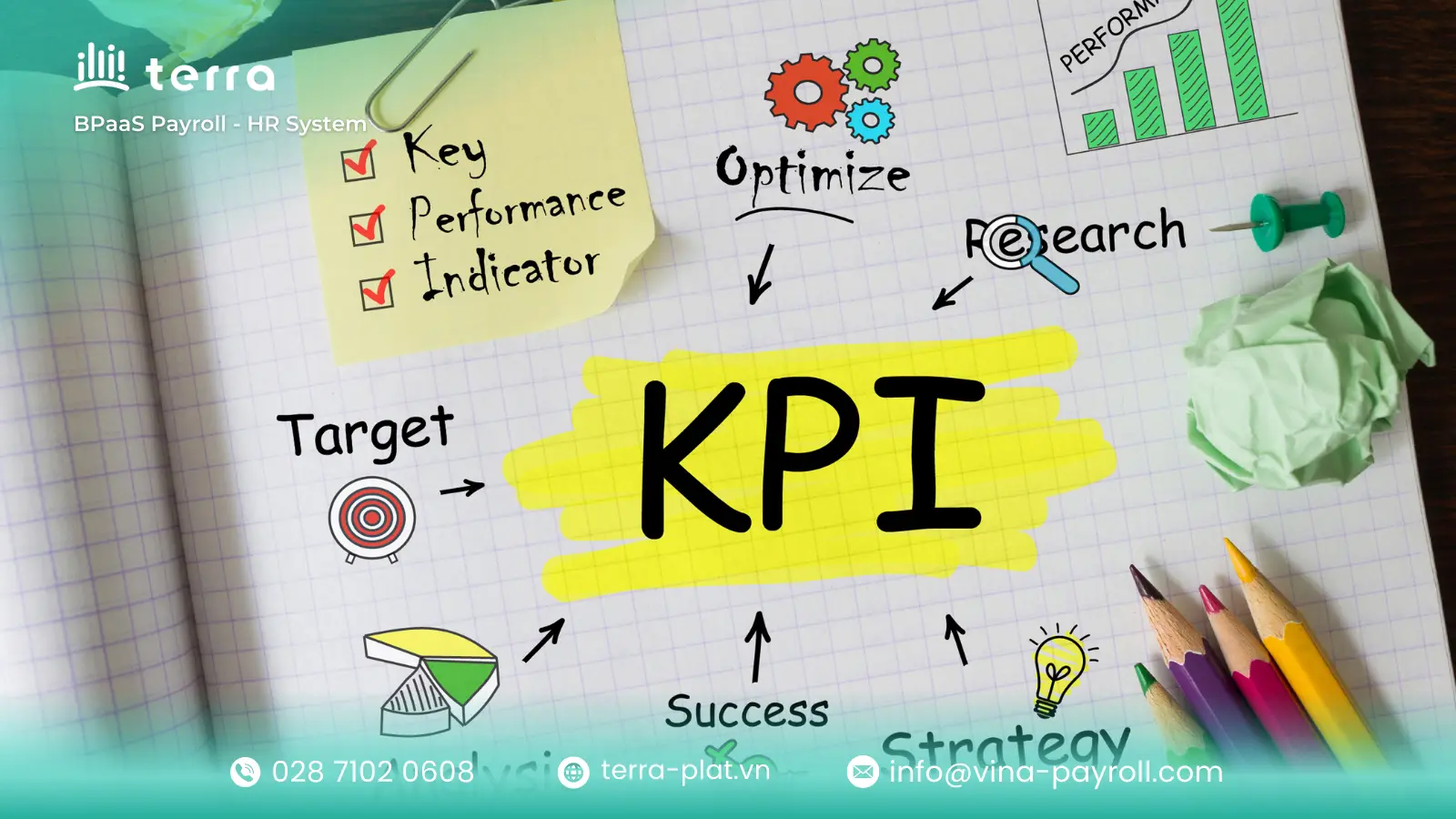
The importance of KPIs for organizations
Why do successful companies obsess over these numbers? Implementing a robust KPI framework is not just about tracking; it is about driving behavior and clarifying direction.
Ensure your teams remain aligned
KPIs bridge the gap between vision and reality. By establishing clear indicators, you ensure that everyone, from the CEO to the intern, is working towards the same objectives. This alignment prevents silos and ensures resources are focused on what truly matters.
Conduct regular health checks
Just as a doctor checks vitals, KPIs provide an immediate snapshot of your business’s health. They allow leaders to see if the company is thriving or struggling in specific areas, such as cash flow, employee retention, or customer satisfaction.
Implement necessary adjustments
Business is dynamic. When key performance indicators show a decline or a missed target, it acts as an early warning system. This allows management to pivot strategies, reallocate budgets, or change tactics before small issues become critical failures.
Maintain accountability within your teams
KPIs create transparency. When targets are clear and measurable, it is easy to see who is performing well and who needs support. This fosters a culture of accountability where employees take ownership of their results.
Enable data-driven decision making: Rather than relying on gut feeling, leaders can make smart calls based on clear, relevant metrics.
Rather than relying on gut feeling or intuition, leaders can make smart calls based on clear, relevant metrics. Data removes ambiguity, allowing for objective decisions regarding investments, hiring, and leadership style adjustments.
Read more: Leadership Style: Definition and most effective types
Different types of KPIs you should know
To fully understand what is KPI, you must recognize that they come in various forms. Choosing the right type depends on the specific aspect of the business you need to measure.
- Strategic: These monitor the implementation of high-level organizational goals. They are usually long-term, such as Annual Revenue Growth or Market Share.
- Operational: These track the day-to-day efficiency of the business. Examples include Order Fulfillment Time or Average Handling Time in a call center.
- Functional unit: These are specific to a department. Finance, HR, and IT will each have unique indicators relevant only to their specific functions.
- Quantitative: These are the most common KPI examples. They are measurable using numbers, such as dollars, percentages, or raw counts (e.g., Number of units sold).
- Qualitative: These measure opinions, feelings, or properties. An example is Employee Satisfaction (often measured via surveys) or 360 degree feedback scores.
- Leading vs Lagging: Leading indicators predict future performance (e.g., New Leads), while lagging indicators confirm past results (e.g., Total Sales last month).
- Financial: These focus strictly on monetary performance, such as Net Profit Margin, Cash Flow, or EBITDA.
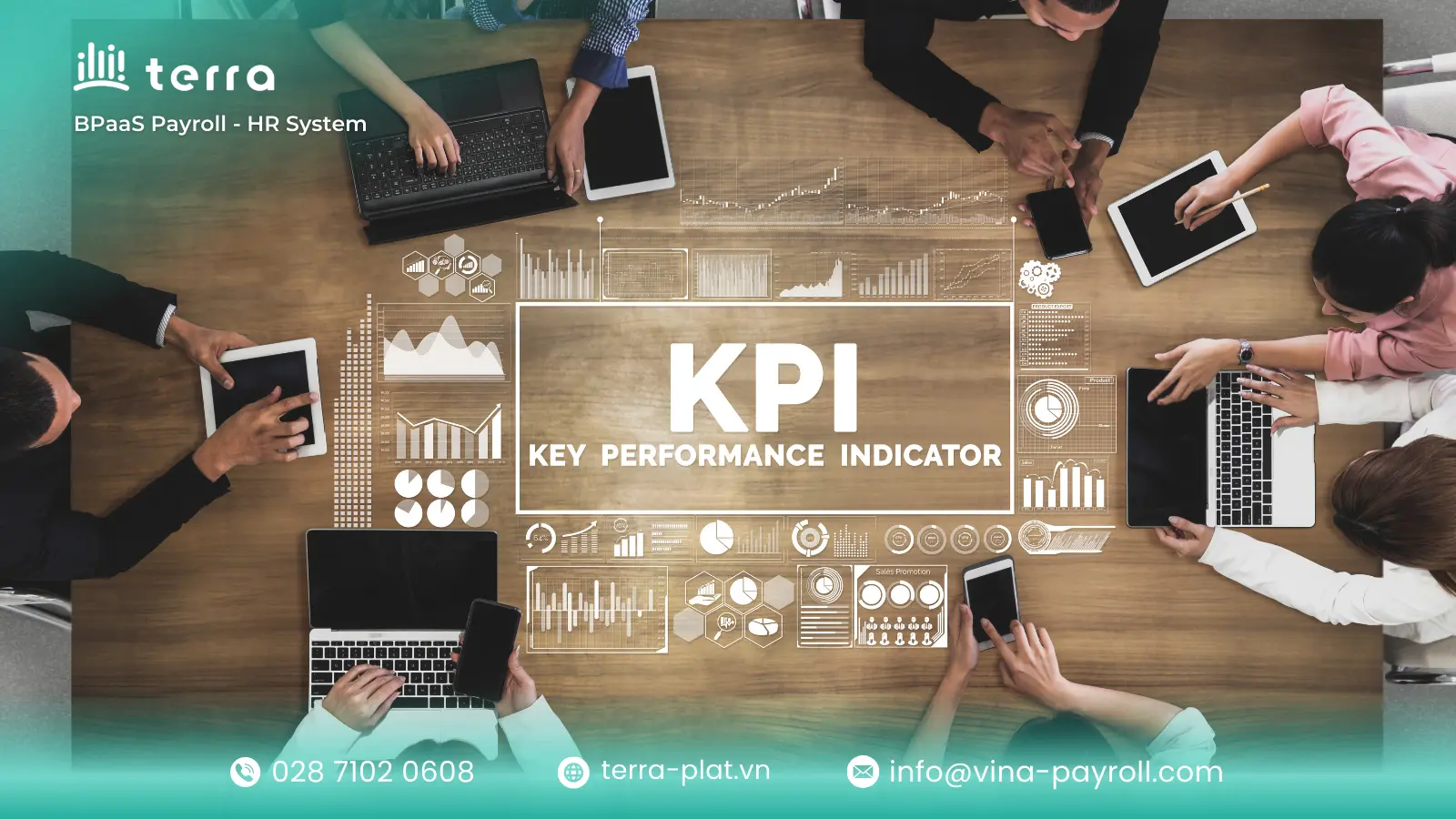
Steps to develop KPIs that improve company performance
Defining what is KPI for your specific context requires a structured approach. It is not about tracking everything, but tracking the right things.
Establish strategic objectives
Start with the Why. You cannot measure success if you haven’t defined it. What is the ultimate goal of the organization for this quarter or year? Your KPIs must flow directly from these high-level objectives.
Identify key focus areas
Narrow down your scope. Instead of trying to fix the whole company at once, identify the key performance areas and key performance indicators that will have the biggest impact. This might be Customer Retention or Operational Efficiency.
How to Determine KPAs:
- Consult the Strategic Objective: If your strategic objective is “Increase Profitability,” your KPAs might be: Sales Growth, Cost Reduction, and Product Development.
- Analyze the Value Chain: Determine which functions are critical to delivering value to the customer.
Choose measurable metrics to track performance
Select data points that accurately reflect the goal. If the goal is “Customer Happiness,” the metric might be “Net Promoter Score (NPS).” Ensure the data is accessible and reliable.
- Match metric to intent: Don’t just pick easy numbers. If you want to measure “Brand Awareness,” counting “Website Hits” might be misleading. “Social Share of Voice” might be better.
- Verify data sources: Ensure you have the tools to capture this data accurately and consistently without manual error.
- Balance quantity and quality: Use a mix of quantitative metrics (e.g., revenue) and qualitative metrics (e.g., employee satisfaction scores) for a full picture.
Set clear and actionable targets
A KPI without a target is just a statistic. You need a benchmark. For example, instead of just “Increase Sales,” set a target of “Increase Sales by 10% year-over-year.” This follows the SMART framework.
- Specific: The target must be unambiguous. “Do better” is not a target; “Reduce churn to under 2%” is.
- Measurable: You must be able to track progress numerically.
- Achievable: The target should stretch the team but remain possible. Unrealistic goals demotivate employees.
- Relevant: The target must matter to the business bottom line.
- Time-bound: Every target needs a deadline. “Increase sales by Q4” creates urgency that “Increase sales” does not.
Engage relevant stakeholders
KPIs should not be dictated solely from the top down. Involve the teams who will be doing the work. Their input ensures the targets are realistic and increases their buy-in to achieve them.
- Conduct workshops: Hold sessions with department heads to brainstorm which metrics they believe best represent their performance.
- Negotiate targets: Allow managers to push back on targets they feel are unachievable due to resource constraints. This dialogue creates shared ownership.
- Clarify responsibilities: Assign a specific “owner” to every KPI. If everyone is responsible, no one is.
Emphasize actionable priorities
Good KPIs inspire action. If a metric goes down, the team should know exactly what levers to pull to fix it. Avoid “vanity metrics” that look good but offer no insight on how to improve.
- Avoid Vanity Metrics: Ignore numbers like “total registered users” if they aren’t active. Focus on “Daily Active Users” which shows real value.
- Focus on Leading Indicators: prioritize metrics that predict future success (e.g., “Sales Proposals Sent”) rather than just reacting to the past (e.g., “Last Month’s Revenue”).
- Define reaction plans: For every KPI, have a plan. “If Customer Satisfaction drops below 80%, we will immediately review support logs.”
Monitor progress and oversee project performance
Set up a dashboard or reporting rhythm. Whether it is weekly or monthly, consistent monitoring ensures you don’t lose sight of the goal amidst daily tasks.
- Use visual dashboards: Implement tools that visualize trends (charts, graphs) so anomalies can be spotted instantly.
- Establish review cadences: Set weekly or monthly meetings specifically to review these numbers. Don’t let them gather dust in a spreadsheet.
- Automate tracking: Use systems like the terra HR Management System to automate data collection, ensuring your “people metrics” are always up to date.
Regularly review, evaluate, and adjust KPIs
Business environments change. A KPI that was relevant last year might be obsolete today. Schedule quarterly reviews to ensure your indicators still align with business goals.
- Check for obsolescence: Ask “Is this metric still driving the right behavior?” If a goal is met, maybe it’s time to maintain it and focus on a new area.
- Adjust targets: If you consistently miss a target, determine if performance is poor or if the target itself was unrealistic. Adjust accordingly.
- Pivot with strategy: If the company strategy shifts from “Growth” to “Profitability,” your KPIs must shift from “User Acquisition” to “Cost Reduction” immediately.
Communicate and cascade KPIs throughout the organization
Transparency is vital. Ensure every employee knows what is KPI for their role and how it contributes to the big picture. This can be reinforced during employee training sessions.
- Contextualize the data: Don’t just share numbers; explain the story. “We missed the sales target because lead volume dropped.”
- Celebrate wins: When a KPI target is hit, celebrate it publically. This reinforces the importance of the metric.
- Integrate into culture: Make KPIs part of the daily conversation, not just a scary report during performance reviews.
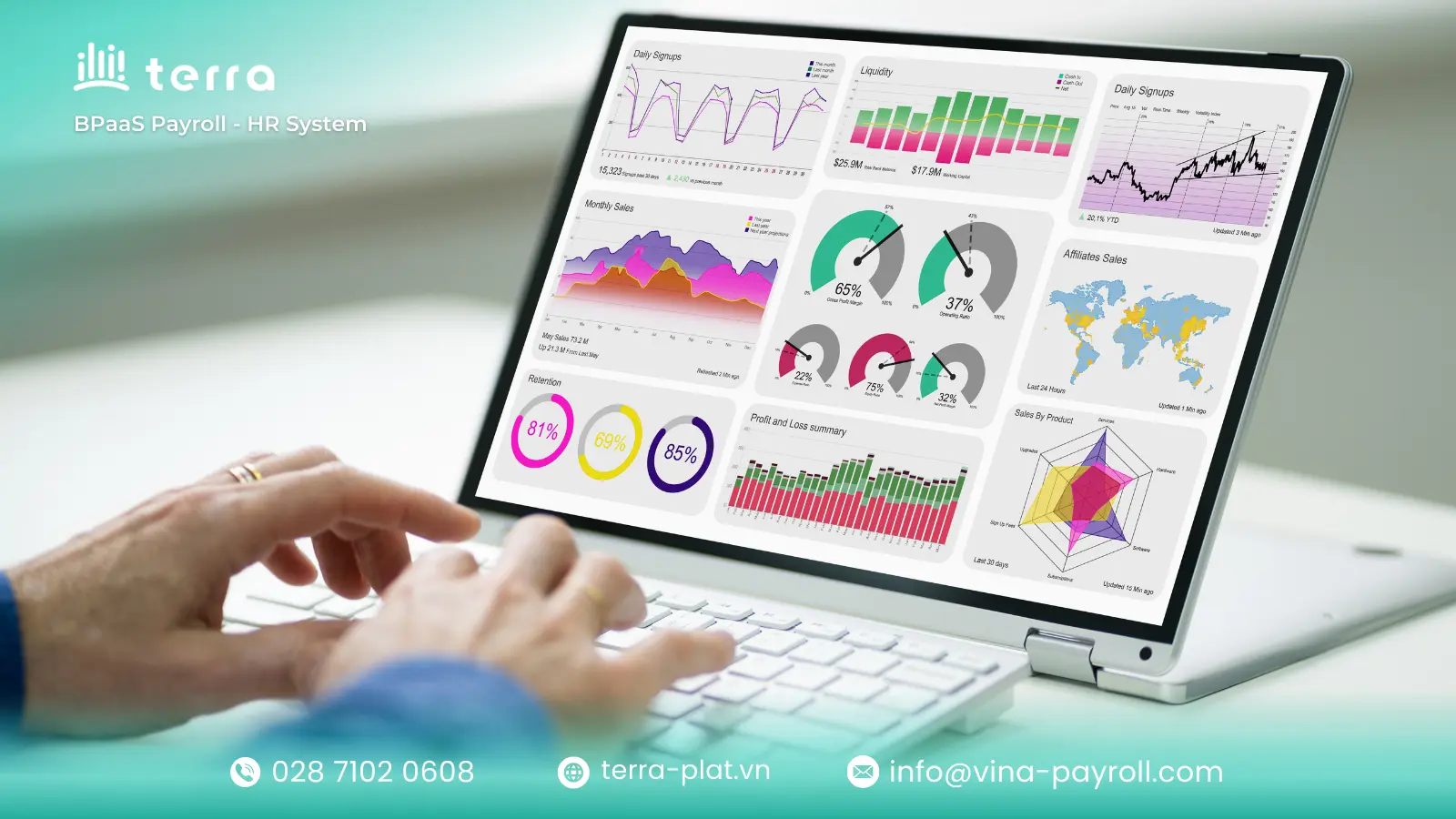
Common KPI examples across functions
To help you visualize what is KPI in practice, here are specific examples categorized by business function.
Finance KPIs
- Net Profit Margin: The percentage of revenue left after all expenses have been deducted.
- Return on Investment (ROI): Measures the gain or loss generated on an investment relative to the amount of money invested.
- Operating Cash Flow: The amount of cash generated by a company’s normal business operations.
- Accounts Receivable Turnover: How effectively a company uses its assets by measuring how many times a business can turn its accounts receivable into cash during a period.
Sales KPIs
- Monthly Sales Growth: The increase or decrease in sales revenue month-over-month.
- Quote-to-Close Ratio: The percentage of quotes that result in a closed deal.
- Average Purchase Value: The average amount a customer spends per transaction.
- Sales Target Attainment: The percentage of sales reps achieving their sales goals.
Marketing KPIs
- Cost Per Lead (CPL): The amount of money spent to acquire a new lead.
- Website Traffic: The number of visitors to your website.
- Conversion Rate: The percentage of visitors who take a desired action (e.g., fill out a form, make a purchase).
- Social Media Engagement: Likes, shares, comments, and clicks on social media posts.
IT key performance indicators
- Server Downtime: The amount of time servers are unavailable.
- Mean Time to Repair (MTTR): The average time required to repair a failed component or device.
- Ticket Resolution Time: The average time it takes to resolve a support ticket.
- System Availability: The percentage of time a system is operational and accessible.
Customer service KPIs
- Net Promoter Score (NPS): Measures customer loyalty and likelihood to recommend your product or service.
- Customer Satisfaction Score (CSAT): Measures how satisfied customers are with a specific interaction or overall experience.
- First Response Time: The average time it takes for a customer service agent to respond to a customer inquiry.
- Customer Retention Rate: The percentage of customers who continue to do business with you over a given period.
Process performance metrics
- Cycle Time: The total time from the beginning to the end of a process.
- Error Rate: The frequency of errors in a process.
- Throughput: The amount of material or items passing through a system or process.
- Efficiency Ratio: Measures how well a company uses its assets and liabilities internally.
Human resource and staffing metrics
- Employee Turnover Rate: The percentage of employees who leave the organization during a certain period.
- Time to Hire: The number of days between a candidate applying for a job and accepting a job offer.
- Absenteeism Rate: The percentage of work time lost due to unplanned absences.
- Training Cost Per Employee: The average amount spent on training and development for each employee.

Frequently asked questions about KPIs
Even with a solid understanding of definitions and examples, practical questions often arise when implementing a KPI framework. Here are clear answers to the most common queries business leaders and managers have about defining and using Key Performance Indicators effectively.
Which is the best KPI definition?
Answer: A KPI is a measurable value that demonstrates how effectively a company is achieving key business objectives.
It serves as the critical bridge between your high-level strategy and your actual day-to-day results, helping you understand if you are on track or need to pivot. Furthermore, a KPI acts as an early warning system, signaling potential issues before they become severe, ensuring transparency and accountability within the organization.
How do you define KPIs?
Answer: You define them by using the SMART criteria (Specific, Measurable, Achievable, Relevant, Time-bound).
A good definition clearly states exactly what is being measured, why it matters to the organization, and what the target success looks like within a specific timeframe. Crucially, a KPI must have a clear Owner (the person responsible for tracking and acting on its result) to ensure action is taken rather than just passive monitoring.
Which are the best KPIs to use?
Answer: The best KPIs are those strictly aligned with your specific business goals at your current stage of growth.
There is no universal list. A startup might focus on Burn Rate to survive, while a mature retailer focuses on Same-Store Sales to monitor steady growth. The best KPIs should also be categorized into Leading (which forecasts future outcomes, e.g., number of new leads) and Lagging (which measures results that have already occurred, e.g., total revenue).
What is an example of a KPI?
Answer: Customer Acquisition Cost (CAC) is a classic and widely used example.
It measures exactly how much money you spend on marketing and sales to get one new customer. If your CAC is lower than the Customer Lifetime Value (CLV), your business model is scalable. Another example is the Conversion Rate in Marketing, which measures the percentage of website visitors who take a desired action (purchase, sign up, etc.).
What are 5 of the most common KPIs?
Answer: Revenue Growth, Net Profit Margin, Customer Retention Rate, Employee Satisfaction, and Return on Investment (ROI).
These five cover the essential bases of any business: money coming in, money kept, customer loyalty, internal team health, and investment efficiency. However, don’t confuse a KPI with a simple Metric; for instance, the number of social media followers is a Metric, but the Engagement Rate is a KPI because it measures the effectiveness of the marketing activity.
What makes a KPI good?
Answer: A good KPI inspires action and provides immediate context.
It should be simple to understand, relevant to the audience, and timely. If you look at a KPI and don’t know what specific action to take next, it is not a good KPI. An effective KPI must always be Actionable. For example, instead of tracking “Total Expenses,” you should track “Operating Expense Per Unit Produced” so that specific cost-cutting decisions can be made.

HR Management system for modern businesses – terra HR System
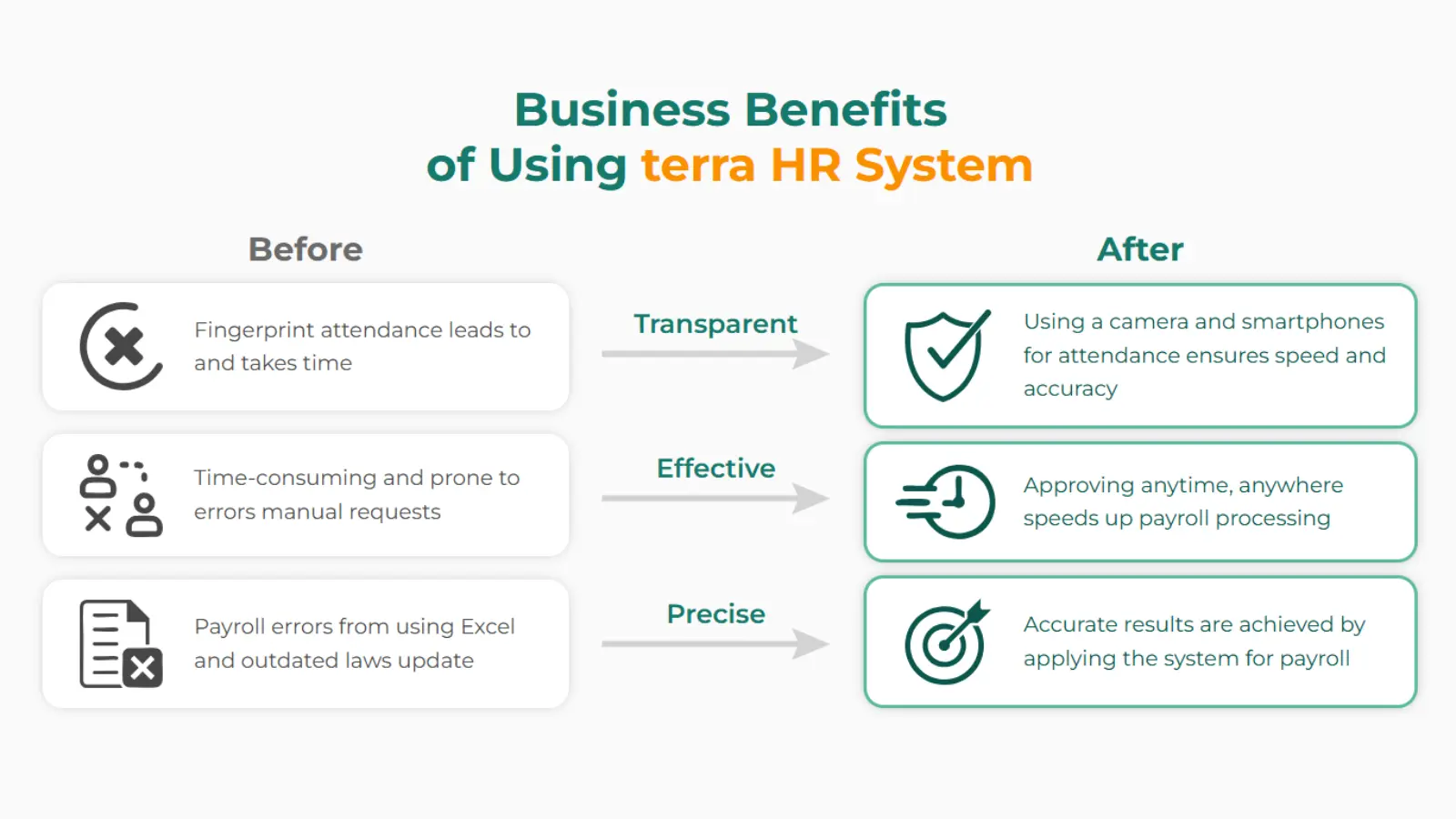
Tracking performance manually via spreadsheets is a recipe for error and disconnection. To truly leverage key performance indicators, modern businesses need a unified ecosystem. The terra HR management system is designed to centralize this critical data, making performance tracking seamless.
- Seamless Integration with Payroll: The terra HR Solution goes beyond simple tracking by linking performance results directly to payroll and reward structures. This automation reduces administrative burden and ensures that high performers are recognized and compensated accurately without complex manual calculations.
- HR Information Management: Efficiently store, update, and retrieve all personnel data. This terra hr solution ensures your database is centralized and easily accessible.
- Time & Attendance Management: The terra HR Platform supports diverse, flexible tracking methods:
- WiFi Attendance: Automatically verify location when connecting to internal WiFi. This feature of the terra hr software minimizes fraud and requires no additional hardware.
- GPS Attendance: Track attendance at off-site locations like construction sites or fieldwork areas using the terra hr management system.
- Camera Attendance: Touchless, automatic recording for a seamless experience.
- Contracts & Procedures: Digitize the management of labor contracts, Personal Income Tax (PIT), and social insurance. The terra HR Platform helps businesses strictly adhere to legal regulations.
Contact terra now for advice!
Conclusion
Understanding what is KPI is the first step toward business mastery. These indicators are the vital signs of your organization, guiding every strategic move. By selecting the right metrics and using powerful tools like terra, you can transform your business from reactive to proactive, ensuring sustainable growth and alignment.









