
Navigating the tax system in Vietnam has become more streamlined yet detailed with the official enforcement of the Law on Value Added Tax 2024, effective July 1, 2025. Whether you are a business owner or an investor, understanding the latest updates on VAT Vietnam is crucial for compliance and financial optimization in 2026.
What is VAT in Vietnam?
VAT (Value Added Tax), known locally as GTGT, is an indirect tax calculated on the added value of goods and services arising during production, circulation, and consumption.
Value Added Tax (VAT) Features
- Indirect tax: The end consumer bears the cost, but businesses act as the collecting agents for the State.
- Multistage tax: It is levied at every stage of the supply chain but only on the “new value” created at that specific stage.
VAT’s function
- In the movement of goods: It ensures a transparent flow of tax responsibilities and prevents double taxation.
- In state economic management: It serves as a stable revenue source and a tool for the government to regulate consumption.
Who covers the VAT?
According to Article 4 of Law No. 48/2024/QH15, taxpayers include:
- Organizations and individuals producing or trading goods/services in Vietnam.
- Importers of goods.
- Domestic companies purchasing services from foreign entities without a permanent establishment in Vietnam.
- Foreign E-commerce and digital platform providers.

Product and service categories that are both subject to and exempt from VAT
Product and service categories include:
VAT-eligible groups
Generally, most goods and services used for production, business, and consumption are subject to VAT Vietnam unless specifically listed as exempt.
VAT-exempt groups
There are 27 groups exempt from VAT, including:
- Agriculture: Unprocessed farm, livestock, and aquatic products.
- Finance: Credit granting, securities trading, and capital transfer.
- Public services: Public bus transport, funeral services, and education.
- Small businesses: Starting Jan 1, 2026, those with annual revenue below 200 million VND.
Learn more: PIT Finalization for Foreigners in Vietnam: A Complete and Updated Guide
Rates of VAT
The current VAT tax rate in Vietnam is divided into three main brackets, plus a special temporary reduction.
| Tax rate | Applied |
| 0% (Encouraging Exports) | Applied to exported goods/services and international transportation. From 2025, promotional goods/services according to trade laws are also subject to 0% VAT. |
| 5% (Essential Goods) | Applied to clean water, fertilizers, medical equipment, social housing, and specialized agricultural machinery. Fertilizers, specialized agricultural machinery, and offshore fishing vessels have moved from “Exempt” to the 5% bracket. |
| 10% (Standard Rate) | The standard VAT tax rate in Vietnam applied to most commercial activities not categorized under the 0% or 5% brackets. |
| 8% Tax Rate (The 2% Reduction) | Under Resolution 204/2025/QH15, the 8% rate (a 2% cut from 10%) is extended until December 31, 2026 for many industries to stimulate economic growth. |
A continuous 2% VAT cut till December 31, 2026
Following Resolution 204/2025/QH15 and Decree 174/2025/NĐ-CP, the 2% VAT reduction (from 10% down to 8%) is extended until the end of December 31, 2026.
Exclusions: This reduction does not apply to telecommunications, banking, securities, insurance, real estate, metals, mining products, and items subject to Special Consumption Tax (except gasoline, which is eligible for the 8% rate at certain stages).
Uniform Application: The 8% rate applies consistently across import, production, processing, and commercial business stages.
How to calculate VAT
Depending on your business model, you can choose one of two methods:
- Deduction method: VAT Payable = Output VAT – Input VAT (For businesses with revenue >= 1 billion VND).
- Direct method: VAT Payable = Revenue x Direct Rate (%).

Methods of calculating VAT
Method of calculating VAT include:
Deduction method
Commonly used by businesses with annual revenue over 1 billion VND and full accounting records.
| VAT Payable = Output VAT – Input VAT |
- Output VAT: Collected from customers.
- Input VAT: Paid to suppliers.
Direct calculation method
Used by small businesses, households, or foreign entities without full accounting systems.
| VAT Payable = Revenue x Direct Rate (%) |
Direct rates by industry:
- Distribution/Supply: 1%.
- Services/Construction (without materials): 5%.
- Production/Transport/Construction (with materials): 3%.
- Other activities: 2%.
How to find VAT rates
Determining the precise VAT tax rate in Vietnam or any other jurisdiction is the first step toward tax compliance. Since tax policies are tied to specific geographical regions and product classifications, rates can fluctuate significantly. Here is a professional guide to identifying the correct rate for your transactions.
Step-by-Step Guide to Identifying VAT Rates
- Define the tax jurisdiction: VAT is a location-based tax. The applicable rate is determined by where the transaction is legally “consumed” or where the service is rendered.
- Prioritize authoritative government portals: To ensure the highest accuracy, always refer to the official tax agency of the relevant country.
- Classify your goods or services: Tax authorities often divide products into specific categories. While a standard rate applies to most items, essential goods (like medicine or food) may qualify for reduced or zero rates. Use the search or “Tariff” tools on government websites to find the exact code for your item.

Filing and paying taxes
It is essential to distinguish between tax filing (submitting the required VAT refund declaration form Vietnam and reports) and tax payment (the actual transfer of funds to the State Treasury). While these actions are linked, they involve different procedures and deadlines under the VAT Vietnam framework.
Step 1: Gather and authenticate your documents
Accuracy starts with documentation. To calculate your tax liability or prepare for a Vietnam VAT refund, you must consolidate all financial records. Key documents include:
- VAT invoice Vietnam (Input & Output): E-invoices for all goods sold (output) and services purchased (input).
- Customs Declarations: Required for any imported or exported goods to verify the VAT tax rate in Vietnam (0% for exports).
- Non-cash payment vouchers: Bank statements proving transactions over 20 million VND, which are mandatory for tax deduction.
- Contractual agreements: Particularly for service exports or high-value trade to justify tax classifications.
Step 2: Submit your VAT return
Businesses in Vietnam typically file returns monthly (by the 20th of the following month) or quarterly (by the last day of the first month of the following quarter). You have several digital-first options:
- HTKK Software & GDT Portal: Most businesses use the “Tax Declaration Support” (HTKK) software to generate the VAT refund declaration form Vietnam and submit it via the General Department of Taxation’s electronic portal.
- Tax service providers (TPAs): Engaging a professional firm like terra or a certified CPA ensures that your filings align with the complex 2024 VAT Law updates.
- Direct e-filing: Integrated accounting software often allows you to transmit data directly to tax authorities, reducing manual entry errors.
Step 3: Execute tax payments
VAT is a reconciliation-based tax. You pay the difference between your collected Output VAT and your paid Input VAT. If your input exceeds your output, you may be eligible for a VAT refund in Vietnam.
Payments can be settled through:
- E-banking & portals: Use the “ThueDienTu” portal to pay directly from your corporate bank account.
- State treasury or authorized banks: Payments can be made in person at the State Treasury or commercial banks authorized by the Ministry of Finance.
- Electronic federal/state systems: Ensure you use the correct tax chapter and sub-category codes to avoid mismanaged funds.
Important note: Even if your business has no revenue for the period or cannot pay the full balance immediately, you must file your return on time. Late filing of the VAT refund declaration form Vietnam carries heavy administrative penalties, whereas paying late only incurs interest on the unpaid balance.

VAT deduction and refund regulations
Understanding the mechanism of VAT deduction and refunds is vital for maintaining healthy cash flow. In Vietnam, the tax system operates on a “credit-invoice” basis, where businesses offset the tax they pay on purchases against the tax they collect on sales.
Under the Law on VAT 2024, effective July 1, 2025, these regulations have been sharpened to increase transparency and digital compliance.
The Fundamental Mechanics of VAT Offsetting
The core principle is simple: businesses act as intermediaries. You only pay the government the “net” tax amount.
| VAT Payable = Output VAT – Deductible Input VAT |
Key principles for deduction:
- Business purpose: Input VAT can only be reclaimed if the expenses are used exclusively for taxable production or business activities.
- Documentation: You must possess a valid VAT invoice Vietnam (e-invoice) and relevant shipping/contractual documents.
- Payment thresholds: For any transaction valued at 20 million VND or more (including VAT), proof of non-cash payment (bank transfer) is mandatory to qualify for deduction.
- Proportional allocation: If your business deals in both taxable and VAT-exempt goods, you can only deduct the portion of input VAT corresponding to your taxable revenue.
Conditions and timeframes for VAT refund
Claiming a VAT refund Vietnam is a structured process designed to support business liquidity. However, to ensure a successful application, enterprises must navigate strict eligibility criteria and understand the statutory processing windows defined by the General Department of Taxation.
Conditions for VAT refunds
To qualify for a Vietnam VAT refund, a business establishment must strictly satisfy the following “standard” conditions under the 2024 VAT Law:
- Taxation method: The entity must be registered to pay tax under the deduction method. Businesses using the direct method are not eligible for refunds.
- Legal compliance: Possession of a valid Business Registration Certificate or Investment License is mandatory.
- Accounting standards: The business must maintain a transparent accounting system with complete books and records as prescribed by law.
- Banking requirements: A corporate bank account must be registered under the business’s tax identification number (TIN).
- Invoice & payment validity: Every VAT invoice Vietnam included in the claim must be valid. For transactions valued at 5 million VND or more (updated threshold under Decree 181/2025), evidence of non-cash payment (bank transfer) is strictly required.
- Supplier compliance (new): At the time of filing the VAT refund declaration form Vietnam, the taxpayer’s suppliers must have fulfilled their own tax filing obligations and have no outstanding VAT debts for the relevant period.
Timeframe for VAT refunds
The efficiency of receiving your vat Vietnam back depends on your compliance history and risk profile. The tax authority categorizes applications into two distinct streams:
- Refund First, Audit Later (Priority Stream):
Processing Time: Within 06 working days from the date of receiving a complete and valid dossier.
Applicable to: Businesses with a high compliance ranking, low-risk exporters, and entities with a history of transparent filings. - Audit First, Refund Later (Standard/High-Risk Stream):
Processing Time: Within 40 working days from the date of receiving a complete and valid dossier.
Applicable to: First-time refund applicants, businesses with high-risk indicators, or cases involving complex restructuring like dissolution or bankruptcy.
Cases That Qualify for a VAT Refund Starting on July 1, 2025
The Law on VAT 2024 introduces several significant shifts in who can apply for a refund. Below are the primary cases eligible under the new regime:
- Export activities: Businesses with exported goods or services (subject to a 0% VAT tax rate in Vietnam) can claim a refund if their uncredited input VAT reaches 300 million VND or more in a month or quarter.
- Investment projects: New or expanded projects in the investment phase (before generating revenue) with accumulated input VAT of 300 million VND or more are eligible.
- The 5% VAT group (new expansion): Enterprises exclusively providing goods or services subject to the 5% VAT tax rate in Vietnam can now claim a refund if their input VAT remains uncredited for 12 consecutive months or 4 quarters (minimum threshold of 300 million VND).
- Dissolution or bankruptcy: Organizations closing down can receive a refund for overpaid VAT or remaining uncredited input tax.
Foreign tourists: International travelers remain eligible for a Vietnam vat refund on goods purchased at designated shops and carried upon departure.

Documents needed for the VAT refund application
To avoid delays, ensure your dossier contains:
- VAT refund declaration form Vietnam (Form 01/HT).
- Valid VAT invoice Vietnam (E-invoice XML files).
- Bank remittance certificates.
- Customs declarations (for exporters) or Investment Certificates (for projects).
Typical mistakes to avoid
- Applying 8% to Excluded Items: Incorrectly applying 8% to IT services or certain metal products that are strictly 10% per Appendix I of Decree 174/2025/NĐ-CP.
- Missing Bill of Lading: For 0% export VAT, failing to provide the Packing List and Bill of Lading as required by the 2024 Law.
- Ineligible Refunds: Attempting to claim a refund for imported goods that are subsequently re-exported, which is now prohibited under the new regulations.
Common questions concerning VAT
Here are common questions:
What does a 0% VAT rate mean?
It is a “tax-free” rate for exports that allows businesses to recover the input Vietnam VAT they paid during production.
What do input and output VAT mean?
Input VAT is what you pay to suppliers; Output VAT is what you collect from customers.
Can you tell the difference between a sales invoice and a red VAT invoice?
A VAT invoice Vietnam (red invoice) is for businesses using the deduction method, whereas a Sales Invoice is for those using the direct method.
From VAT compliance to PIT finalization: How terra supports end-to-end tax compliance
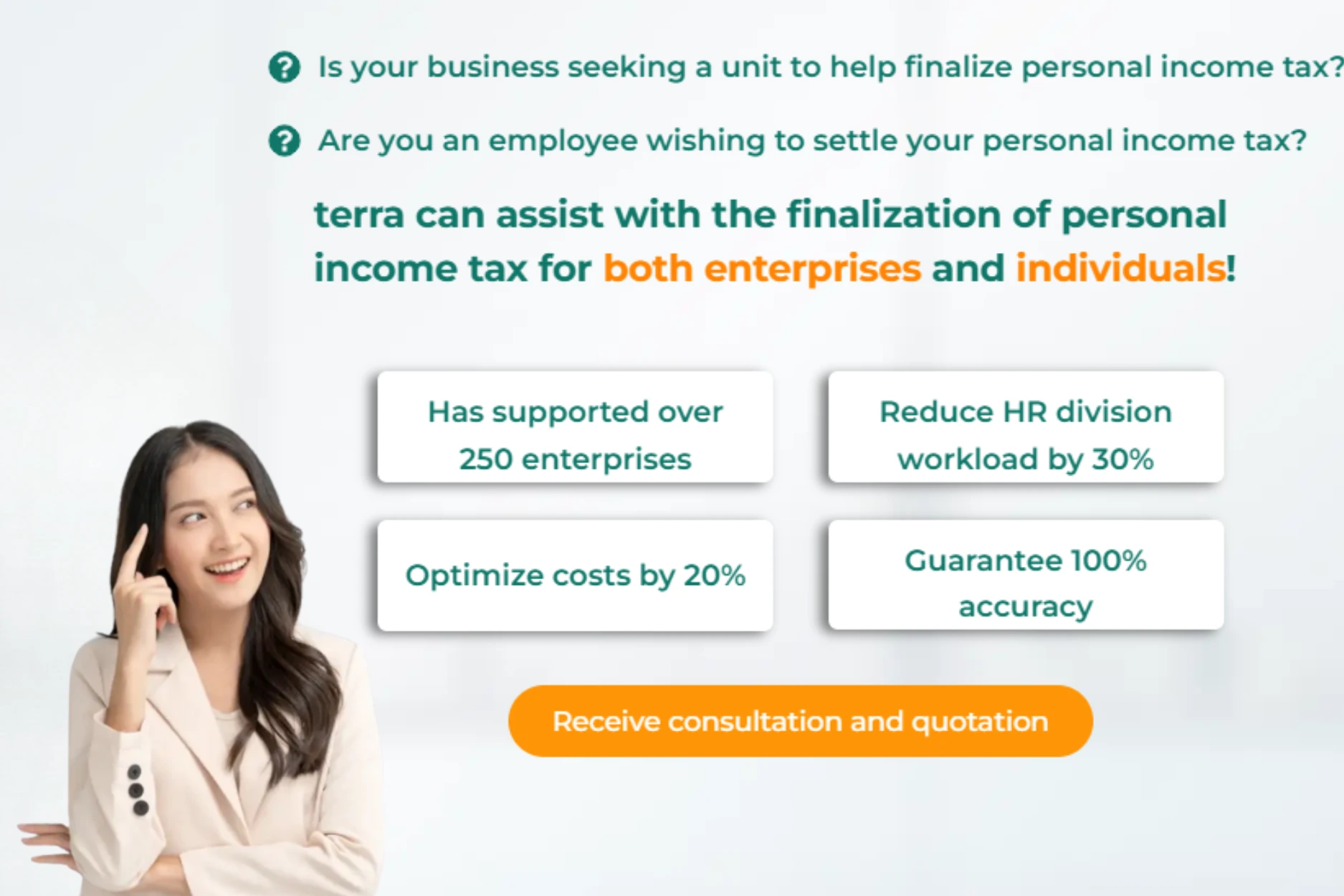
With a proven track record serving over 250 companies across Japan, New Zealand, Singapore, and other countries, terra is a trusted provider of professional HR and compliance services. We offer a comprehensive suite including terra payroll, labor reporting, personal income tax finalization service, social insurance, and payroll disbursement, helping organizations maintain full legal compliance while focusing on growth.
Benefits of using terra’s PIT finalization service:
- Reduce up to 30% of HR & tax-related workload.
- Optimize operating costs by up to 20%.
- Ensure 100% accuracy and minimize tax errors.
- Full compliance with Vietnam’s legal regulations.
terra’s commitments:
- Compliant, risk-free personal income tax finalization.
- Real-time policy and regulation updates.
- Absolute client data confidentiality.
- Prompt support and issue resolution.
Let terra be your partner in navigating tax and finance with clarity, confidence, and professionalism.
Conclusion
Mastering the complexities of VAT Vietnam is no longer just a legal obligation, it is a strategic necessity for any business aiming to thrive in this high-growth market. In 2026, leveraging the expertise of digital tax partners like terra will ensure your business remains compliant, transparent, and ready for future growth.









